Understand Your Body
Sent on
She Was Told She Had Leaky Gut. The Biopsy Said Otherwise
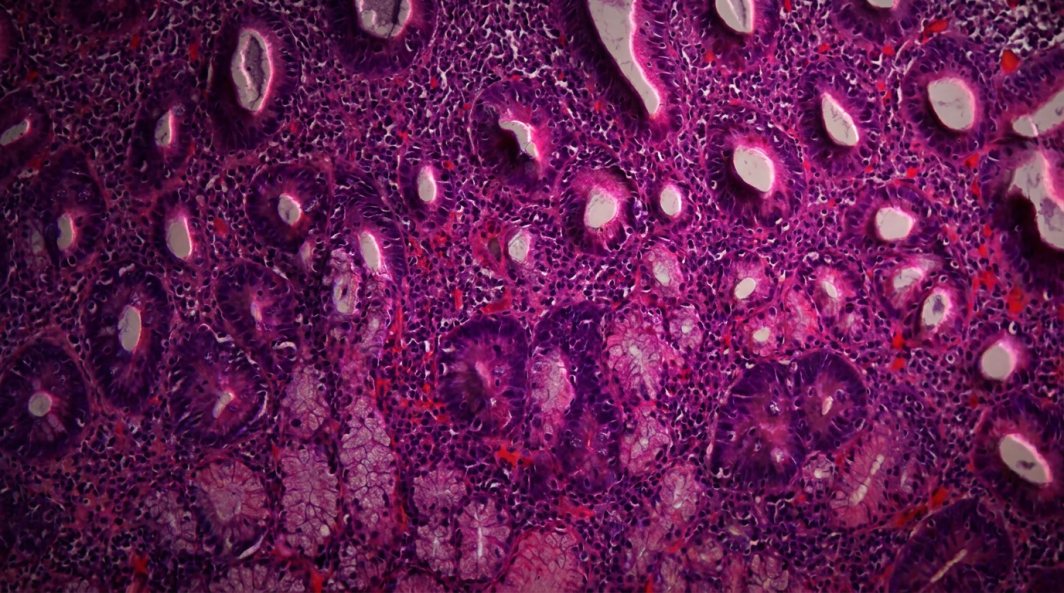
Duodenum with celiac disease under the microscope. Between the glands, almost all the small dark purple dots are immune cells.
THE CASE
For months, a 34-year-old woman had ended each day with a bloated belly and a tiredness that sleep didn't fix. On social media, she was given an answer that seemed to fit everything: leaky gut. She bought powders and capsules to "seal" her gut. But the fatigue didn't go away, and a blood test turned up something that didn't fit: iron deficiency anemia. Her periods were normal, she had no bleeding, and she ate well. The iron wasn't leaving her body. It wasn't getting in. And the clue was in the first part of the small intestine.
THE INVESTIGATION
That first part, right where the stomach empties, is called the duodenum, and it's the main place where the body absorbs iron from food. Its inner surface isn't smooth: it's lined with villi, tiny finger-like projections that make it look like a terry cloth towel and multiply the surface area available for absorption.
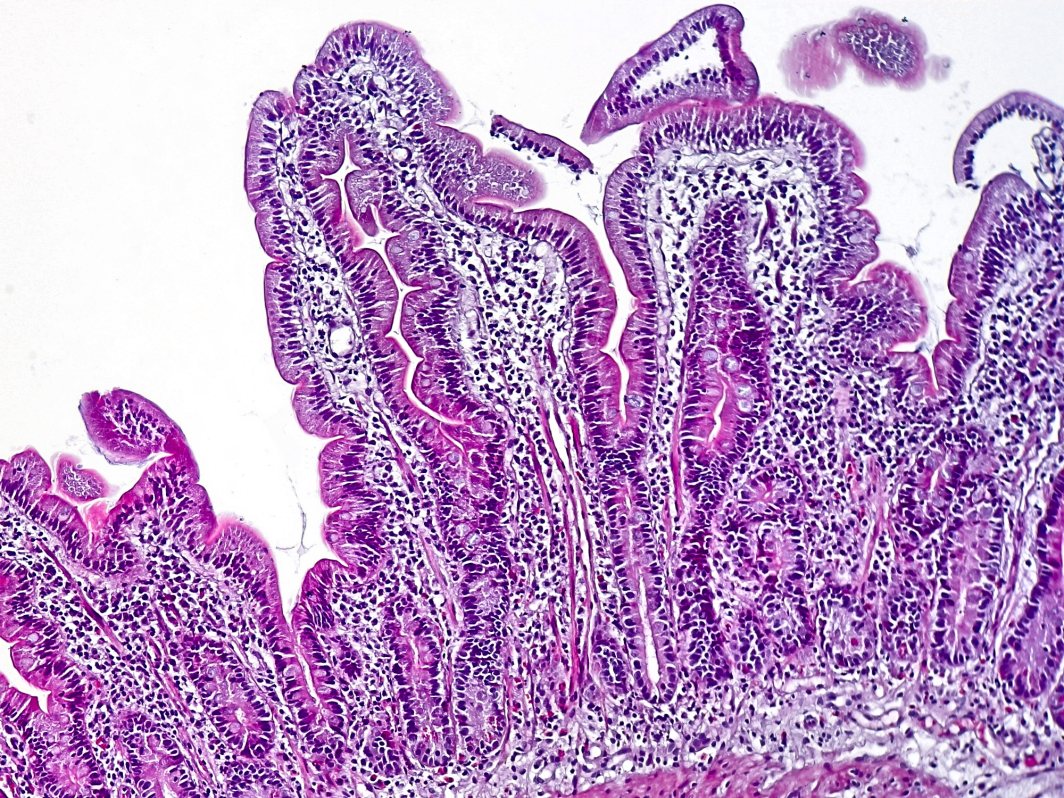
Healthy duodenum under the microscope. The villi are the long, slender projections reaching upward.
In her duodenum, the towel had worn down into a flat rag. That has a name: celiac disease. Gluten (found in wheat, barley and rye) causes no problem at all for most people. But in some people with certain genes, the immune system mistakes it for a threat and attacks the lining of the duodenum. The villi flatten, and with less surface area, less iron gets in.
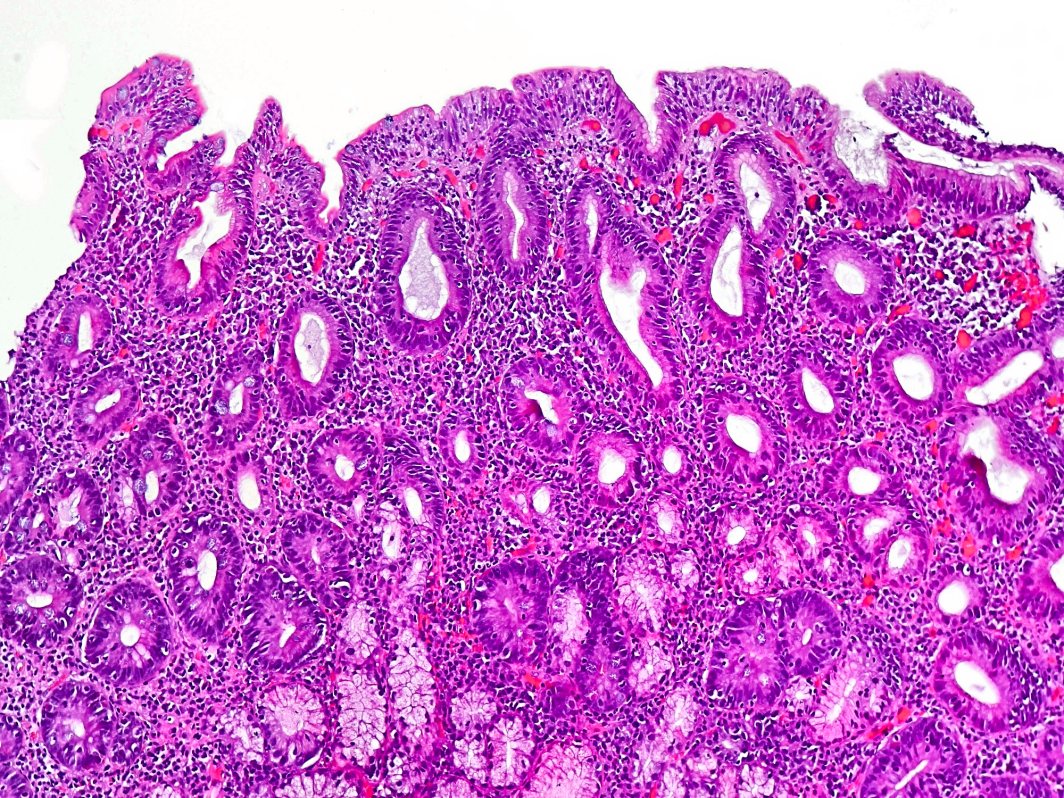
Duodenum with celiac disease under the microscope. This is the image at the top of the page, now shown in full. The projections on top are gone: the surface has become almost flat, and underneath, the glands and immune cells are crowded together.
So did she have "leaky gut"? No. That isn't a diagnosis: there are no criteria or guidelines that define it. What explained the bloating, the fatigue and the anemia was celiac disease. The problem was never a "leaky gut": it was a disease with a name, a test and a treatment. The social media label only distracted her from looking for it.
And celiac disease isn't rare: in Latin America it affects about 1 in 200 people (many of whom don't know they have it), and roughly 1 in 30 among people with iron deficiency anemia.
The problem was never a "leaky gut": it was a disease with a name, a test and a treatment.
Keep this in mind: the tests look for the footprint your immune system leaves when it reacts to gluten. If you cut it out on your own before you're evaluated, that footprint fades and the result can come back normal even if you have the disease.
And what about her? Luckily, she hadn't given up bread. Her antibody test, that footprint, came back very high, and a biopsy of the duodenum confirmed the flattened villi.
WHAT YOU CAN DO
What's up to you
- If you suspect gluten doesn't agree with you, don't cut it out before you're evaluated: see your doctor or a gastroenterologist for guidance. They'll decide whether you need blood tests or an endoscopy.
- Unexplained iron deficiency anemia should be investigated to find the cause.
- If someone in your immediate family has celiac disease, tell your doctor, even if you have no symptoms.
- There's no evidence that powders and capsules to "seal" the gut cure any disease just by "sealing" the intestinal lining.
- And these can't wait: diarrhea that lasts for weeks, losing weight without trying, blood in your stool or pain that wakes you up at night. If you have any of these, see a doctor.
IN SUMMARY
- In celiac disease, gluten makes your immune system attack the duodenum: the villi flatten and less iron gets in.
- "Leaky gut" is not a diagnosis. What she had was a disease with a name, a test and a treatment.
- In people who don't have celiac disease, gluten doesn't cause that damage: don't cut it out without a diagnosis.
Today she eats gluten-free, strictly and for life. With that, the bloating went away, and with the iron her doctor prescribed, her anemia was corrected within a few months. Her villi will take longer (in an adult it can take years), but they're already on their way back.
Dr. Carlo De la Sancha
Pathologist, professor and researcher.
This is educational content, meant to help you understand your body. It is not a medical consultation or a diagnosis. If something worries you, talk to a doctor you trust.
Duodenum images: CoRus13, CC BY-SA 4.0, via Wikimedia Commons.
The images are digitally enhanced photos of real tissue, for illustrative purposes.