Understand Your Body
Sent on
She blamed the sun. The clue was in her urine
THE CASE
A 26-year-old woman came back from the beach with red cheeks and a red nose. Sunburn, she thought. But two weeks went by and the rash was still there, shaped like a butterfly. For months her hands had ached in the mornings, she was tired, and she had fevers that came and went; she was told she was too young for arthritis. Nobody asked about her urine: it was foamy, like soap, and in the afternoons her ankles swelled. That foam was the clue, and it came from two organs you have too: your kidneys.
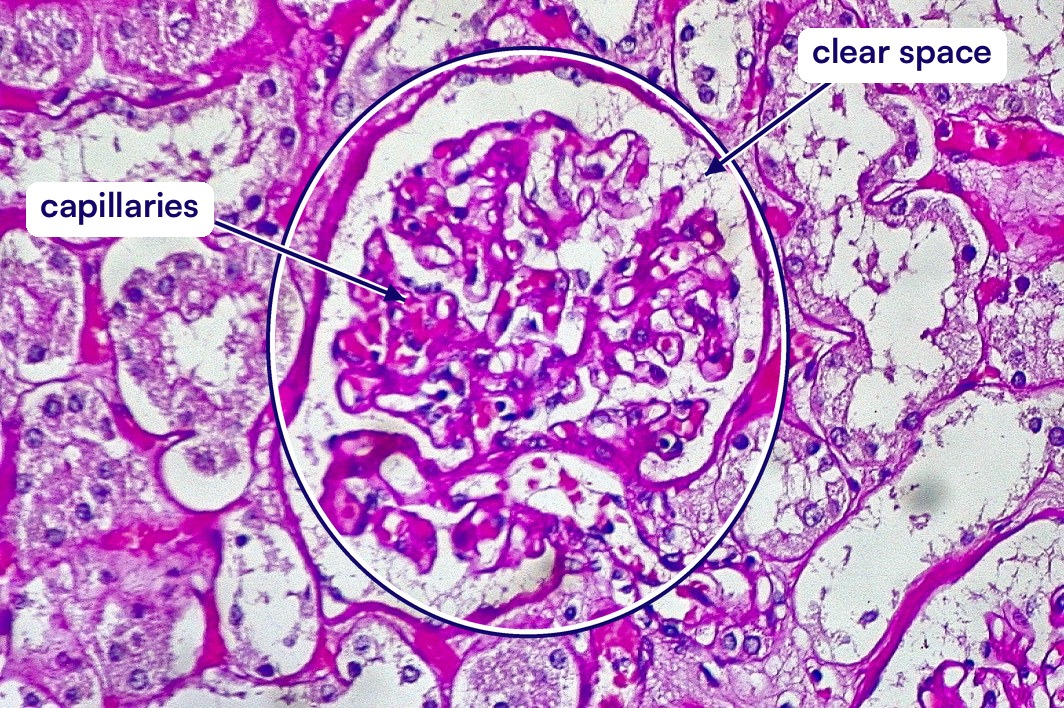
A healthy glomerulus under the microscope. It's one of the kidney's filters; each kidney has about a million. The thing in the middle is a tangle of capillaries: very small blood vessels with very thin walls. Blood runs inside them, and through that wall water and waste leak out into the clear space around them. Protein barely gets through: it stays in the blood. That fluid is the start of urine.
THE INVESTIGATION
Her doctor ordered tests. There was protein in her urine. And in her blood, antibodies against the nucleus of her cells, where each cell keeps its DNA, and against the DNA itself. That has a name: systemic lupus erythematosus. Systemic, because it can affect the skin, the joints, the blood and the kidneys. Almost 9 in 10 people with lupus are women, many of them young like her.
Her immune cells were attacking the very center of her own cells.
Why does it happen? Genes, hormones and the environment all play a part. Every day huge numbers of your cells die, and your body clears away what's left of them so fast that your immune cells almost never see what was inside. In lupus, that debris sometimes stays around longer without being cleared. And the immune cells mistake those pieces of nucleus for an enemy, so they make antibodies. The antibodies stick to the pieces of nucleus and form clumps: an antigen-antibody complex.

An antigen-antibody complex, drawn: each antibody (the blue Y) grabs pieces of nucleus (the antigen) with its two arms, and that's how a clump builds up.
Those clumps get stuck, or form right there, in different parts of the body, including the glomeruli, the kidney filters you saw above.
In several autoimmune diseases, these clumps are at the heart of the problem: where they build up they set off an alarm, more immune cells arrive to attack them, and in the fight your own tissue gets inflamed.
In the kidney, the glomerulus gets inflamed, fills up with cells and lets protein leak into the urine. That's where the foam came from.
And the swollen ankles? That protein is needed in the blood: it helps keep water inside the blood vessels. When a lot of it is lost, and the inflamed kidney also holds on to extra salt and water, fluid seeps out into the tissues and gravity pulls it down to the ankles, especially in the afternoon.
Something similar happens in the skin. The sun makes more cells die right where it hits, on the cheeks and nose: more loose pieces of nucleus, the immune cells switch on there, and the skin gets inflamed. That was the butterfly-shaped rash. And in that skin, clumps of antibodies are also found stuck just beneath its top layer.
To find out how much damage had been done, she had a kidney biopsy, and that's where we pathologists come in. Under the microscope, many of those tiny vessels have thick, stiff walls, deep pink, like wire. We call them wire loops, and what thickens them are the stuck clumps.
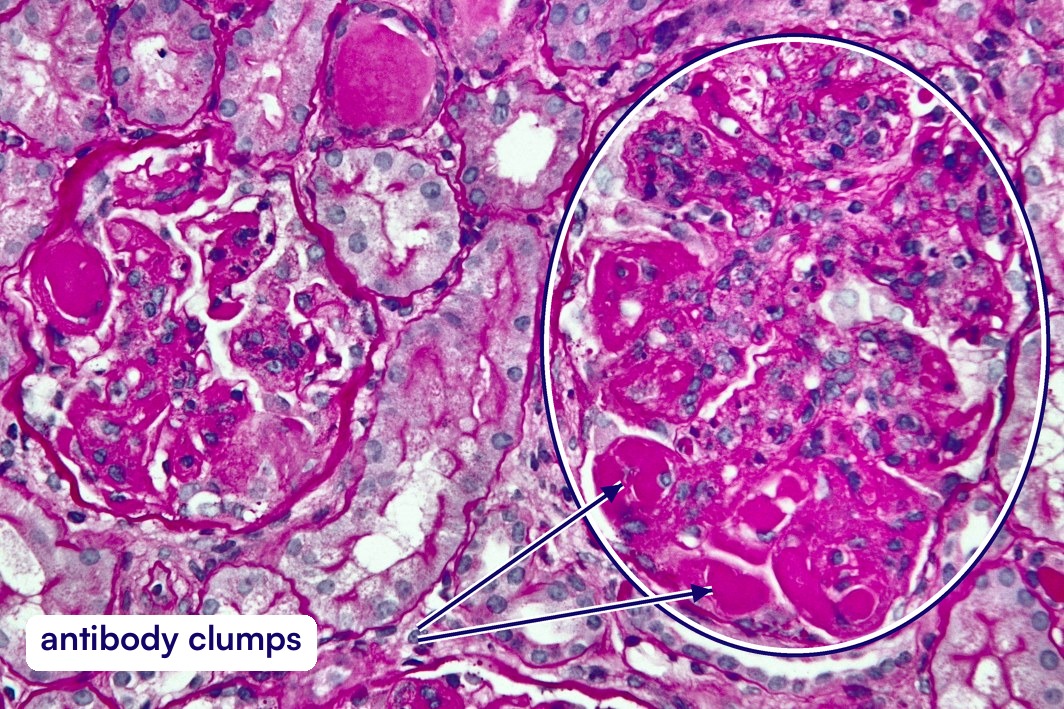
A kidney with lupus under the microscope. Compare it with the healthy glomerulus above: the one in the circle is packed with cells, with almost no clear space left, and the deep pink masses in its lower half (the arrows) are clumps of antibodies stuck in its tiny vessels.
This is called lupus nephritis, and it affects almost 4 in 10 people with lupus, many of them from the start. It may cause no symptoms, and in some people, over the years, the kidneys stop working. Finding it early and treating it promptly is what protects the kidneys most.
One thing to keep in mind: having antibodies against the nucleus is not the same as having lupus. About 1 in 7 people have them, and almost none of them ever develop it. That's why doctors don't test for them in people who feel well, just in case.
WHAT YOU CAN DO
What’s in your hands
- If you get a red rash on your face that gets worse in the sun and doesn't go away, especially with joint pain, tiredness or fevers that come and go, don't write it off as "just the sun" or "just arthritis": tell your doctor. They'll decide what to check.
- If you already have lupus, protecting yourself from the sun is part of your treatment, and don't stop or change your medications on your own: your rheumatologist adjusts them.
- And if you have lupus, this can't wait: foamy urine that doesn't go away, or very dark urine, swelling in your ankles or eyelids, shortness of breath or chest pain when you take a deep breath. If you notice any of these, see your doctor soon.
IN SHORT
- In lupus, your immune cells mistake pieces of the nucleus of your cells for an enemy and make antibodies.
- Together they form clumps that get stuck, for example in the kidneys, and set off inflammation there.
- In the kidney, the inflamed filter lets protein leak out (that was the foam) and holds on to extra salt and water: hence the swollen ankles.
What about her? Her rheumatologist and her nephrologist started a treatment to calm that attack, and months later the foam was gone and the protein in her urine had almost disappeared. Today she still has regular checkups, protects herself from the sun and gets her urine checked even when she feels well. And the clue that mattered most was the one nobody had asked her about: her urine.
Dr. Carlo De la Sancha
Pathologist, professor and researcher.
This is educational content, meant to help you understand your body. It isn’t a medical consultation or a diagnosis. If something worries you, talk to a doctor you trust.
Kidney with lupus: Nephron, CC BY-SA 3.0. Healthy glomerulus: Ed Uthman, CC BY-SA 2.0. Via Wikimedia Commons.
The micrographs are digitally enhanced from real tissue, for illustrative purposes.