Understand Your Body
Sent on
Why this man got throat cancer without ever smoking a cigarette
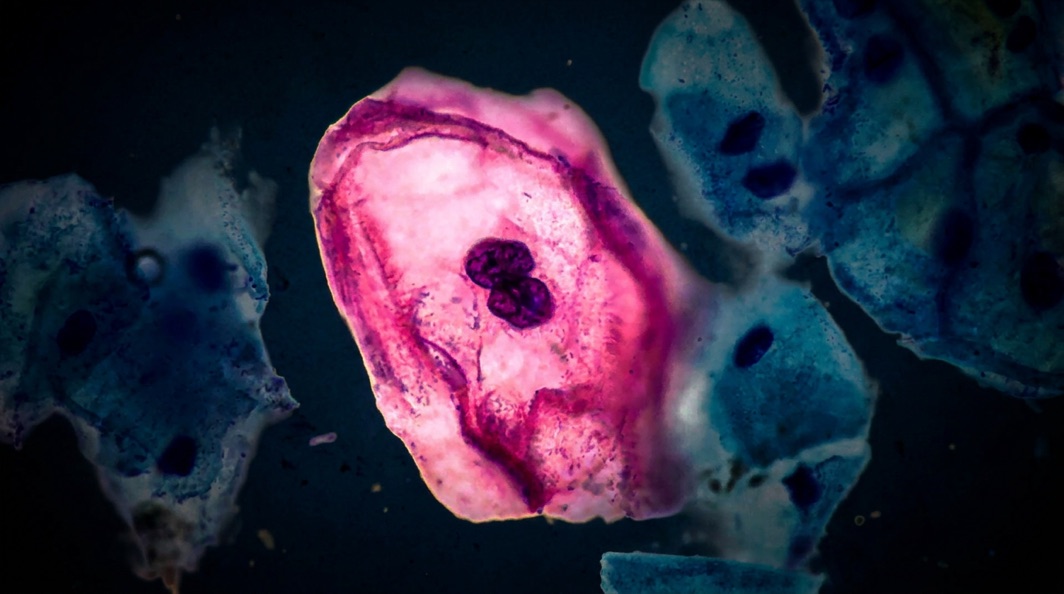
A koilocyte under the microscope: a cell with a dark, irregular nucleus and a clear halo around it. That empty space is the footprint of the papillomavirus making copies of itself inside the cell.
THE CASE
A man in his early fifties came to the clinic with a lump in his neck. It didn't hurt. He had never smoked and barely drank, the opposite of the patient you expect to see with a throat tumor. Tests found a cancer hidden in his tonsil, and under the microscope it bore the signature of a virus most people file away as a "women's thing": the same virus we look for in a Pap test. And here's the uncomfortable part: you have almost certainly come into contact with that virus too, without ever knowing it. More than 8 in 10 people get HPV at some point in their lives.
THE INVESTIGATION
Let's start by putting your mind at ease. HPV (human papillomavirus) is almost always spread through sexual contact, and the vast majority of the time it does nothing: your immune system recognizes it and clears it on its own, usually within one or two years, without you ever noticing. Catching it isn't the problem. The problem is when a high-risk type settles in and stays there quietly for years.
So what does it do inside your cells? It's not what you'd imagine: HPV doesn't burst the cell, it hijacks it. The high-risk types (especially types 16 and 18) make two proteins with code-like names, E6 and E7, and each one disables one of the cell's safety systems.
Think of it this way. Every one of your cells comes with two locks against cancer. One is a guardian, the protein p53, which orders a damaged cell to stop or to self-destruct. The other is a brake, the protein Rb, which keeps the cell from dividing when it shouldn't. E6 knocks out the guardian. E7 disables the brake. A cell with no guardian and no brake divides, and divides again, and piles up errors in its DNA over the years.
The virus doesn't kill the cell. It removes the locks and lets the cell grow out of control.
All of this leaves a footprint. The cell in the photo, with its dark nucleus and the clear halo around it, is called a koilocyte: the mark of the virus copying itself inside. In the cervix, that footprint can be caught early with a Pap test, while it's still a warning and not yet cancer. That's the power of the Pap: catching it with plenty of time to spare.
But here's the detail almost nobody knows: this doesn't happen only in the cervix. The same virus also causes cancer of the throat, anus, penis, vulva and vagina. Six cancers, one virus. And in countries like the United States, HPV-related throat cancer has already overtaken cervical cancer as the most common cancer caused by this virus, especially in men. That's what makes our case so unfair: for the cervix we have the Pap test, which catches the footprint in time; for the throat there is no routine screening like it. That's why, in this man who had never touched a cigarette, nothing was caught early: by the time it was found, it had already become a tumor in his tonsil.
Almost no one with HPV will ever go through any of this. But a few people, over the years, will: cervical cancer kills about 350,000 women a year worldwide, and it is the leading cause of cancer death in women in several Latin American countries. And the man from the beginning? His tumor turned out to be HPV positive, the kind that tends to respond better to treatment. A silver lining to his bad luck. But all of this can be prevented.
WHAT YOU CAN DO
What is in your hands
- The HPV vaccine is meant to prevent, not to cure. It teaches your immune system to recognize the virus before the first exposure. That's why it works best when given early, between ages 9 and 14, before a person becomes sexually active. And it's for boys and girls alike: it protects the throat, anus and penis, not just the cervix.
- If you're past that age, don't write it off: catch-up vaccination is still recommended through age 26, and from 27 to 45 it's a decision you make together with your doctor.
- The vaccine does not replace the Pap test or the HPV test. It doesn't cover every type, and it doesn't clear an infection you already have. If you have a cervix, keep up with your screening even if you've been vaccinated.
- Red flags (a reason to see a doctor, not a diagnosis): a lump in the neck that doesn't go down in two or three weeks, hoarseness or a sore throat that won't go away, or abnormal bleeding between periods or after sex.
IN SHORT
- The virus doesn't kill the cell: it makes two proteins (E6 and E7) that switch off the guardian (p53) and release the brake (Rb). With no locks, the cell grows out of control.
- That koilocyte with its clear halo is the virus's footprint; in the cervix it can be caught early with a Pap test, but there is no such screening for the throat.
- It's not a "women's thing": the same virus causes cancer of the throat, anus and penis, and in several countries throat cancer is already the most common HPV-related cancer.
Our patient was born before the HPV vaccine existed. You, or your children, still have time.
Dr. Carlo De la Sancha
Pathologist, professor and researcher.
This is educational content, meant to help you understand your body. It is not a medical consultation or a diagnosis. If something worries you, talk to a doctor you trust.
Images are digitally enhanced from real tissue for illustrative purposes. Base image: koilocyte in cervical cytology, Ed Uthman (CC BY 2.0).