Understand Your Body
Sent on
Why your stomach doesn't digest itself
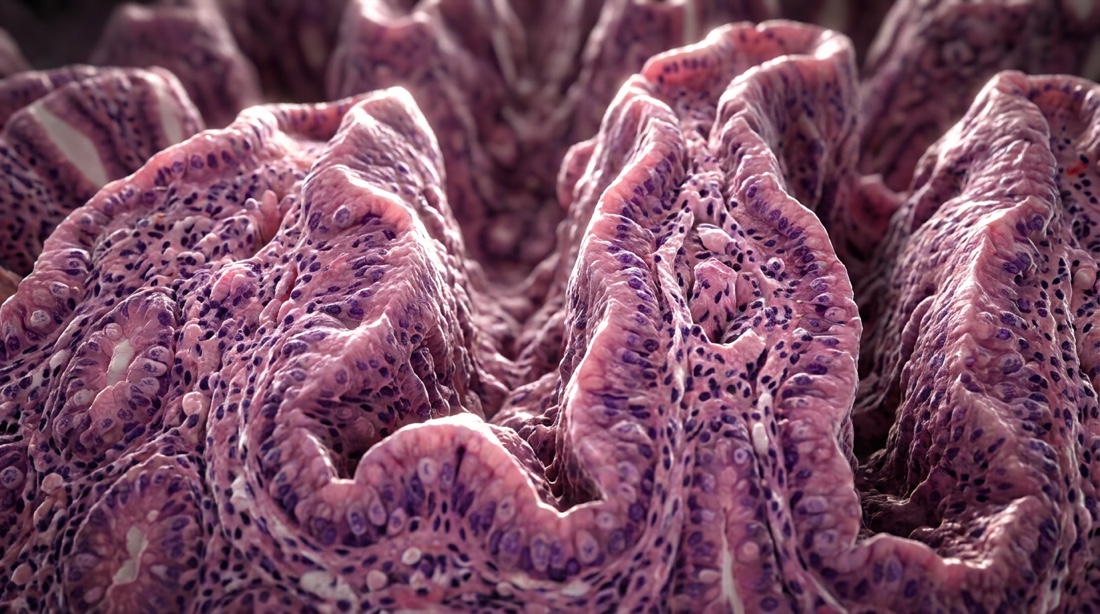
This is what the stomach wall looks like under the microscope. That surface is the barrier that holds the line, every single day, against the most acidic environment in your body.
THE CASE
A man came in with a burning pain in the pit of his stomach that wouldn't go away. He had spent months blaming hot peppers, coffee, stress. He'd take an antacid, feel better for a while, and then it would come back. What nobody had noticed: his food wasn't the culprit. The answer was in a shield, the same one that is working inside you right now without your feeling a thing.
THE INVESTIGATION
Your stomach makes the most acidic fluid in your body. It's as acidic as lemon juice, sometimes more, with a pH that can drop as low as 1.5. It uses that acid to break down food and kill almost every microbe you swallow. Which raises the obvious question: if it's that acidic, why doesn't the stomach dissolve itself?
Because it has a shield made of several layers: a blanket of mucus over the wall; a wash of bicarbonate that neutralizes acid right at the surface of the cells; good blood flow, which carries off the little acid that gets through; and a set of messengers, the prostaglandins, that keep the whole system running and patch up scrapes remarkably fast.
As long as that team is on the job, the acid never wins. The trouble starts the day something lowers those defenses: then the very same acid that was always there starts to injure the wall. First it irritates the lining (gastritis), and if it keeps going, it opens a sore: an ulcer.
The acid was always there. What changed was the shield.
So what brings the shield down? Almost always one of two things. The first is a bacterium, Helicobacter pylori, which lives hidden in the mucus. And this surprises almost everyone: in Latin America it infects about 7 in 10 adults, and most of them never know it. For nearly everyone it causes no trouble, but for some it leads to an ulcer, and for a few, over the years, even to stomach cancer. The second is nonsteroidal anti-inflammatory drugs (NSAIDs): ibuprofen, naproxen, diclofenac, aspirin. They block cyclooxygenase (COX), the enzyme that makes prostaglandins, and without prostaglandins the shield has no one to repair it from the inside. Here's something few people know: not every pain reliever does this. Acetaminophen is not an NSAID. It works through a different pathway and doesn't hit that shield the same way.
And the patient from the beginning? He had been taking ibuprofen for months for nagging knee pain. His burning didn't come from hot peppers: it came from a shield that was shutting down, one dose at a time.
WHAT YOU CAN DO
If you take anti-inflammatories often
- Use the lowest dose, and only when you truly need them.
- Taking them with food eases the discomfort in the moment, but it doesn't protect your stomach, because the damage travels through the bloodstream. If you need them often, let your doctor decide whether you need stomach protection.
- There are more selective anti-inflammatories (COX-2 inhibitors) that are easier on the stomach. Ask your doctor whether they're an option for you.
- If you have burning or pain that comes and goes, don't keep covering it up with antacids forever. It could be H. pylori, which can be detected with a breath test or a stool test, and it can be treated.
- If you vomit blood, have black, tar-like stools, or lose weight without trying, that can't wait. See a doctor right away.
IN SUMMARY
- Your stomach's protection is made of three things: mucus, bicarbonate and good blood flow.
- Prostaglandins are the molecules that keep those three protectors working.
- NSAIDs (aspirin, ibuprofen, naproxen, etc.) block cyclooxygenase, the enzyme that makes prostaglandins, and that's why they weaken all of the stomach's defenses.
- Helicobacter pylori is the other common reason that shield fails.
The patient stopped the ibuprofen and completed his treatment, and the burning he had blamed on hot peppers for months went away. His body wasn't failing: his shield was asking for help.
Dr. Carlo De la Sancha
Pathologist, professor and researcher.
This is educational content, meant to help you understand your body. It is not a medical consultation or a diagnosis. If something worries you, talk to a doctor you trust.
Images are digitally enhanced photos of real tissue, for illustrative purposes.