
You asked
Is there a test that catches pancreatic cancer early?
No. No guideline recommends pancreatic cancer screening for adults without symptoms. There is no validated blood test for early detection. People in families with an inherited risk do undergo surveillance with MRI or endoscopic ultrasound. Your doctor makes that decision.
Why is pancreatic cancer almost always found late?
Because the pancreas sits deep in the abdomen, an early tumor cannot be seen or felt on a routine exam, and symptoms usually start once it is large or has spread. Only about 15% of cases are found while the cancer is still localized. Five-year survival is 43.6% in that group and 3.4% once the cancer has reached other organs.
Besides back pain, what symptoms might suggest a problem with the pancreas?
Yellow skin and eyes. Losing weight without trying. Pain in the upper abdomen that spreads to the back. These three call for prompt medical evaluation. Diabetes that develops suddenly also raises the risk. These symptoms have many benign causes. Bring to your appointment a record of when your symptoms began and how much weight you have lost.
What can I do starting today to lower my risk?
You cannot prevent it entirely, but you can lower the risk. Quit smoking, maintain a healthy weight, and moderate your alcohol intake. Keep diabetes well controlled, because having it adds to the risk. If several people in your family have had pancreatic cancer, genetic counseling should come before any testing. The counselor explains what testing can and cannot tell you.
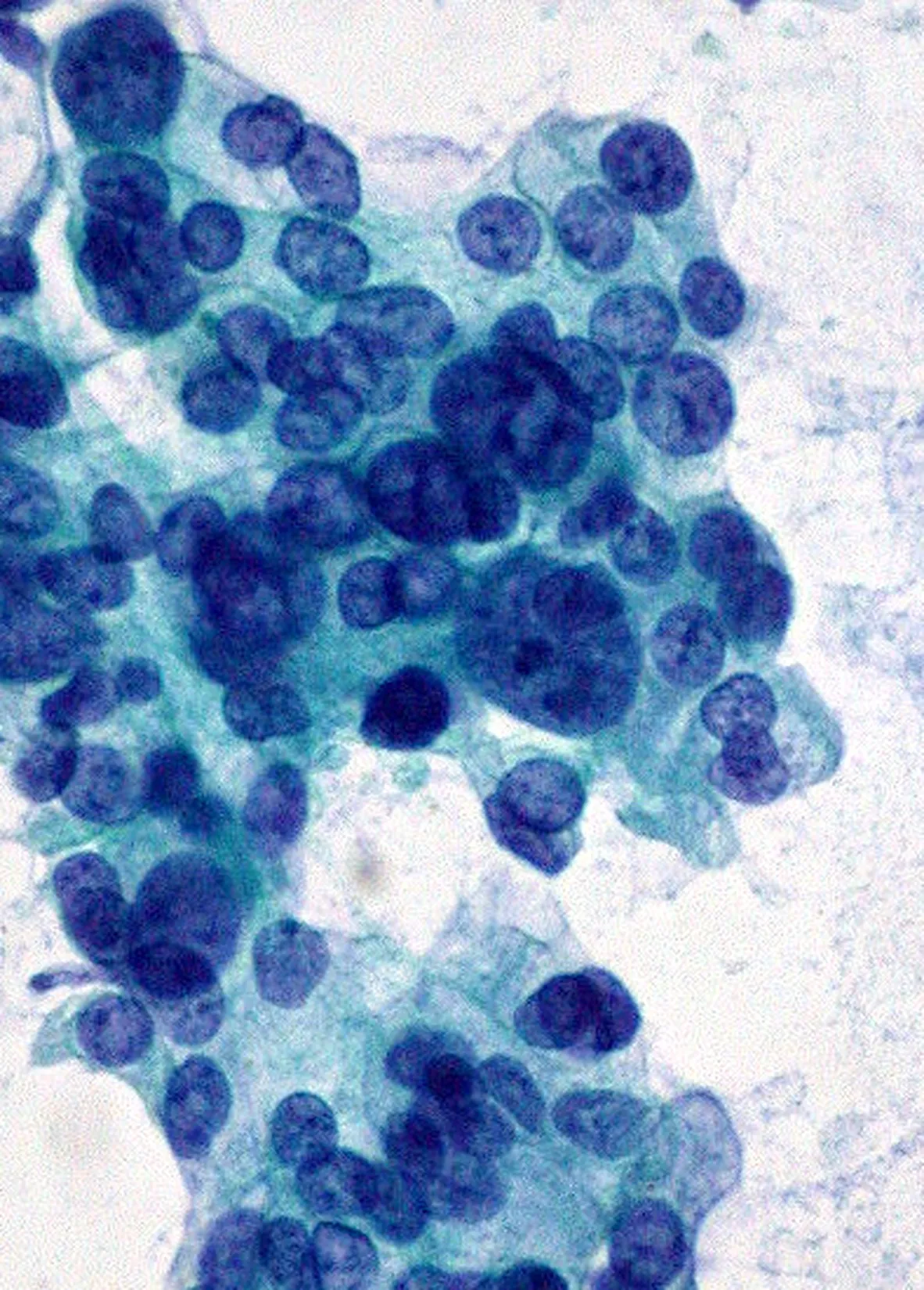
Micrograph: Ed Uthman, Pancreas FNA; adenocarcinoma vs. normal ductal epithelium (400x), CC BY 2.0. Cropped and enlarged from the original.

Where this comes from
- USPSTF: recommends against pancreatic cancer screening in asymptomatic adults (grade D); this recommendation does not cover people with inherited high risk.
- American Cancer Society: there is no screening for people at average risk because no test has been shown to reduce mortality; in high-risk families, endoscopic ultrasound and MRI/MRCP are used.
- SEER (National Cancer Institute): about 1.7 percent of people will receive this diagnosis during their lifetime; 15 percent of cases are detected while localized and 51 percent after metastasis has occurred.
- American Cancer Society (ACS): accessed 2026-09-20
- National Cancer Institute (NCI, PDQ Patient Version): accessed 2026-09-20
- American Cancer Society (ACS): accessed 2026-09-20
- American Cancer Society (ACS): accessed 2026-09-20
This is educational content, meant to help you understand your body. It is not a medical consultation or a diagnosis, and it does not tell any particular person what to do. If something worries you, see a doctor you trust.