
YOUR BODY · SLIDE BY SLIDE

Type 2 diabetes: eating a lot less and getting active can put it on pause

In one study, it worked for more than half of the people who did it.

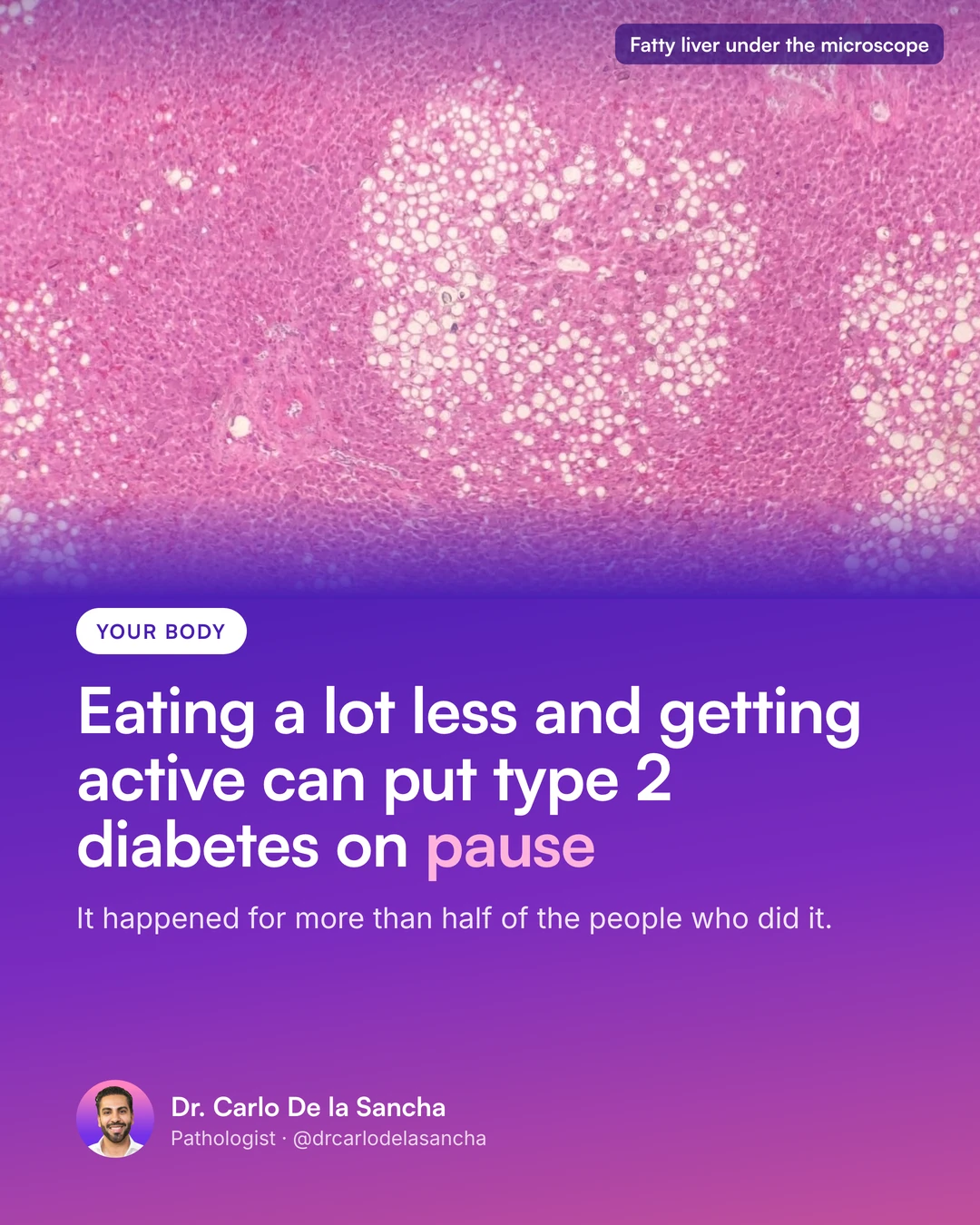
  • Fatty liver under the microscope Your body Eating a lot less and getting active can put type 2 diabetes on pause It happened for more than half of the people who did it. Dr. Carlo De la Sancha Pathologist · @drcarlodelasancha
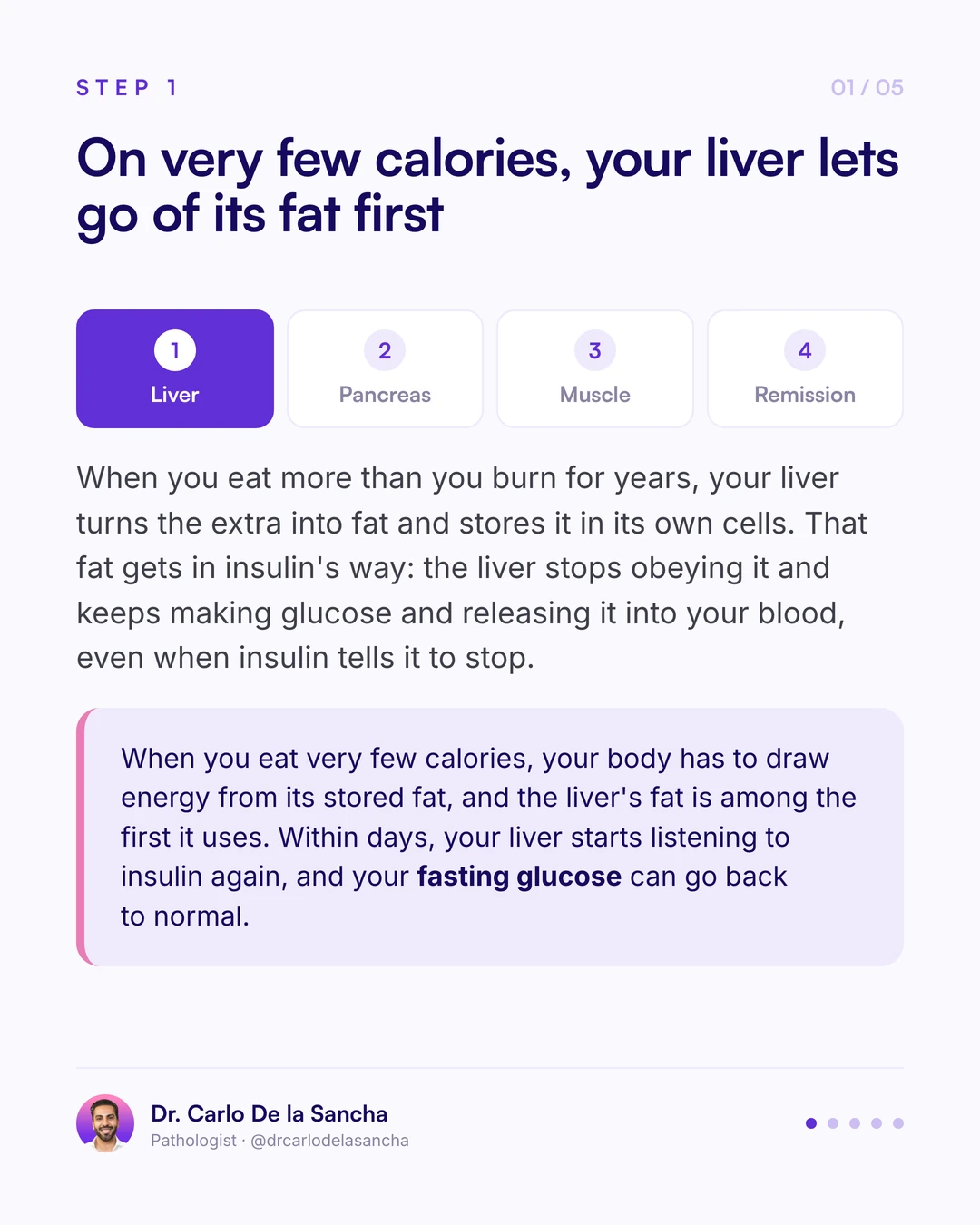
  • Step 1 01 / 05 On very few calories, your liver lets go of its fat first Liver Pancreas Muscle Remission When you eat more than you burn for years, your liver turns the extra into fat and stores it in its own cells. That fat gets in insulin's way: the liver stops obeying it and keeps making glucose and releasing it into your blood, even when insulin tells it to stop. When you eat very few calories, your body has to draw energy from its stored fat, and the liver's fat is among the first it uses. Within days, your liver starts listening to insulin again, and your fasting glucose can go back to normal. Dr. Carlo De la Sancha Pathologist · @drcarlodelasancha
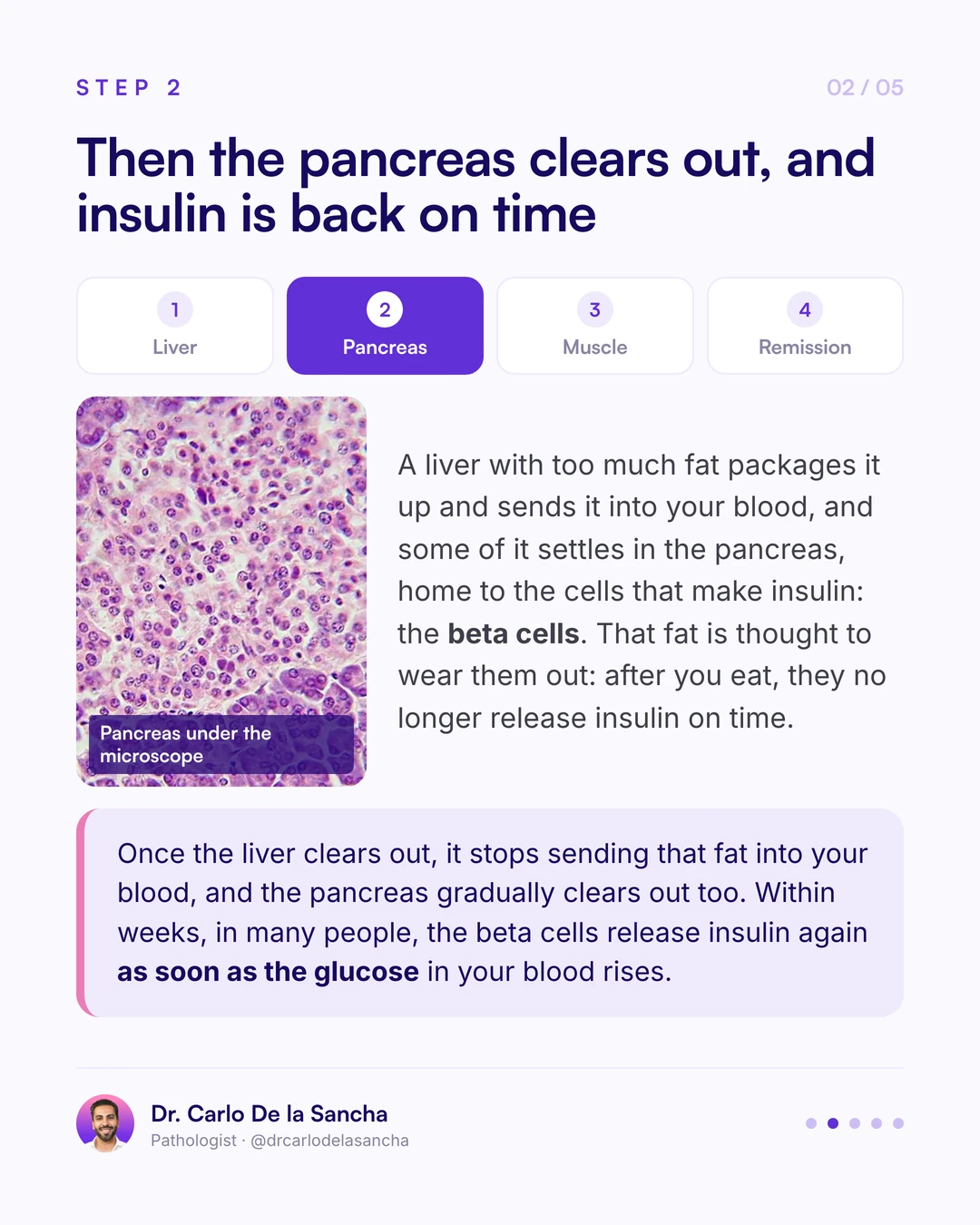
  • Step 2 02 / 05 Then the pancreas clears out, and insulin is back on time Liver Pancreas Muscle Remission Pancreas under the microscope A liver with too much fat packages it up and sends it into your blood, and some of it settles in the pancreas, home to the cells that make insulin: the beta cells. That fat is thought to wear them out: after you eat, they no longer release insulin on time. Once the liver clears out, it stops sending that fat into your blood, and the pancreas gradually clears out too. Within weeks, in many people, the beta cells release insulin again as soon as the glucose in your blood rises. Dr. Carlo De la Sancha Pathologist · @drcarlodelasancha
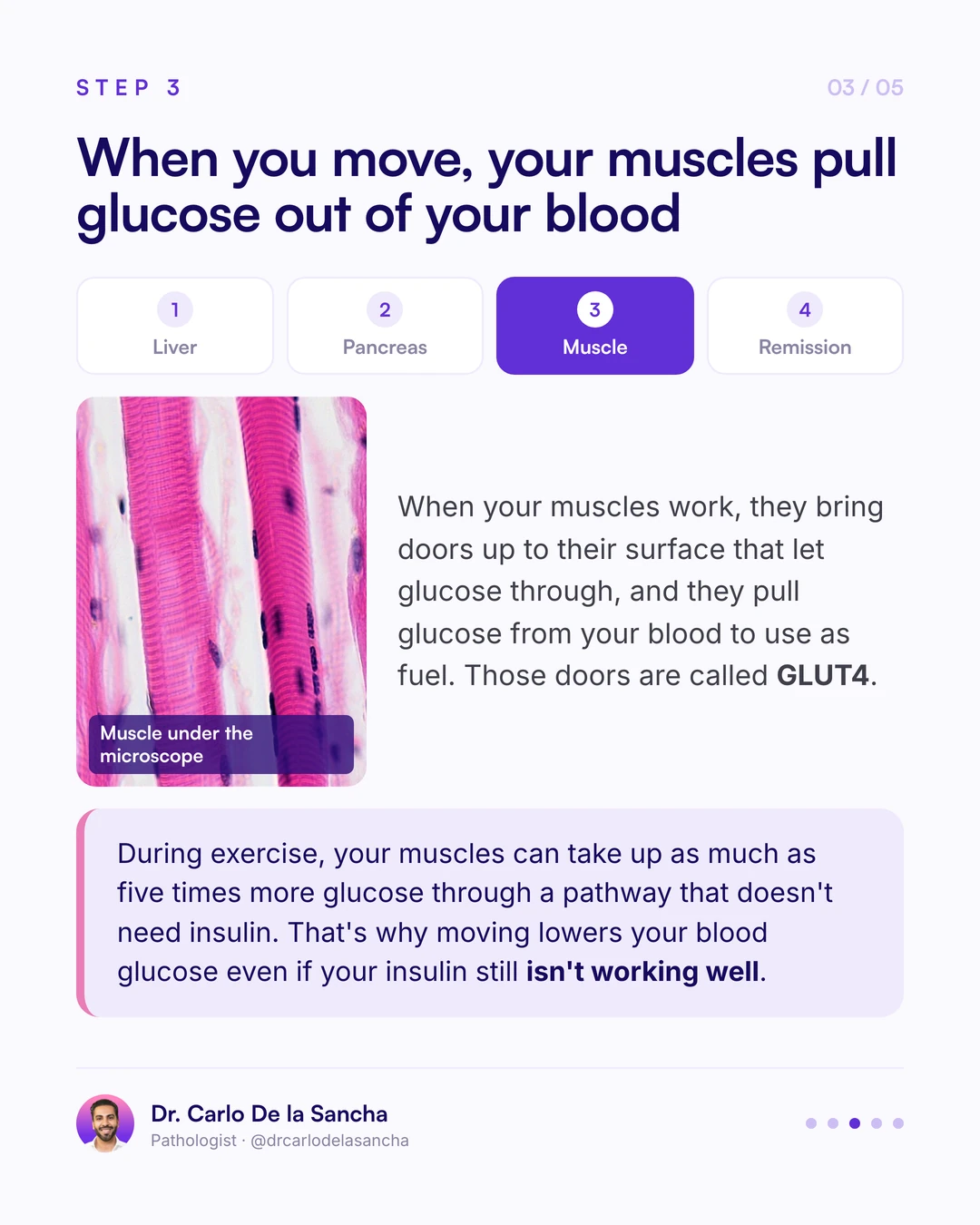
  • Step 3 03 / 05 When you move, your muscles pull glucose out of your blood Liver Pancreas Muscle Remission Muscle under the microscope When your muscles work, they bring doors up to their surface that let glucose through, and they pull glucose from your blood to use as fuel. Those doors are called GLUT4. During exercise, your muscles can take up as much as five times more glucose through a pathway that doesn't need insulin. That's why moving lowers your blood glucose even if your insulin still isn't working well. Dr. Carlo De la Sancha Pathologist · @drcarlodelasancha
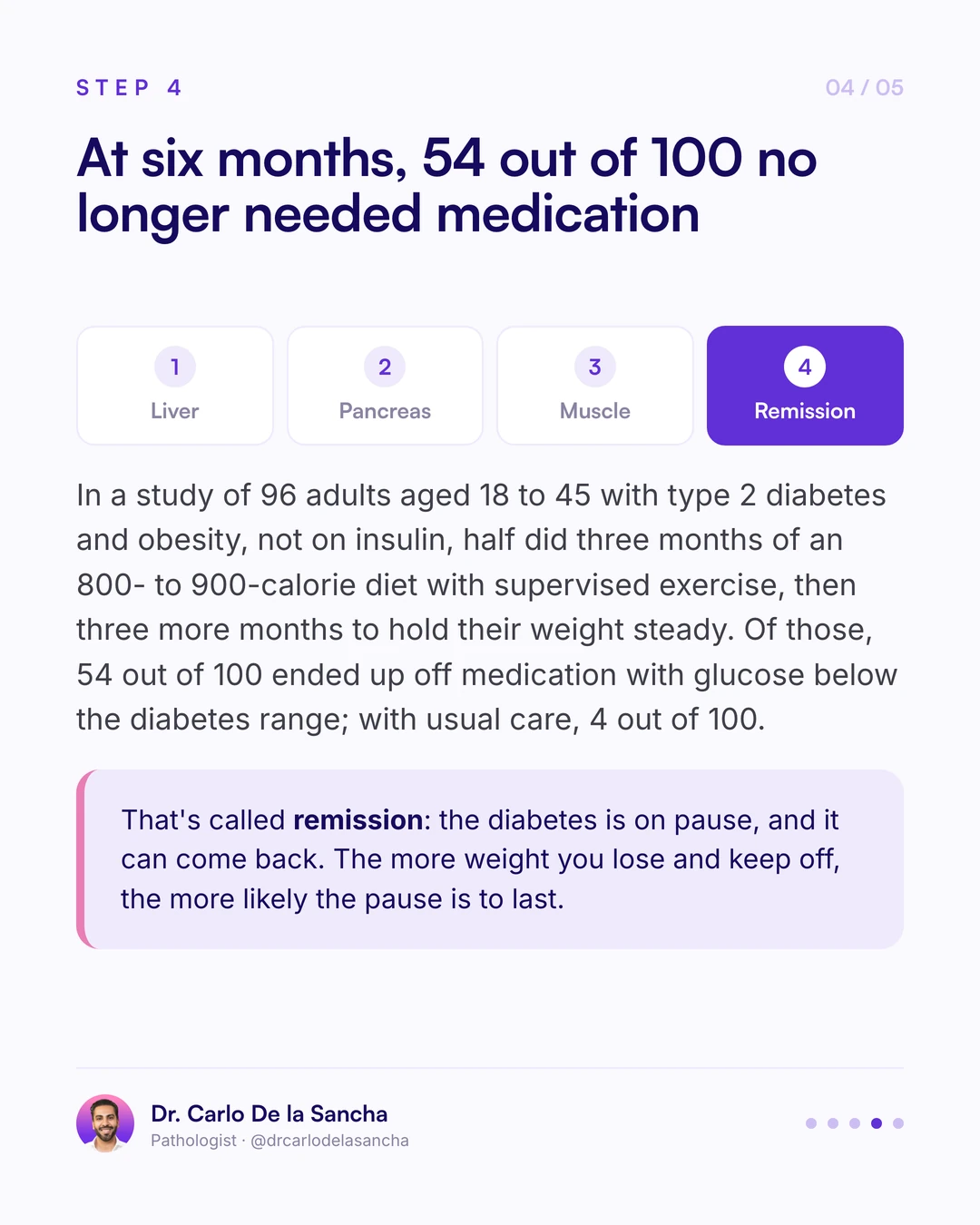
  • Step 4 04 / 05 At six months, 54 out of 100 no longer needed medication Liver Pancreas Muscle Remission In a study of 96 adults aged 18 to 45 with type 2 diabetes and obesity, not on insulin, half did three months of an 800- to 900-calorie diet with supervised exercise, then three more months to hold their weight steady. Of those, 54 out of 100 ended up off medication with glucose below the diabetes range; with usual care, 4 out of 100. That's called remission: the diabetes is on pause, and it can come back. The more weight you lose and keep off, the more likely the pause is to last. Dr. Carlo De la Sancha Pathologist · @drcarlodelasancha
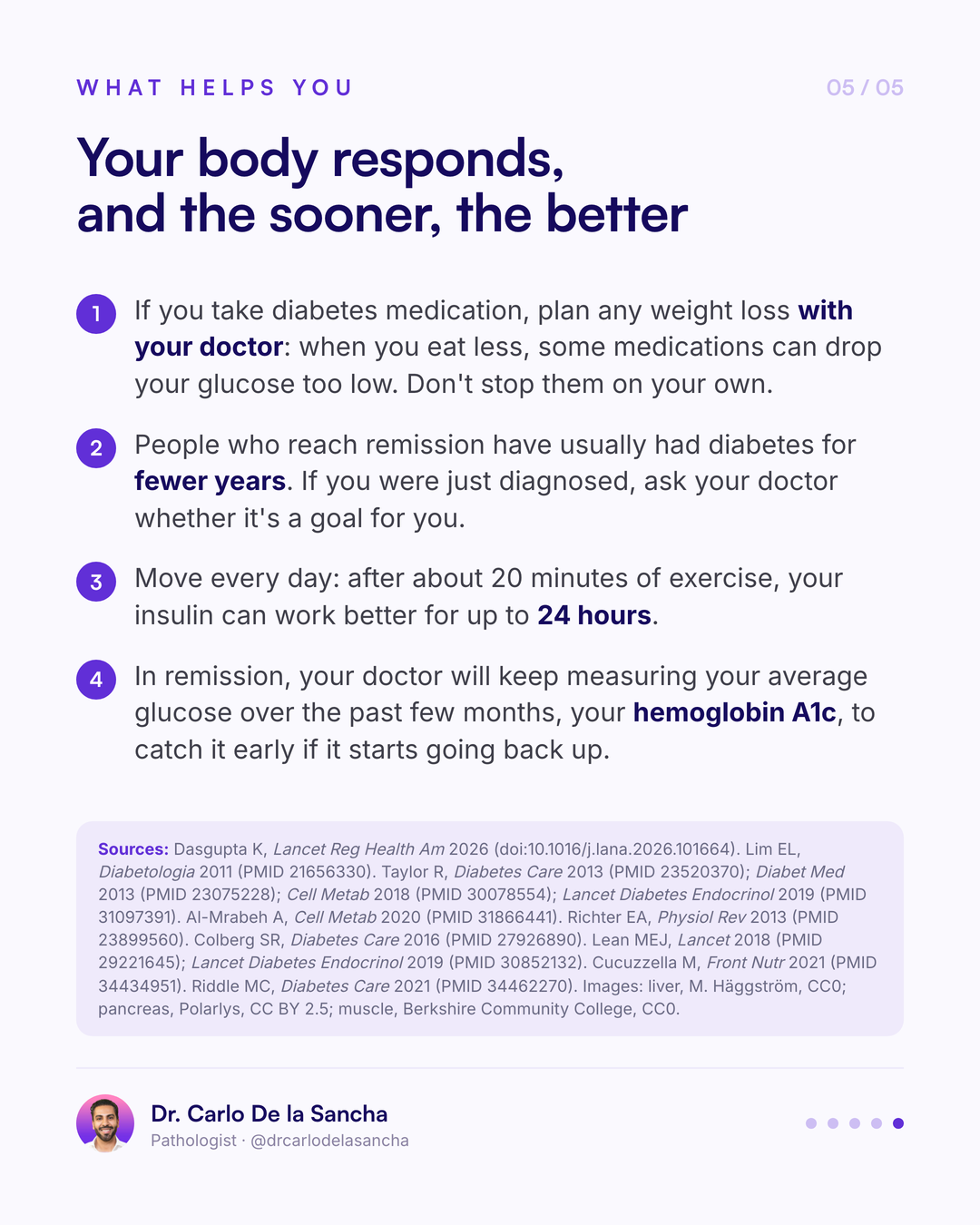
  • What helps you 05 / 05 Your body responds, and the sooner, the better If you take diabetes medication, plan any weight loss with your doctor: when you eat less, some medications can drop your glucose too low. Don't stop them on your own. People who reach remission have usually had diabetes for fewer years. If you were just diagnosed, ask your doctor whether it's a goal for you. Move every day: after about 20 minutes of exercise, your insulin can work better for up to 24 hours. In remission, your doctor will keep measuring your average glucose over the past few months, your hemoglobin A1c, to catch it early if it starts going back up. Sources: Dasgupta K, Lancet Reg Health Am 2026 (doi:10.1016/j.lana.2026.101664). Lim EL, Diabetologia 2011 (PMID 21656330). Taylor R, Diabetes Care 2013 (PMID 23520370); Diabet Med 2013 (PMID 23075228); Cell Metab 2018 (PMID 30078554); Lancet Diabetes Endocrinol 2019 (PMID 31097391). Al-Mrabeh A, Cell Metab 2020 (PMID 31866441). Richter EA, Physiol Rev 2013 (PMID 23899560). Colberg SR, Diabetes Care 2016 (PMID 27926890). Lean MEJ, Lancet 2018 (PMID 29221645); Lancet Diabetes Endocrinol 2019 (PMID 30852132). Cucuzzella M, Front Nutr 2021 (PMID 34434951). Riddle MC, Diabetes Care 2021 (PMID 34462270). Images: liver, M. Häggström, CC0; pancreas, Polarlys, CC BY 2.5; muscle, Berkshire Community College, CC0. Dr. Carlo De la Sancha Pathologist · @drcarlodelasancha
  • Want to understand your body? Subscribe to my newsletter: drcarlodelasancha.com/en/newsletter Save it, share it and follow me → @drcarlodelasancha Educational content. Not a substitute for a visit to your doctor.

Know someone who would find this helpful?

Share it with them.