
YOUR BODY · SLIDE BY SLIDE

His poorly controlled thyroid left a jelly-like substance in his heart

What the biopsy found in his heart, and how to take your thyroid pill the right way.

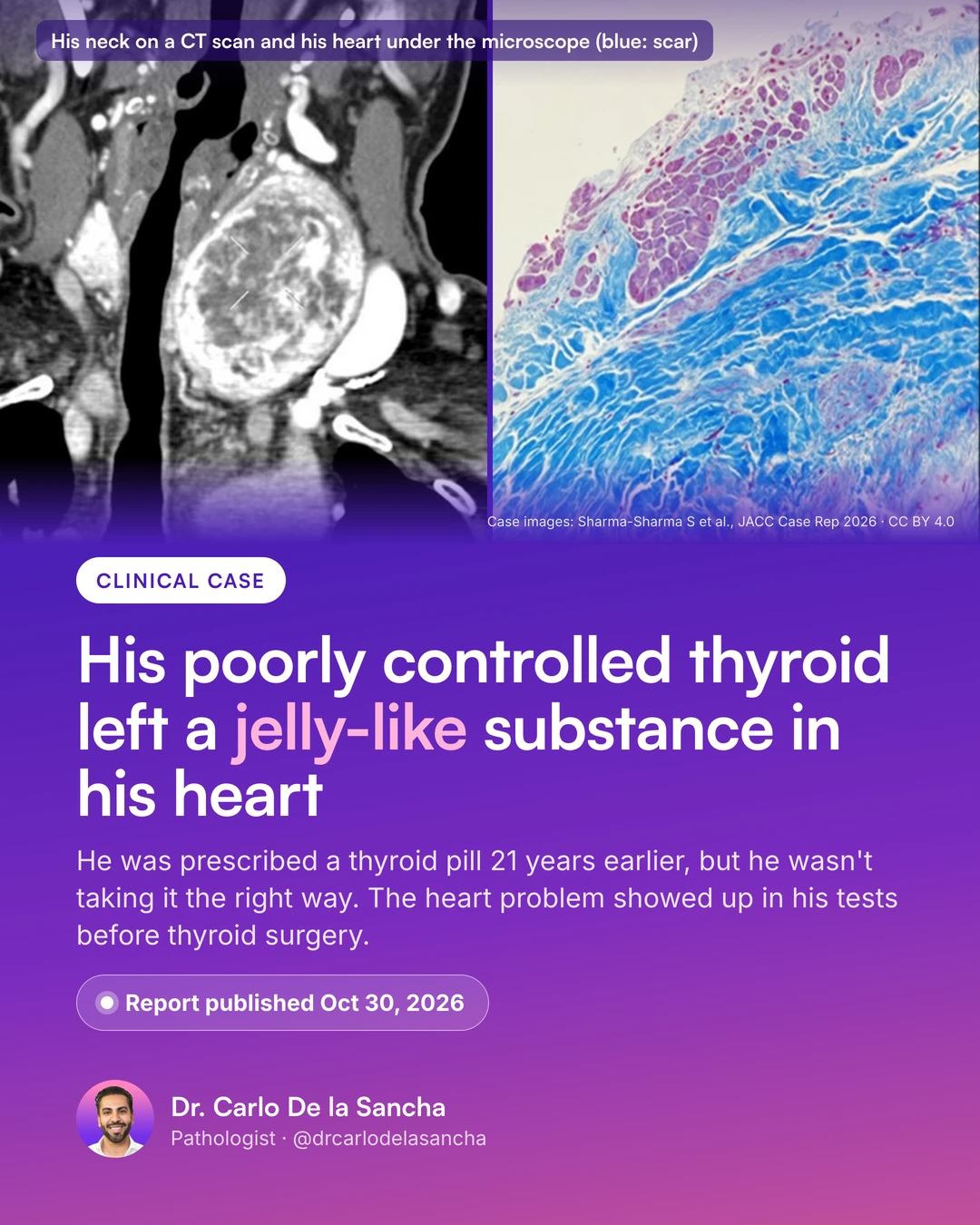
  • His neck on a CT scan and his heart under the microscope (blue: scar) Case images: Sharma-Sharma S et al., JACC Case Rep 2026 · CC BY 4.0 Clinical case His poorly controlled thyroid left a jelly-like substance in his heart He was prescribed a thyroid pill 21 years earlier, but he wasn't taking it the right way. The heart problem showed up in his tests before thyroid surgery. Report published Oct 30, 2026 Dr. Carlo De la Sancha Pathologist · @drcarlodelasancha
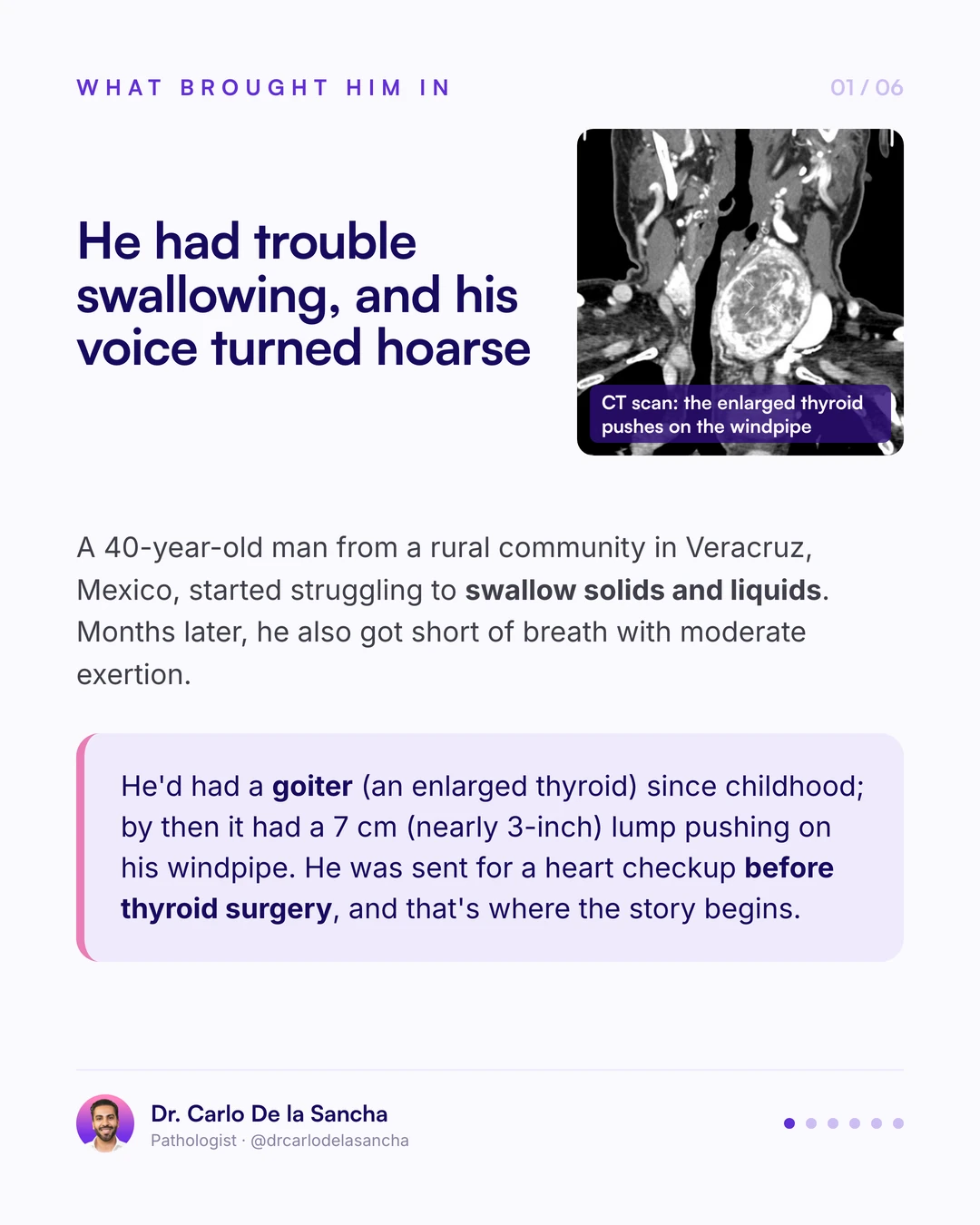
  • What brought him in 01 / 06 He had trouble swallowing, and his voice turned hoarse CT scan: the enlarged thyroid pushes on the windpipe A 40-year-old man from a rural community in Veracruz, Mexico, started struggling to swallow solids and liquids. Months later, he also got short of breath with moderate exertion. He'd had a goiter (an enlarged thyroid) since childhood; by then it had a 7 cm (nearly 3-inch) lump pushing on his windpipe. He was sent for a heart checkup before thyroid surgery, and that's where the story begins. Dr. Carlo De la Sancha Pathologist · @drcarlodelasancha
  • The thyroid 02 / 06 He'd had the pills for 21 years In 2001 he was diagnosed with hypothyroidism (the thyroid makes too little hormone) and prescribed levothyroxine, the same hormone in pill form. But he took it irregularly and not the right way. TSH: 67.8 Free T4: barely detectable TSH is the signal your brain uses to tell the thyroid to get to work. When the thyroid doesn't respond, the signal goes up. His was more than ten times higher than normal. Dr. Carlo De la Sancha Pathologist · @drcarlodelasancha
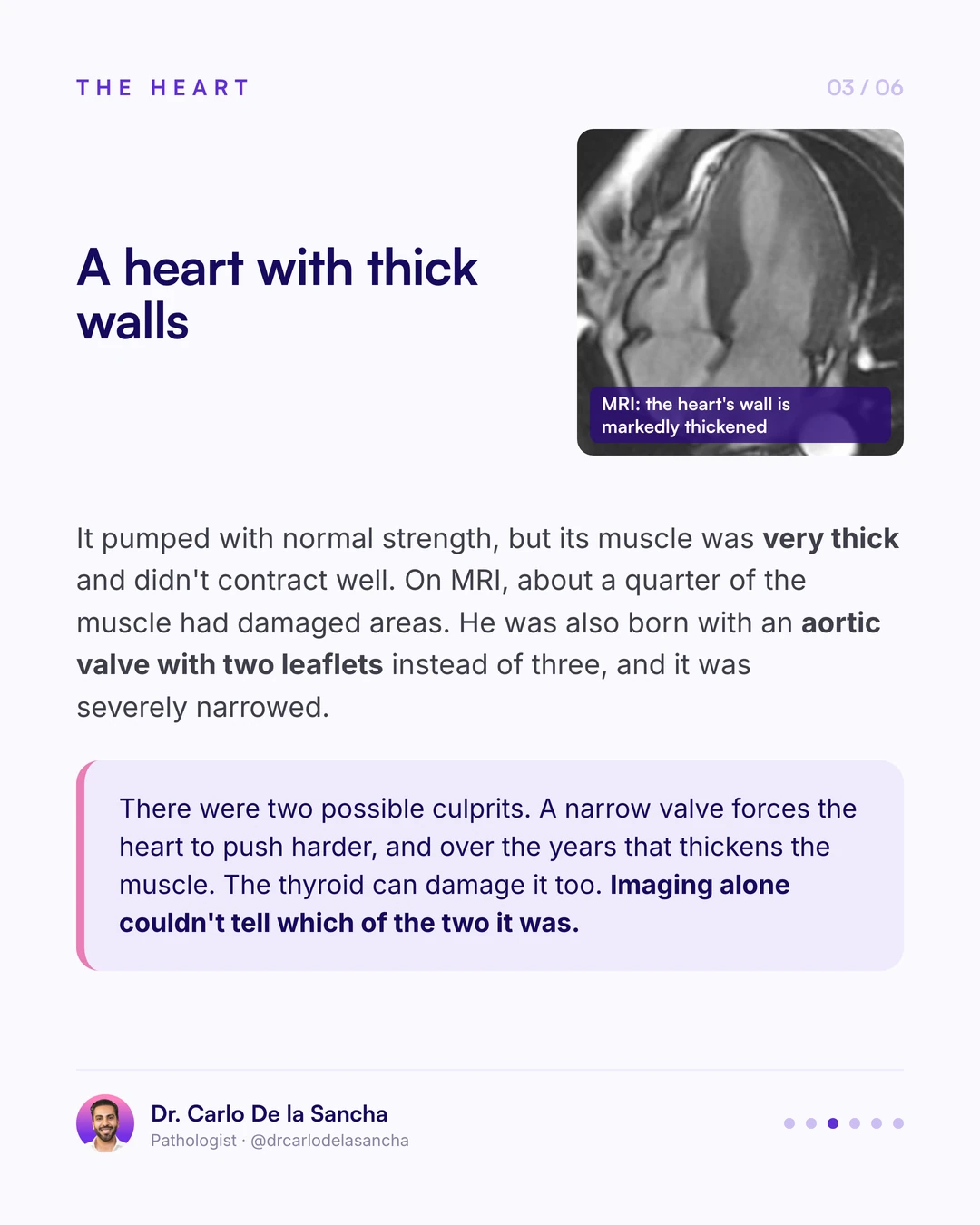
  • The heart 03 / 06 A heart with thick walls MRI: the heart's wall is markedly thickened It pumped with normal strength, but its muscle was very thick and didn't contract well. On MRI, about a quarter of the muscle had damaged areas. He was also born with an aortic valve with two leaflets instead of three, and it was severely narrowed. There were two possible culprits. A narrow valve forces the heart to push harder, and over the years that thickens the muscle. The thyroid can damage it too. Imaging alone couldn't tell which of the two it was. Dr. Carlo De la Sancha Pathologist · @drcarlodelasancha
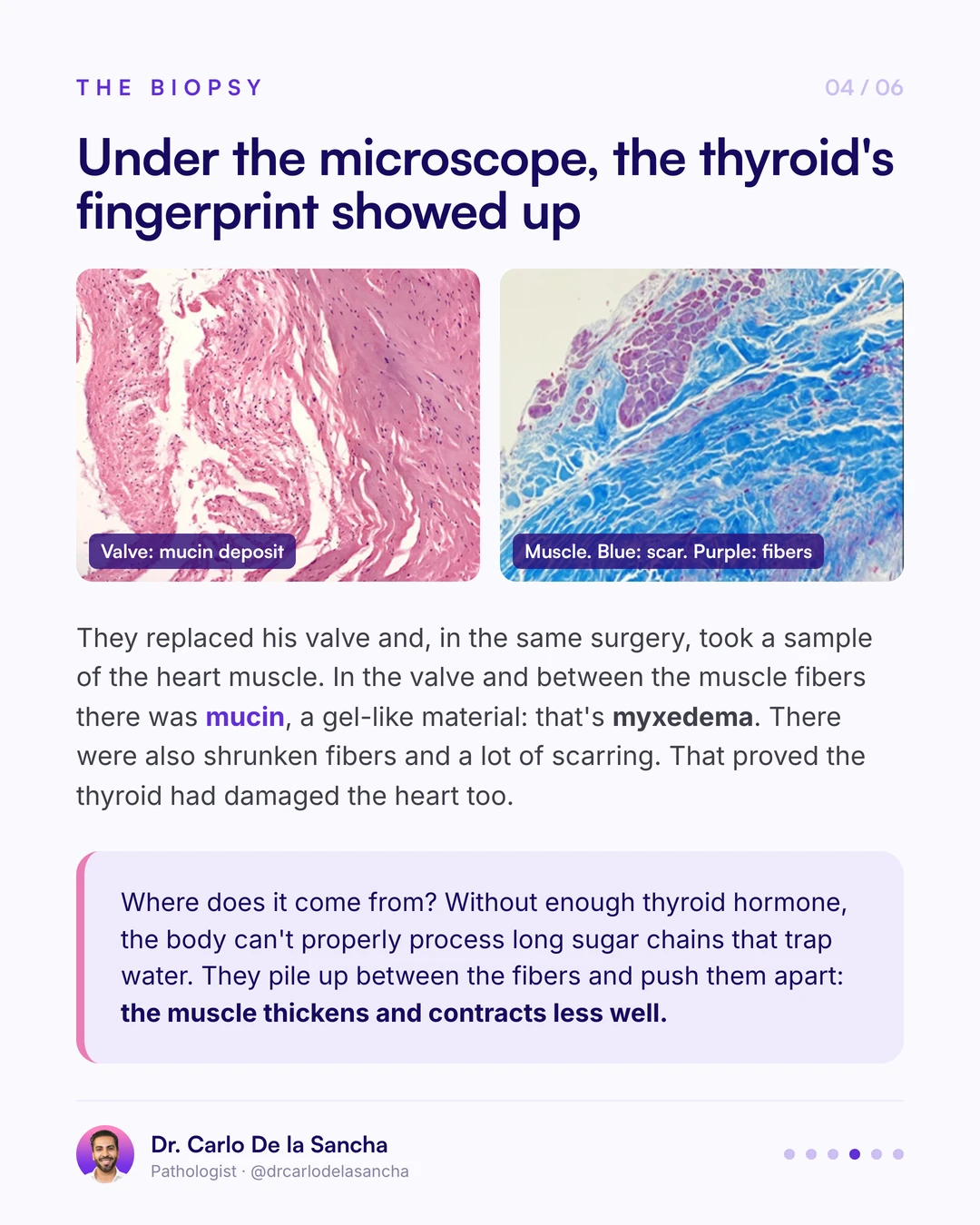
  • The biopsy 04 / 06 Under the microscope, the thyroid's fingerprint showed up Valve: mucin deposit Muscle. Blue: scar. Purple: fibers They replaced his valve and, in the same surgery, took a sample of the heart muscle. In the valve and between the muscle fibers there was mucin, a gel-like material: that's myxedema. There were also shrunken fibers and a lot of scarring. That proved the thyroid had damaged the heart too. Where does it come from? Without enough thyroid hormone, the body can't properly process long sugar chains that trap water. They pile up between the fibers and push them apart: the muscle thickens and contracts less well. Dr. Carlo De la Sancha Pathologist · @drcarlodelasancha
  • Afterward 05 / 06 His thyroid got under control, but his heart didn't fully recover Before surgery, his doctors adjusted his pill, because operating with his thyroid that out of control is riskier. Two months after surgery his TSH was normal, he was swallowing better and his goiter looked smaller. One year later The new valve was working well Blood now flowed out freely. One year later The heart was still thick And its pumping strength ended up slightly low. In many people, getting the thyroid under control reverses most of the heart changes. Mucin can improve, but what has already scarred probably stays. Dr. Carlo De la Sancha Pathologist · @drcarlodelasancha
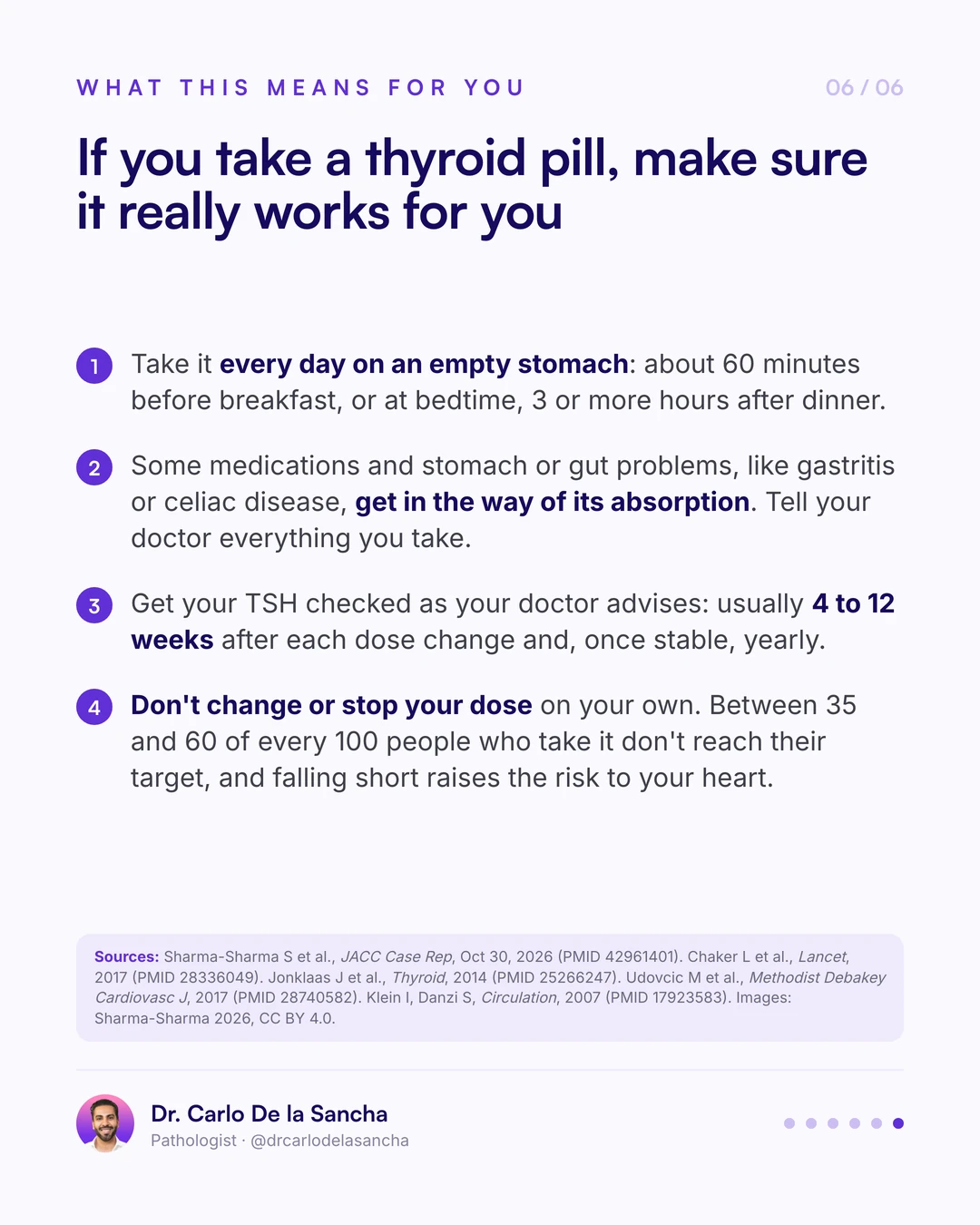
  • What this means for you 06 / 06 If you take a thyroid pill, make sure it really works for you Take it every day on an empty stomach: about 60 minutes before breakfast, or at bedtime, 3 or more hours after dinner. Some medications and stomach or gut problems, like gastritis or celiac disease, get in the way of its absorption. Tell your doctor everything you take. Get your TSH checked as your doctor advises: usually 4 to 12 weeks after each dose change and, once stable, yearly. Don't change or stop your dose on your own. Between 35 and 60 of every 100 people who take it don't reach their target, and falling short raises the risk to your heart. Sources: Sharma-Sharma S et al., JACC Case Rep, Oct 30, 2026 (PMID 42961401). Chaker L et al., Lancet, 2017 (PMID 28336049). Jonklaas J et al., Thyroid, 2014 (PMID 25266247). Udovcic M et al., Methodist Debakey Cardiovasc J, 2017 (PMID 28740582). Klein I, Danzi S, Circulation, 2007 (PMID 17923583). Images: Sharma-Sharma 2026, CC BY 4.0. Dr. Carlo De la Sancha Pathologist · @drcarlodelasancha
  • Want to understand your body? Subscribe to my newsletter: drcarlodelasancha.com/en/newsletter Save it, share it and follow me → @drcarlodelasancha Educational content. Not a substitute for a visit to your doctor.

Know someone who would find this helpful?

Share it with them.