
YOUR BODY · SLIDE BY SLIDE

What does your body do when you get scared?

This is how it gets you ready to run, in four steps.

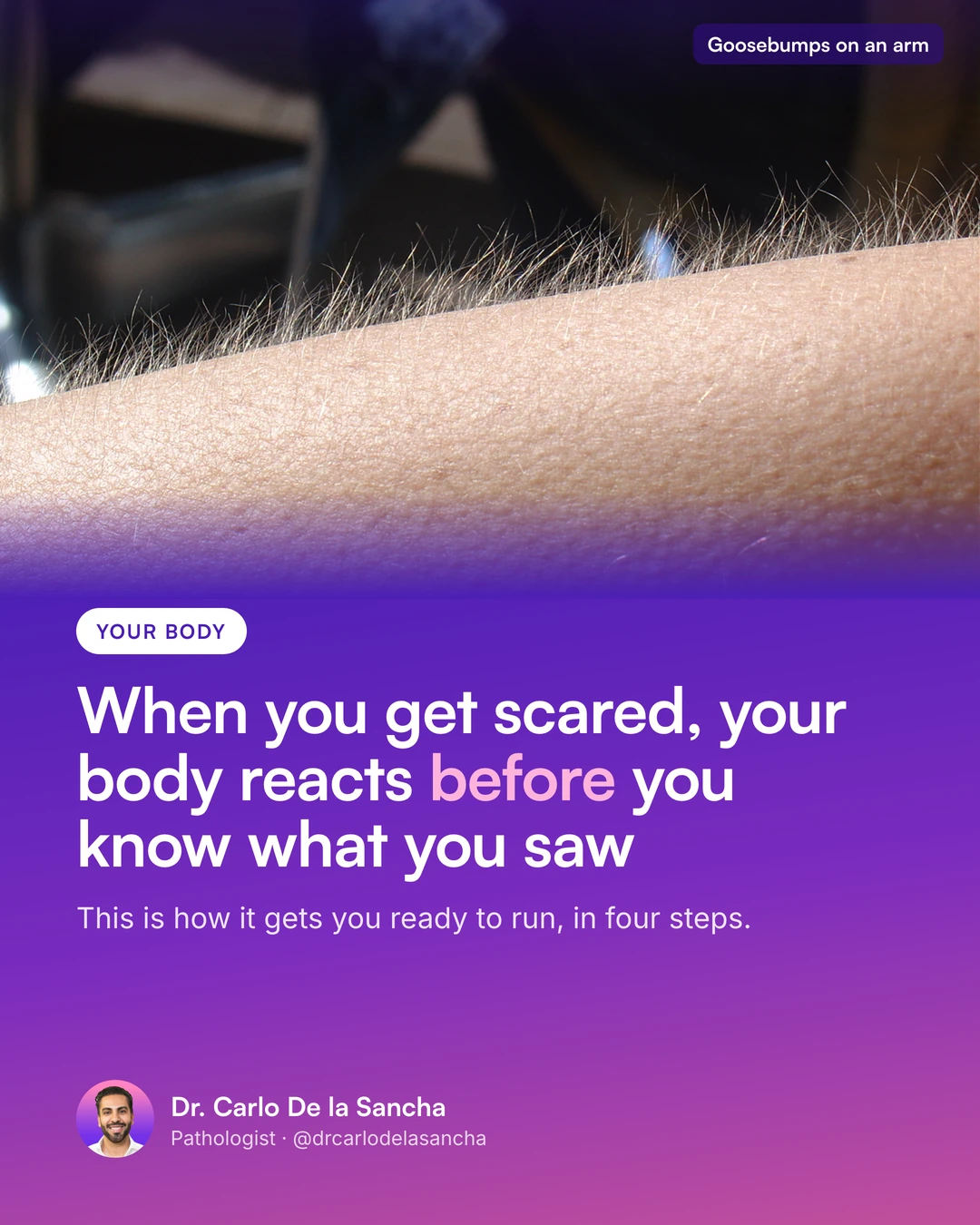
  • Goosebumps on an arm Your body When you get scared, your body reacts before you know what you saw This is how it gets you ready to run, in four steps. Dr. Carlo De la Sancha Pathologist · @drcarlodelasancha
  • Steps 1 and 2 01 / 05 Your brain sounds the alarm and your adrenals release adrenaline Amygdala Adrenaline Heart Goosebumps What you see or hear reaches the amygdala, the part of your brain that recognizes danger. Part of the signal gets there by a shortcut: that's why you react before you understand what you saw. The order travels down the sympathetic nervous system, the nerve network that puts you on alert, to your adrenal glands, which release adrenaline into your blood. Dr. Carlo De la Sancha Pathologist · @drcarlodelasancha
  • Step 3 02 / 05 Your heart speeds up and your pupils widen, so you can run Amygdala Adrenaline Heart Goosebumps Adrenaline, along with norepinephrine from the sympathetic system, speeds up your heart and sends more blood to your muscles. Your pupils and airways open up, and your liver releases sugar: quick fuel. It feels like something is going wrong, and it's the opposite: your body is getting you ready to fight or flee. Dr. Carlo De la Sancha Pathologist · @drcarlodelasancha
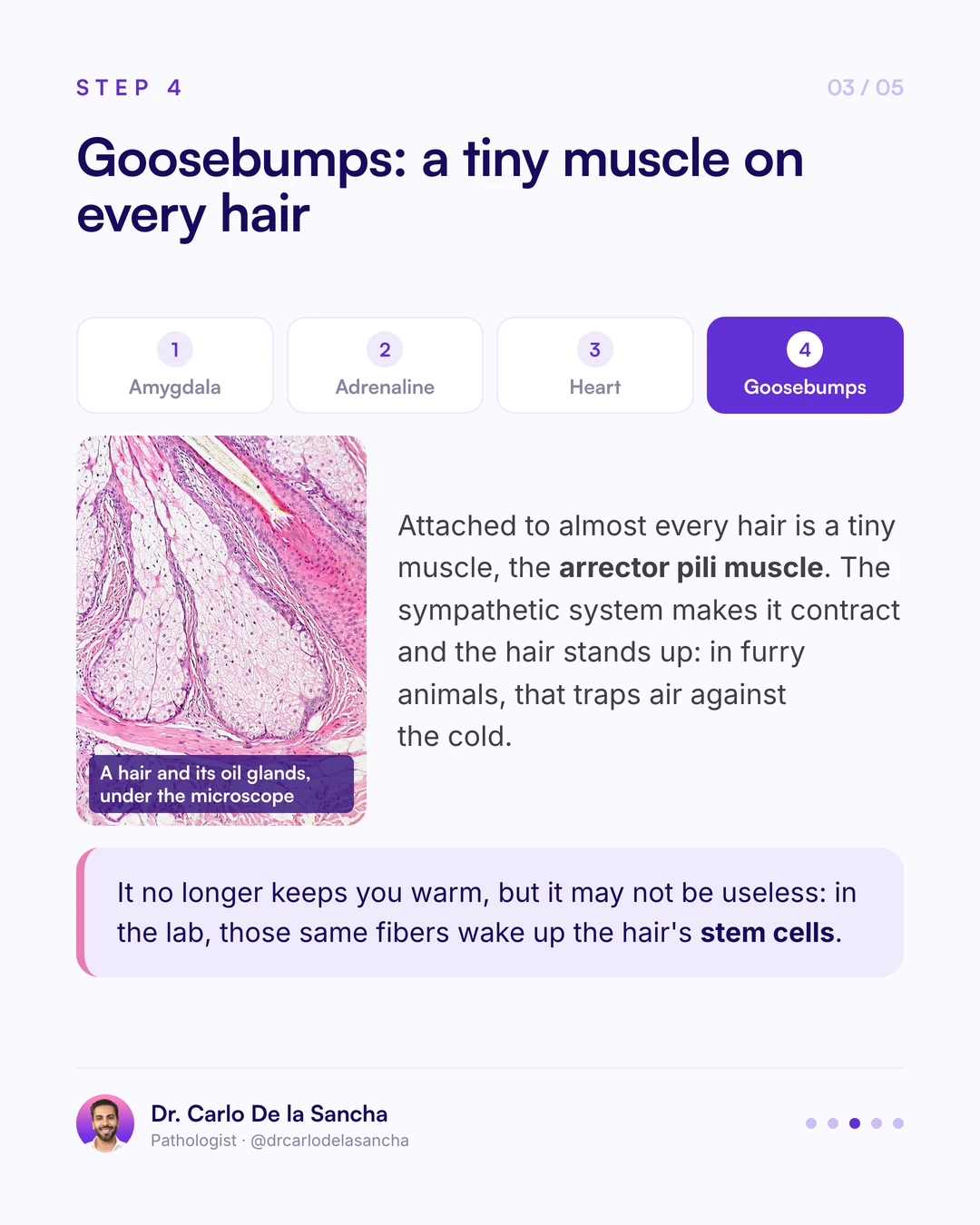
  • Step 4 03 / 05 Goosebumps: a tiny muscle on every hair Amygdala Adrenaline Heart Goosebumps A hair and its oil glands, under the microscope Attached to almost every hair is a tiny muscle, the arrector pili muscle. The sympathetic system makes it contract and the hair stands up: in furry animals, that traps air against the cold. It no longer keeps you warm, but it may not be useless: in the lab, those same fibers wake up the hair's stem cells. Dr. Carlo De la Sancha Pathologist · @drcarlodelasancha
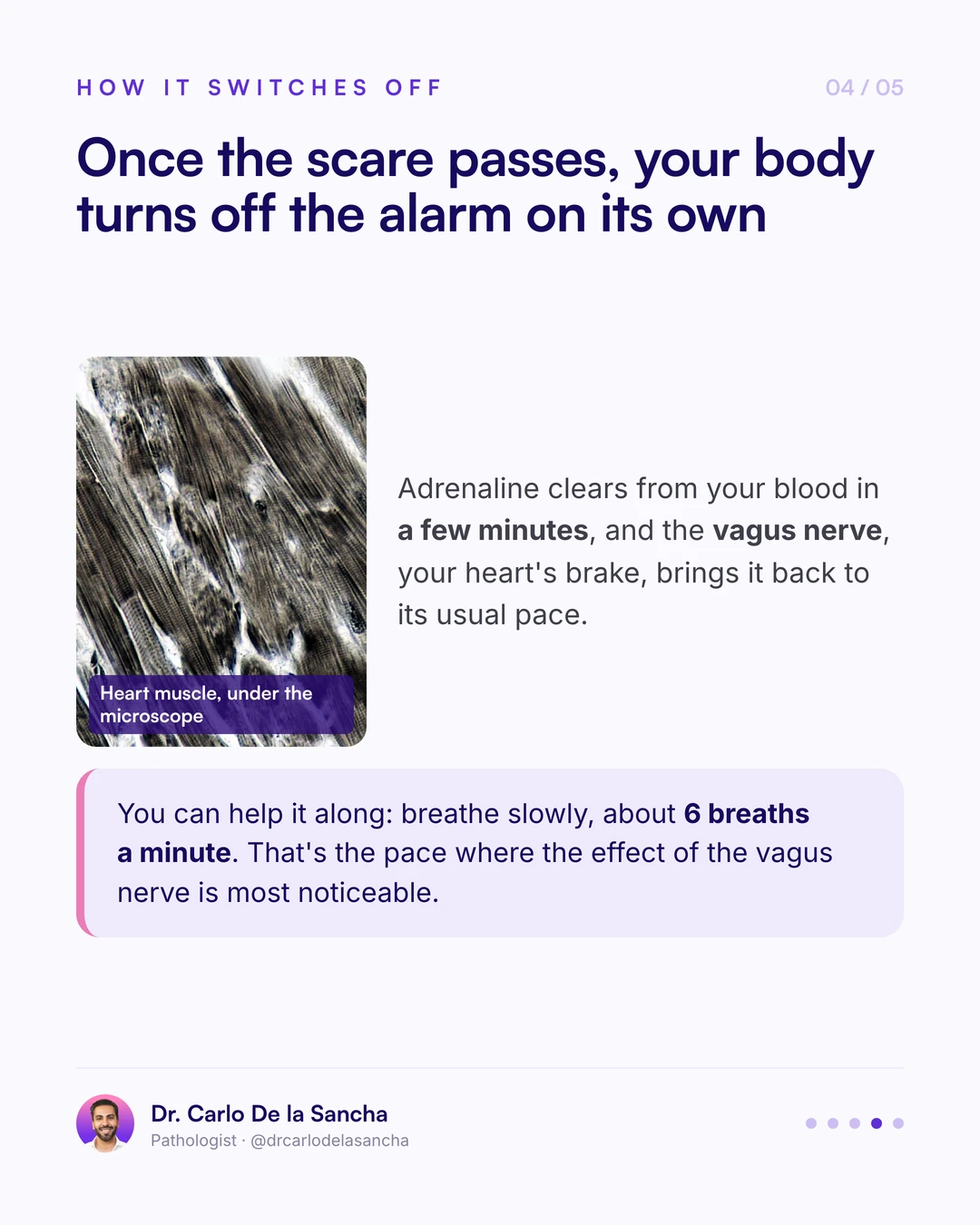
  • How it switches off 04 / 05 Once the scare passes, your body turns off the alarm on its own Heart muscle, under the microscope Adrenaline clears from your blood in a few minutes, and the vagus nerve, your heart's brake, brings it back to its usual pace. You can help it along: breathe slowly, about 6 breaths a minute. That's the pace where the effect of the vagus nerve is most noticeable. Dr. Carlo De la Sancha Pathologist · @drcarlodelasancha
  • What helps you 05 / 05 Enjoy the scare, but know when it's something more Headache, sweating and a racing heart with no scare, especially with high blood pressure: bring it up with your doctor. Rarely, it's the adrenal gland releasing adrenaline on its own. Chest pain or pressure after a strong emotion, if it doesn't go away once you calm down: call 911. Sources: Šimić G et al., Biomolecules 2021 (PMID 34072960). Berends AMA et al., Cancers 2019 (PMID 31390824). Shwartz Y et al., Cell 2020 (PMID 32679029). Russo MA et al., Breathe 2017 (PMID 29209423). Aygun N, Uludag M, Sisli Etfal Hastan Tip Bul 2020 (PMID 33312023). Ghadri JR et al., Eur Heart J 2018 (PMID 29850871). Images: goosebumps, EverJean, CC BY 2.0; hair and sebaceous glands, Kilbad, public domain; heart muscle, Berkshire Community College, CC0. Dr. Carlo De la Sancha Pathologist · @drcarlodelasancha
  • Want to understand your body? Subscribe to my newsletter: drcarlodelasancha.com/en/newsletter Save it, share it and follow me → @drcarlodelasancha Educational content. Not a substitute for a visit to your doctor.

Know someone who would find this helpful?

Share it with them.