
YOUR BODY · SLIDE BY SLIDE

Those floating specks are shadows from your own eye

Where they come from, why they dart away and when to get them checked.

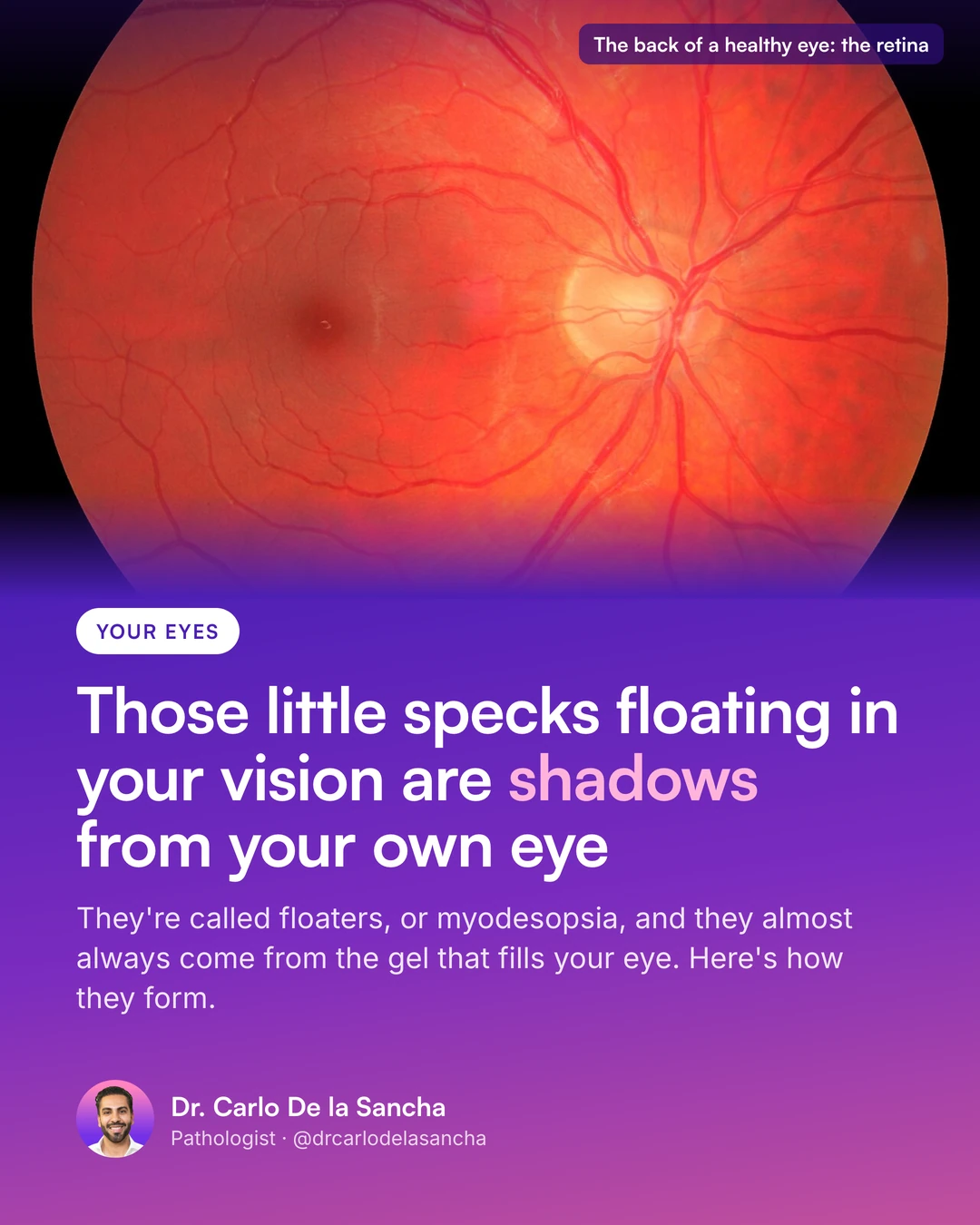
  • The back of a healthy eye: the retina Your eyes Those little specks floating in your vision are shadows from your own eye They're called floaters, or myodesopsia, and they almost always come from the gel that fills your eye. Here's how they form. Dr. Carlo De la Sancha Pathologist · @drcarlodelasancha
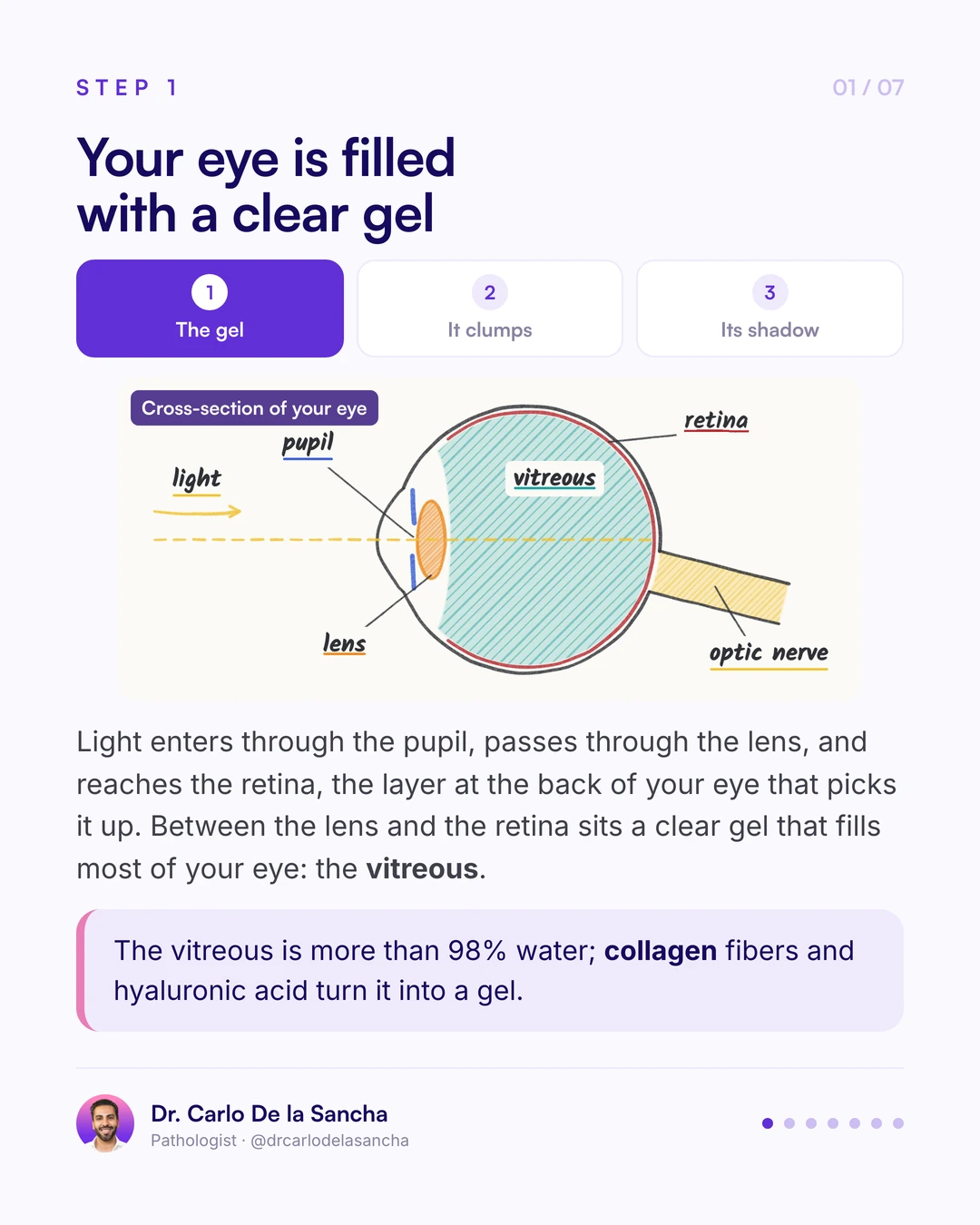
  • Step 1 01 / 07 Your eye is filled with a clear gel 1 The gel 2 It clumps 3 Its shadow Cross-section of your eye Light enters through the pupil, passes through the lens, and reaches the retina, the layer at the back of your eye that picks it up. Between the lens and the retina sits a clear gel that fills most of your eye: the vitreous. The vitreous is more than 98% water; collagen fibers and hyaluronic acid turn it into a gel. Dr. Carlo De la Sancha Pathologist · @drcarlodelasancha
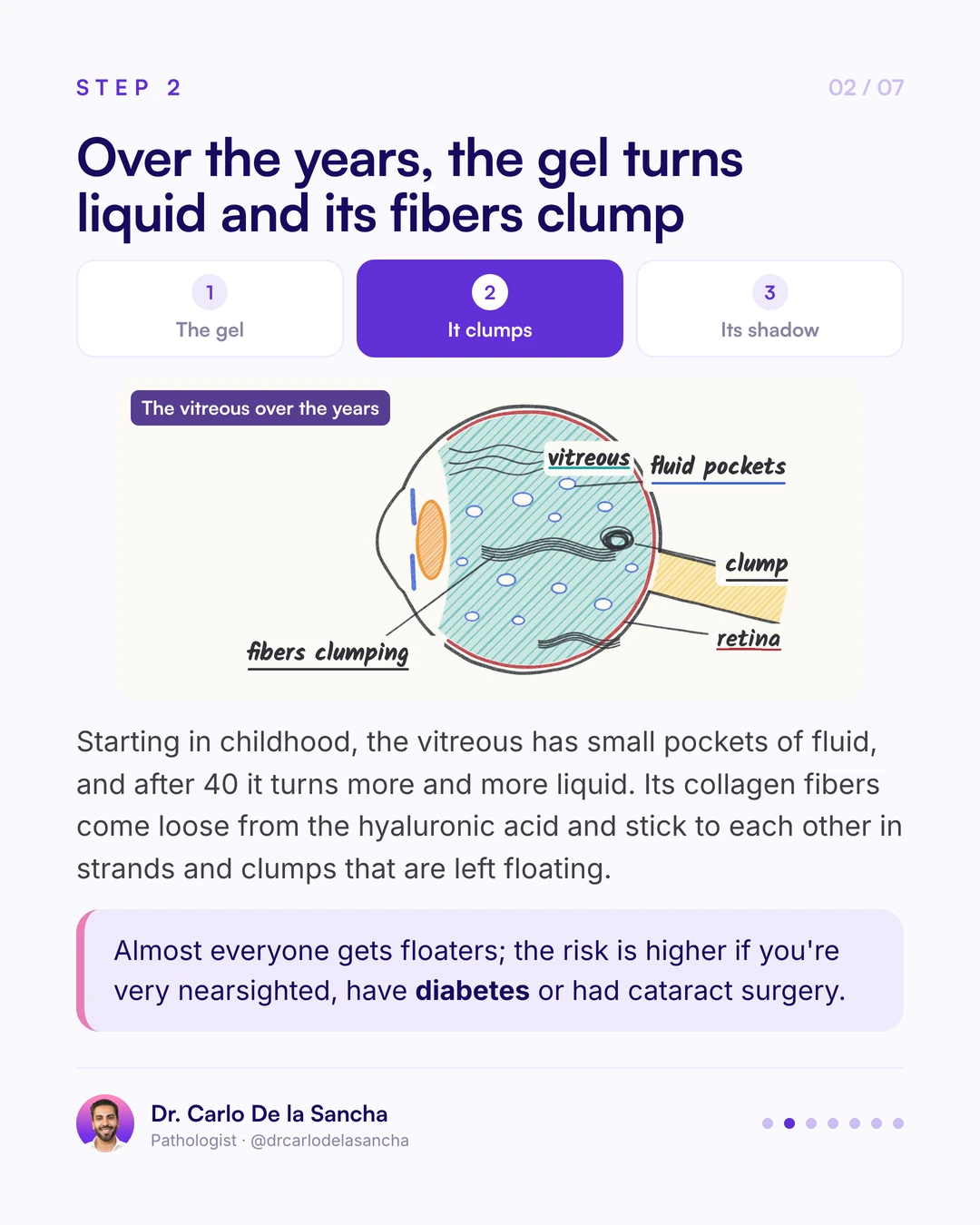
  • Step 2 02 / 07 Over the years, the gel turns liquid and its fibers clump 1 The gel 2 It clumps 3 Its shadow The vitreous over the years Starting in childhood, the vitreous has small pockets of fluid, and after 40 it turns more and more liquid. Its collagen fibers come loose from the hyaluronic acid and stick to each other in strands and clumps that are left floating. Almost everyone gets floaters; the risk is higher if you're very nearsighted, have diabetes or had cataract surgery. Dr. Carlo De la Sancha Pathologist · @drcarlodelasancha
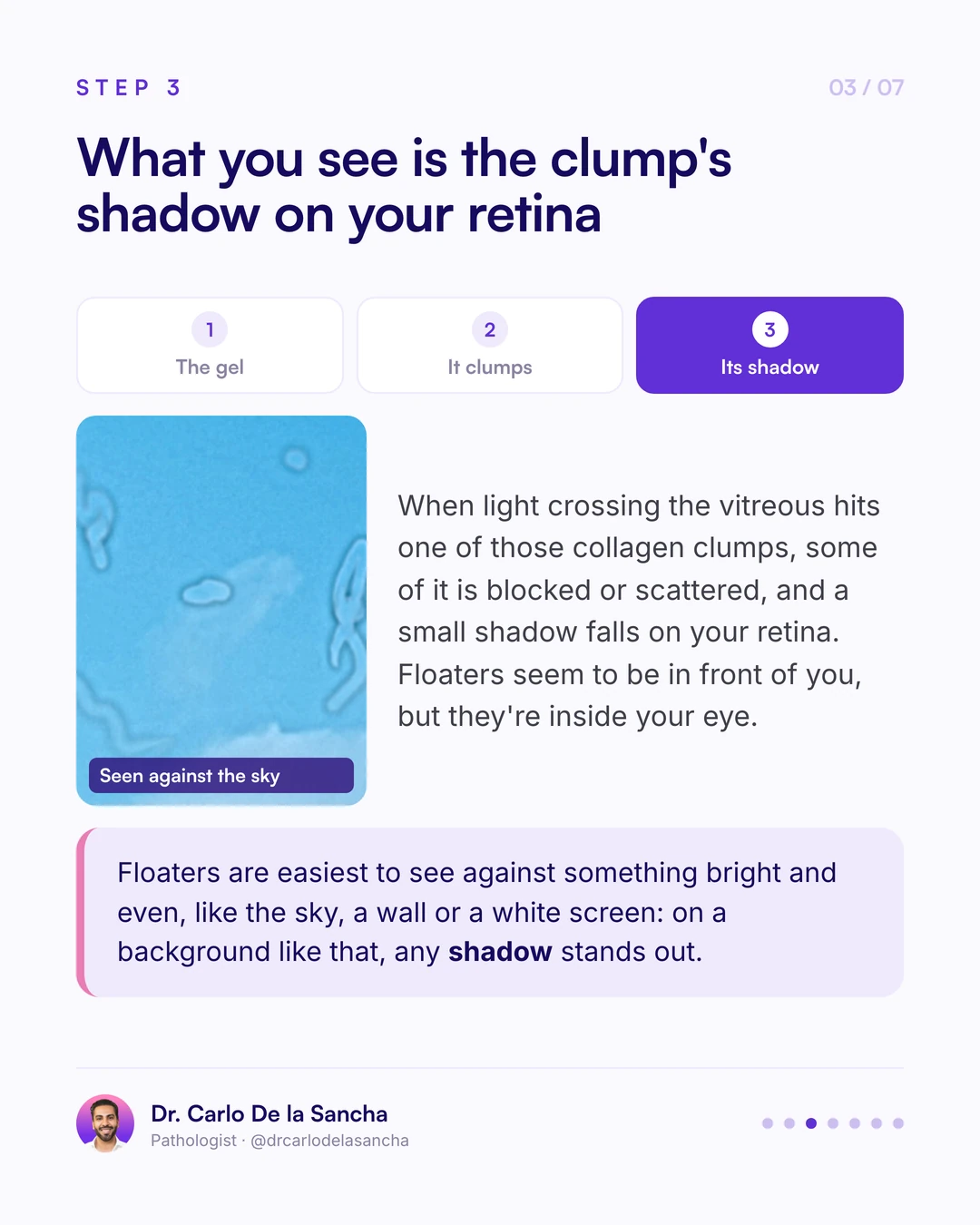
  • Step 3 03 / 07 What you see is the clump's shadow on your retina 1 The gel 2 It clumps 3 Its shadow Seen against the sky When light crossing the vitreous hits one of those collagen clumps, some of it is blocked or scattered, and a small shadow falls on your retina. Floaters seem to be in front of you, but they're inside your eye. Floaters are easiest to see against something bright and even, like the sky, a wall or a white screen: on a background like that, any shadow stands out. Dr. Carlo De la Sancha Pathologist · @drcarlodelasancha
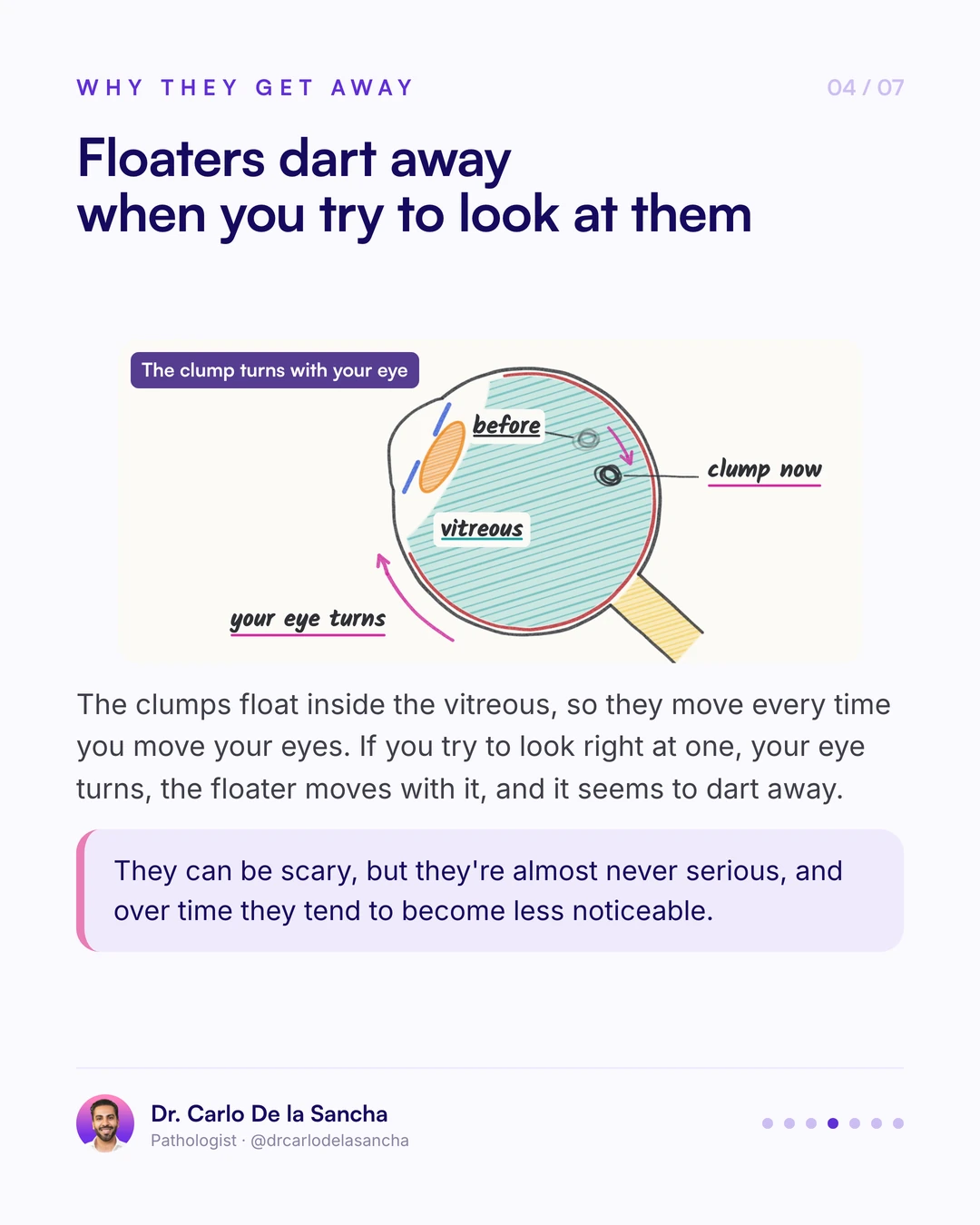
  • Why they get away 04 / 07 Floaters dart away when you try to look at them The clump turns with your eye The clumps float inside the vitreous, so they move every time you move your eyes. If you try to look right at one, your eye turns, the floater moves with it, and it seems to dart away. They can be scary, but they're almost never serious, and over time they tend to become less noticeable. Dr. Carlo De la Sancha Pathologist · @drcarlodelasancha
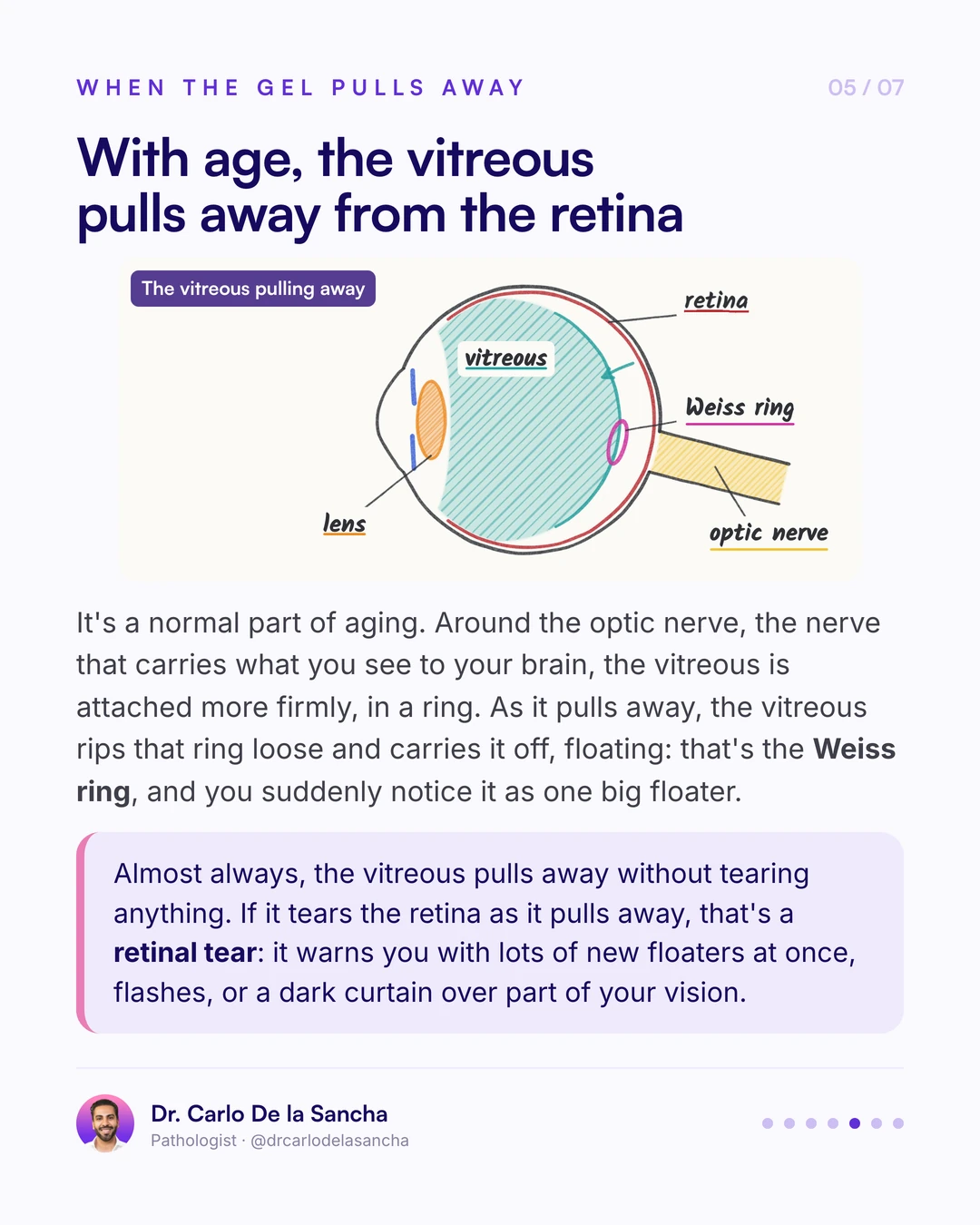
  • When the gel pulls away 05 / 07 With age, the vitreous pulls away from the retina The vitreous pulling away It's a normal part of aging. Around the optic nerve, the nerve that carries what you see to your brain, the vitreous is attached more firmly, in a ring. As it pulls away, the vitreous rips that ring loose and carries it off, floating: that's the Weiss ring, and you suddenly notice it as one big floater. Almost always, the vitreous pulls away without tearing anything. If it tears the retina as it pulls away, that's a retinal tear: it warns you with lots of new floaters at once, flashes, or a dark curtain over part of your vision. Dr. Carlo De la Sancha Pathologist · @drcarlodelasancha
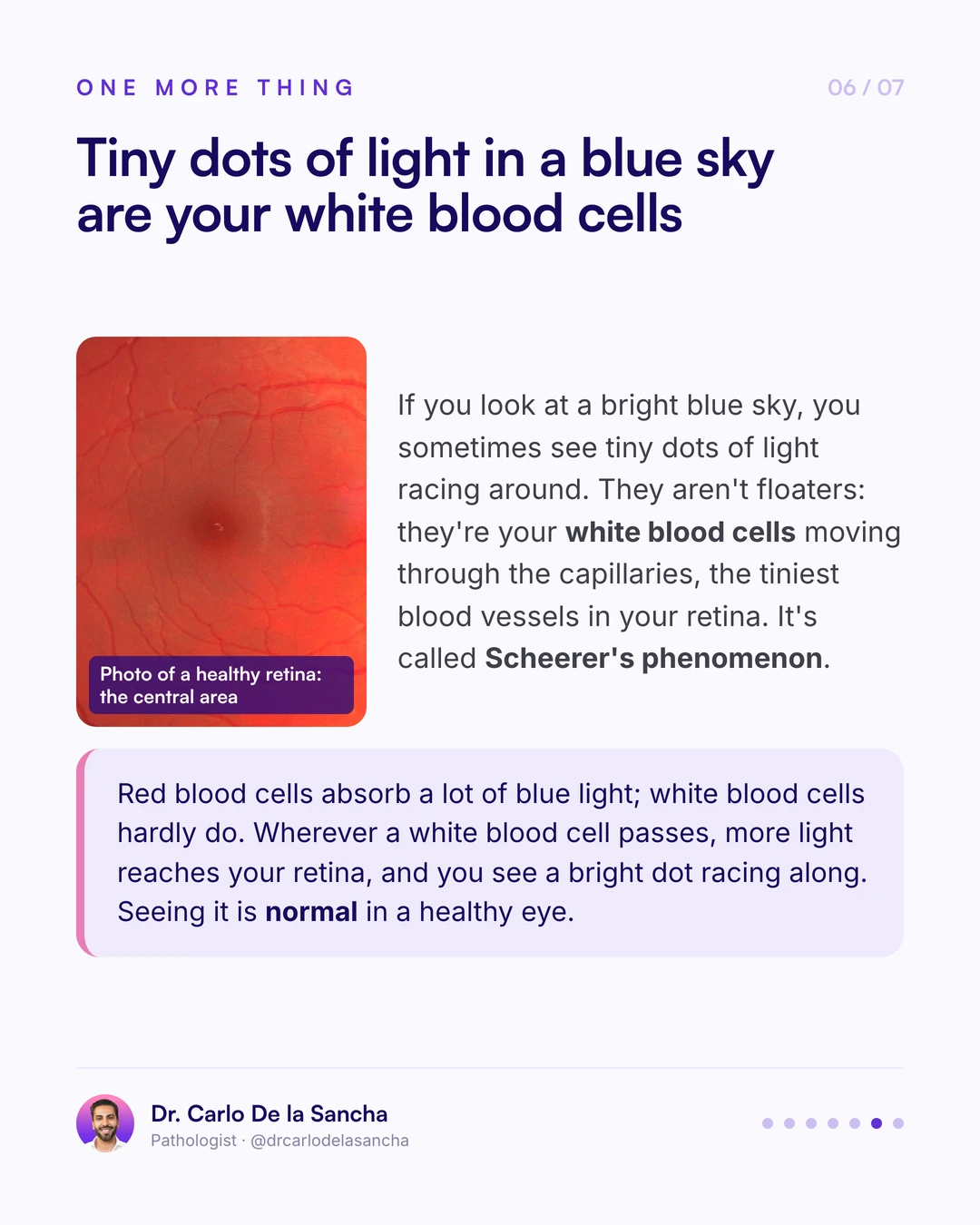
  • One more thing 06 / 07 Tiny dots of light in a blue sky are your white blood cells Photo of a healthy retina: the central area If you look at a bright blue sky, you sometimes see tiny dots of light racing around. They aren't floaters: they're your white blood cells moving through the capillaries, the tiniest blood vessels in your retina. It's called Scheerer's phenomenon. Red blood cells absorb a lot of blue light; white blood cells hardly do. Wherever a white blood cell passes, more light reaches your retina, and you see a bright dot racing along. Seeing it is normal in a healthy eye. Dr. Carlo De la Sancha Pathologist · @drcarlodelasancha
  • What this means for you 07 / 07 Your familiar floaters are your eye aging normally If your floaters are familiar and aren't changing, they almost never need treatment. A new floater that appears and doesn't go away, with no flashes or dark curtain, isn't an emergency, but get it checked: book a visit with your ophthalmologist. Go that same day to an ophthalmologist or the ER for a sudden shower of new floaters, flashes, a dark curtain over part of your vision, or sudden blurry vision: a retinal tear can warn you this way, and treating it early protects your sight. If you've already been checked for those signs, don't skip your follow-up visits: a tear can still show up weeks later. Sources: National Eye Institute, 2024. American Academy of Ophthalmology, 2026. Milston R et al., Surv Ophthalmol 2016 (PMID 26679984). Steel DH, Lotery AJ, Eye 2013 (PMID 24108069). Hollands H et al., JAMA 2009 (PMID 19934426). Ramovecchi P et al., World J Exp Med 2021 (PMID 34141604). Dunsky IL, Optom Vis Sci 1990 (PMID 2082237). Maram et al., Indian J Ophthalmol 2017 (PMID 28573987). Sinclair SH et al., Invest Ophthalmol Vis Sci 1989 (PMID 2703307). Potter JW, Norden LC, J Am Optom Assoc 1983 (PMID 6655191). Images: fundus, Dr. Stephan Kaut, CC0; cross-section, original drawing; vitreous over the years, original drawing; floater simulation (modified), Belbury, CC BY 4.0; turning eye, original drawing; vitreous pulling away, original drawing; macula, Dr. Stephan Kaut, CC0. Dr. Carlo De la Sancha Pathologist · @drcarlodelasancha
  • Want to understand your body? Subscribe to my newsletter: drcarlodelasancha.com/en/newsletter Save it, share it and follow me → @drcarlodelasancha Educational content. Not a substitute for a visit to your doctor.

Know someone who would find this helpful?

Share it with them.