

YOUR BODY · SLIDE BY SLIDE

A cyst from a dog parasite, in her cerebellum

She had headaches and dizziness; under the microscope, the parasite's tiny heads were inside.

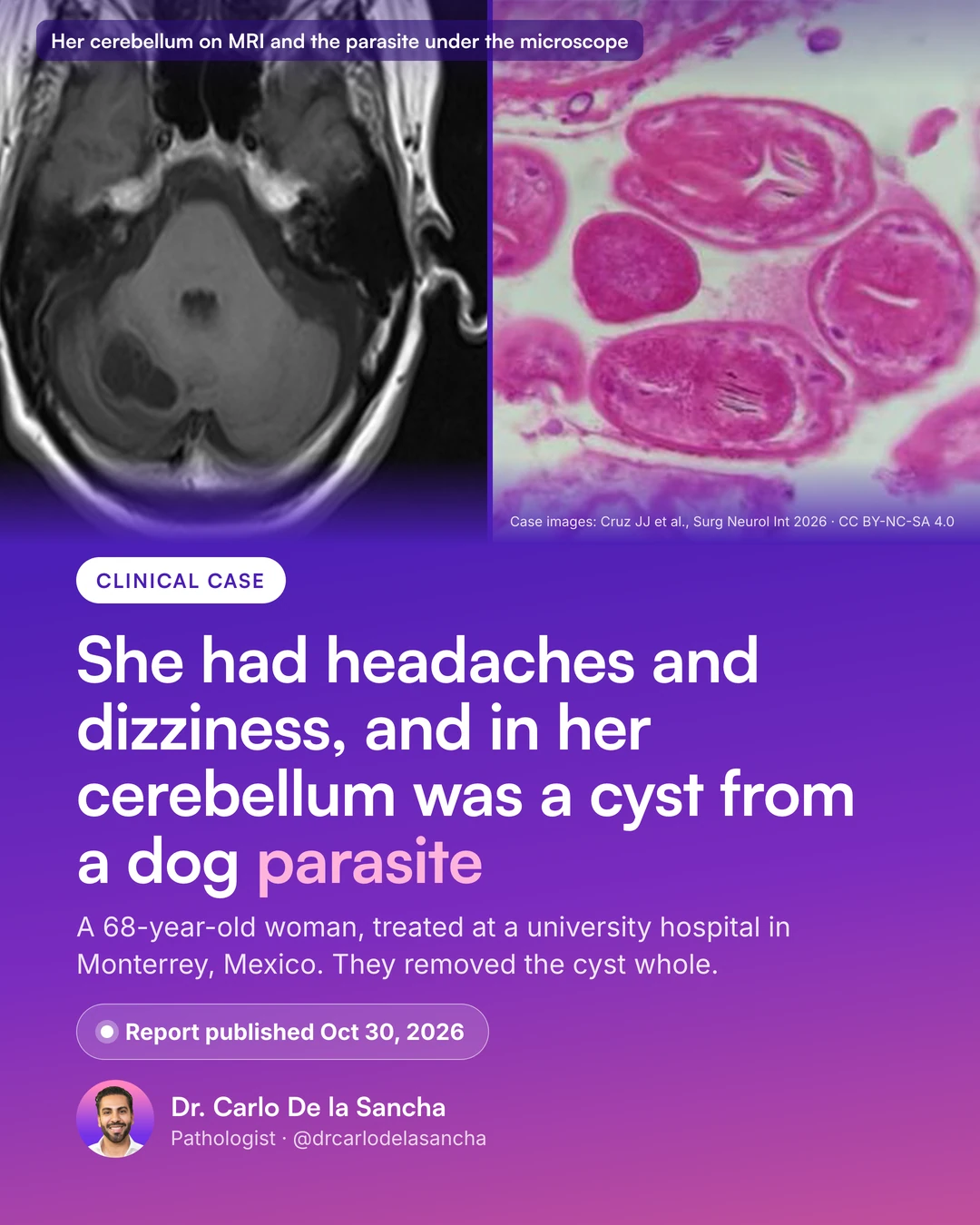
  • Her cerebellum on MRI and the parasite under the microscope Case images: Cruz JJ et al., Surg Neurol Int 2026 · CC BY-NC-SA 4.0 Clinical case She had headaches and dizziness, and in her cerebellum was a cyst from a dog parasite A 68-year-old woman, treated at a university hospital in Monterrey, Mexico. They removed the cyst whole. Report published Oct 30, 2026 Dr. Carlo De la Sancha Pathologist · @drcarlodelasancha
  • What brought her to the doctor 01 / 06 Months of headaches, dizziness and an unsteady walk For several months, a 68-year-old woman had a throbbing headache (it pulsed like a heartbeat) that kept getting worse, especially in the mornings. She also had nausea, vomiting, vertigo (the feeling that everything is spinning), flashes of light in her vision and sensitivity to light. Keeping her balance while walking got harder and harder. First an otolaryngologist, the ear, nose and throat specialist, examined her and ruled out her ear as the source of the vertigo. So next, they took images of her head. Dr. Carlo De la Sancha Pathologist · @drcarlodelasancha
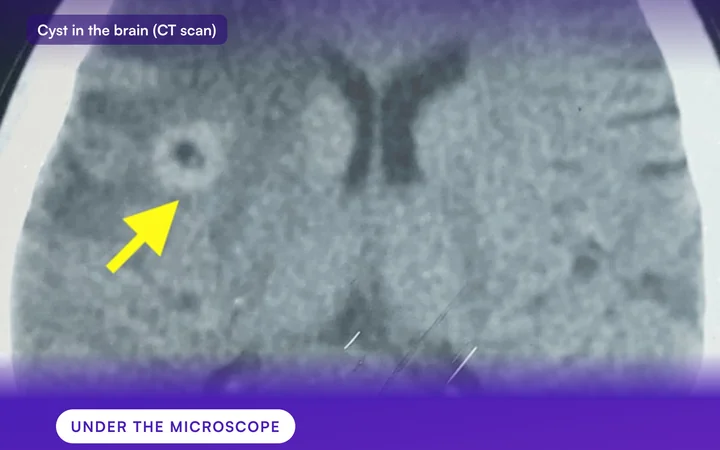
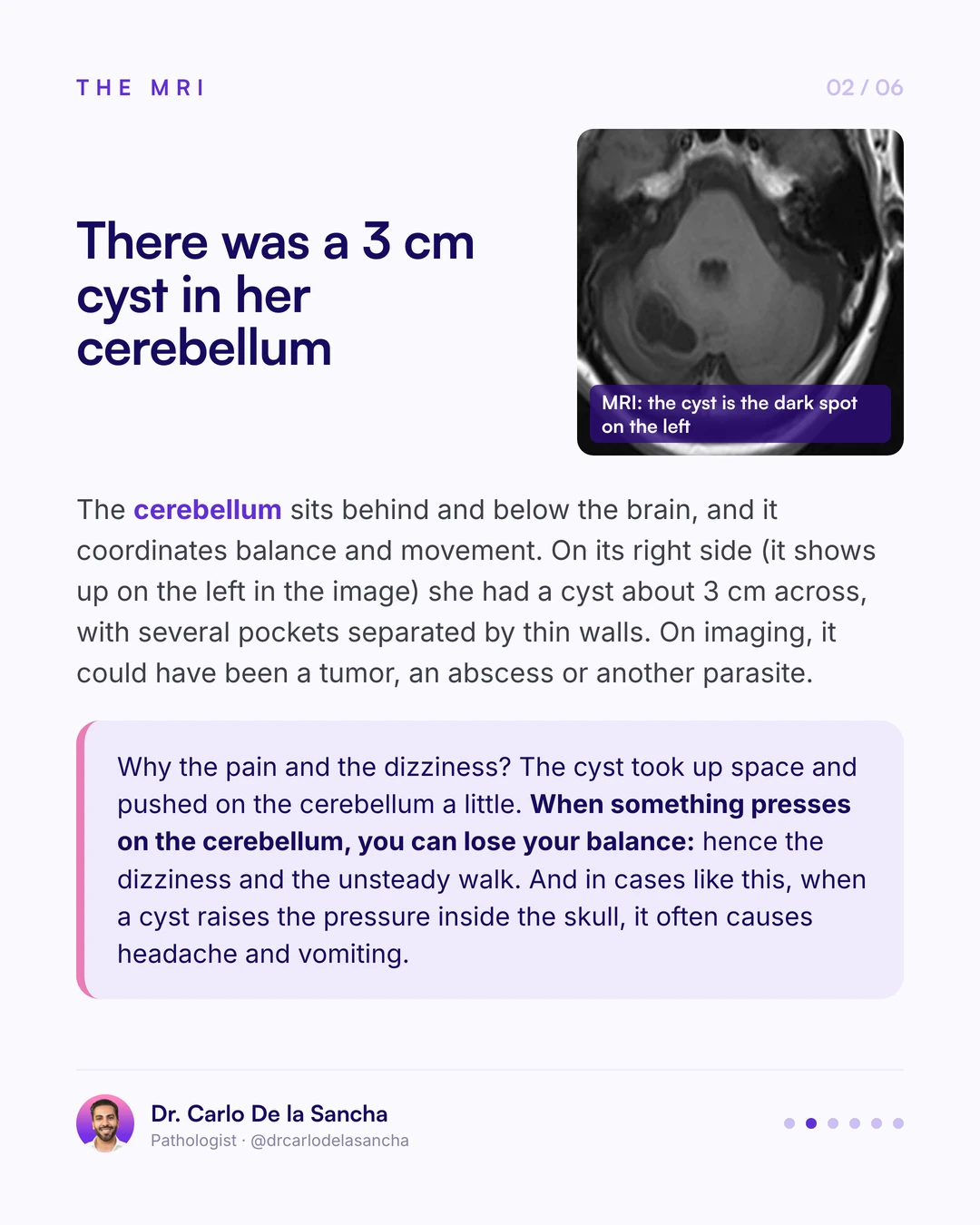
  • The MRI 02 / 06 There was a 3 cm cyst in her cerebellum MRI: the cyst is the dark spot on the left The cerebellum sits behind and below the brain, and it coordinates balance and movement. On its right side (it shows up on the left in the image) she had a cyst about 3 cm across, with several pockets separated by thin walls. On imaging, it could have been a tumor, an abscess or another parasite. Why the pain and the dizziness? The cyst took up space and pushed on the cerebellum a little. When something presses on the cerebellum, you can lose your balance: hence the dizziness and the unsteady walk. And in cases like this, when a cyst raises the pressure inside the skull, it often causes headache and vomiting. Dr. Carlo De la Sancha Pathologist · @drcarlodelasancha
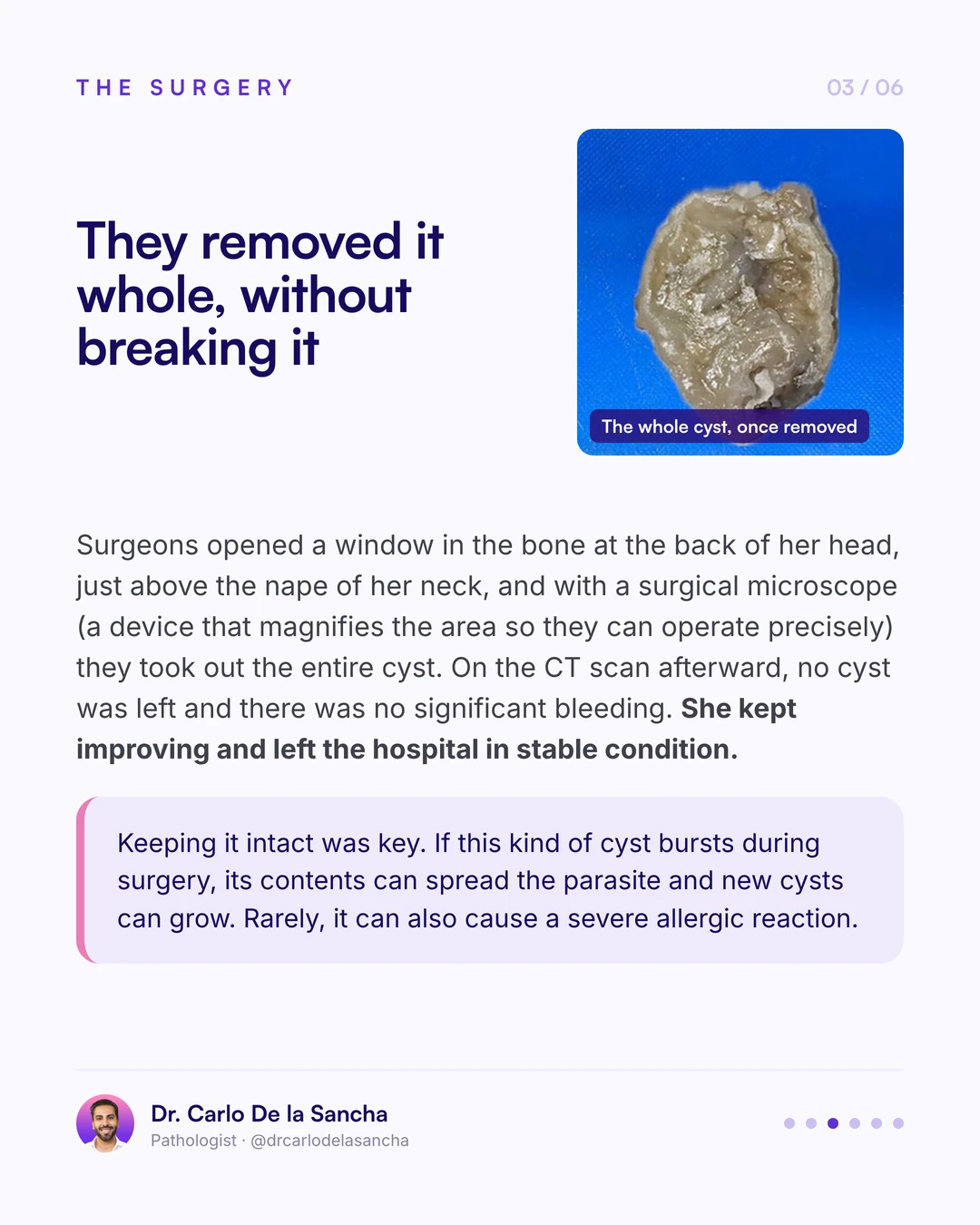
  • The surgery 03 / 06 They removed it whole, without breaking it The whole cyst, once removed Surgeons opened a window in the bone at the back of her head, just above the nape of her neck, and with a surgical microscope (a device that magnifies the area so they can operate precisely) they took out the entire cyst. On the CT scan afterward, no cyst was left and there was no significant bleeding. She kept improving and left the hospital in stable condition. Keeping it intact was key. If this kind of cyst bursts during surgery, its contents can spread the parasite and new cysts can grow. Rarely, it can also cause a severe allergic reaction. Dr. Carlo De la Sancha Pathologist · @drcarlodelasancha
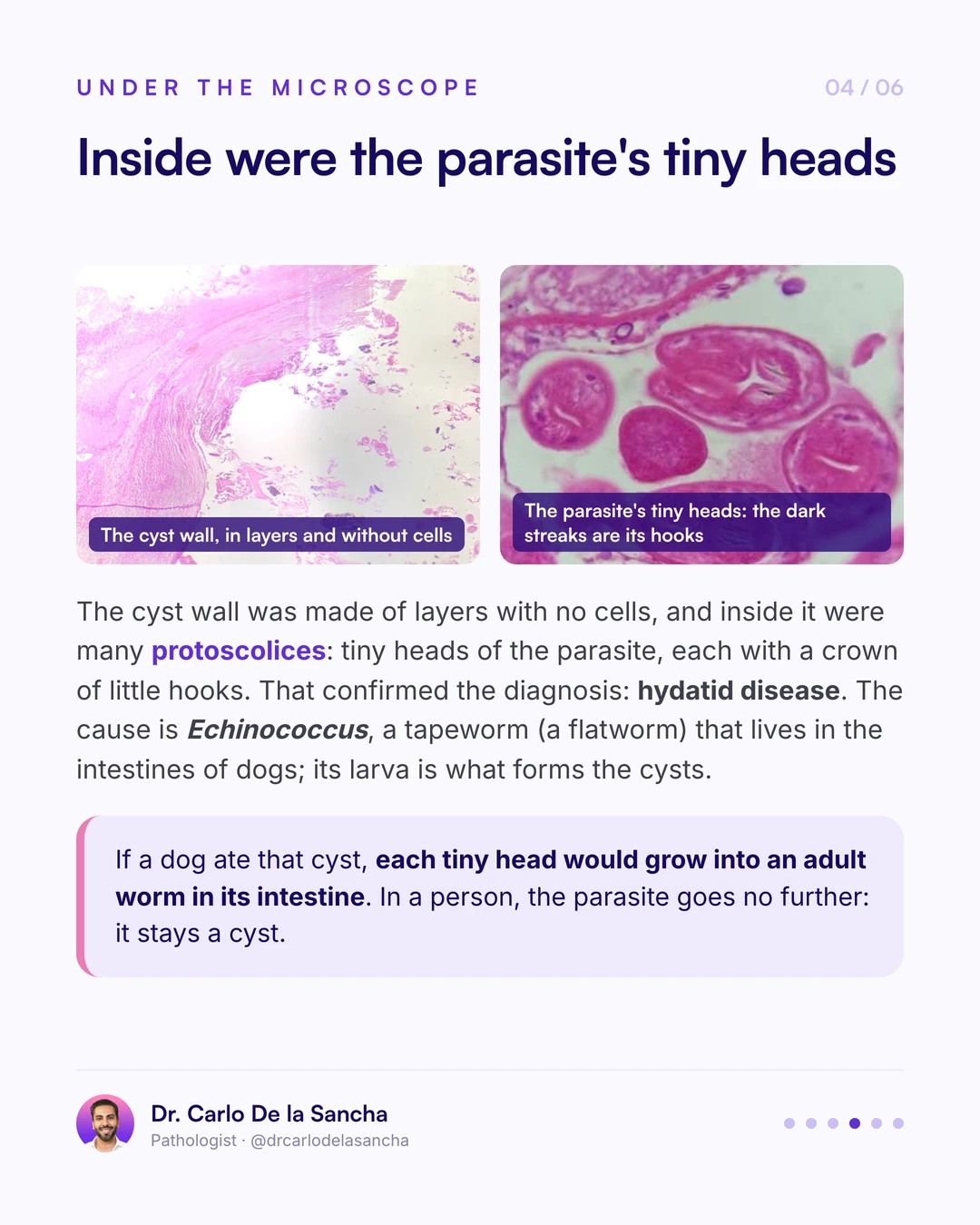
  • Under the microscope 04 / 06 Inside were the parasite's tiny heads The cyst wall, in layers and without cells The parasite's tiny heads: the dark streaks are its hooks The cyst wall was made of layers with no cells, and inside it were many protoscolices: tiny heads of the parasite, each with a crown of little hooks. That confirmed the diagnosis: hydatid disease. The cause is Echinococcus, a tapeworm (a flatworm) that lives in the intestines of dogs; its larva is what forms the cysts. If a dog ate that cyst, each tiny head would grow into an adult worm in its intestine. In a person, the parasite goes no further: it stays a cyst. Dr. Carlo De la Sancha Pathologist · @drcarlodelasancha
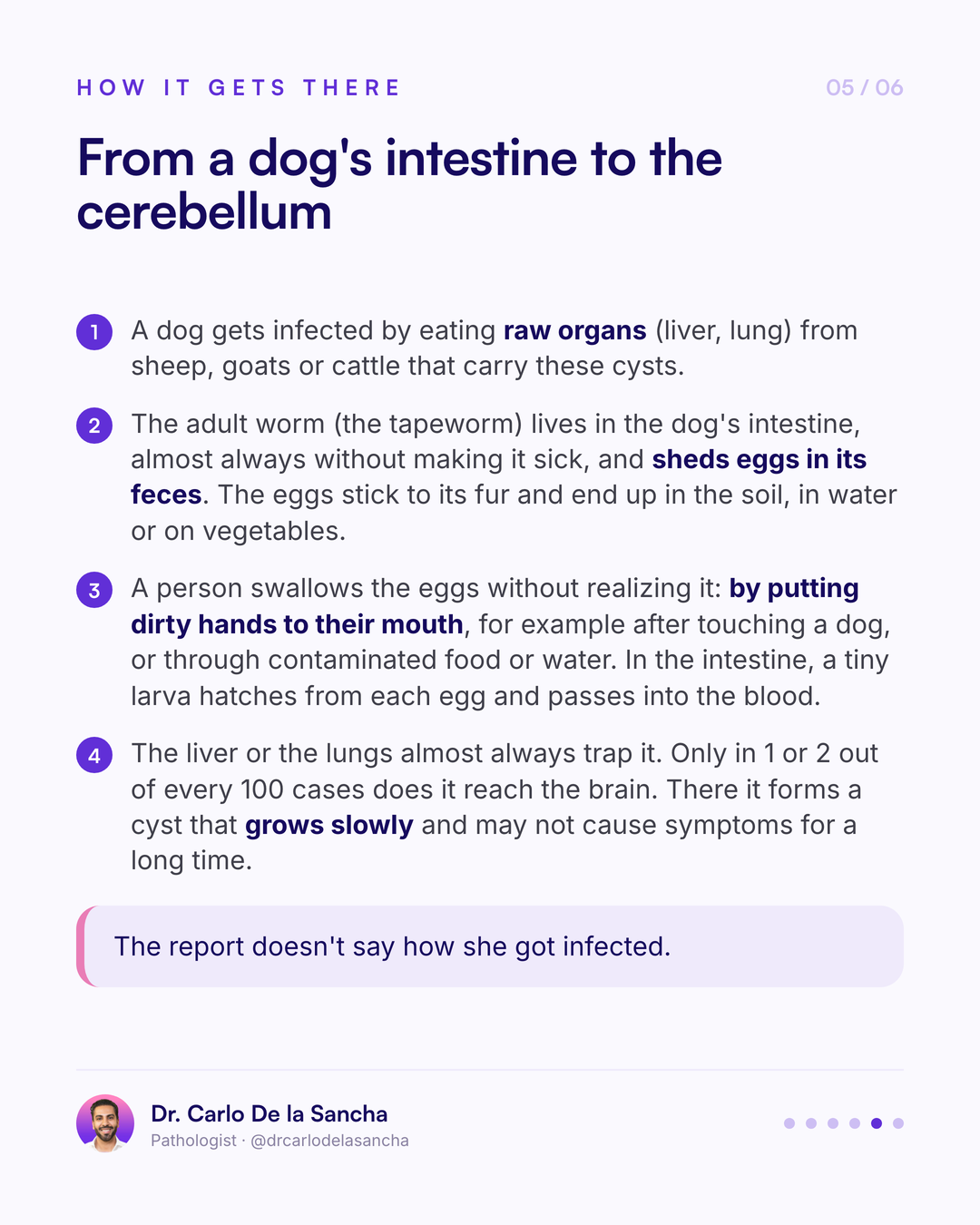
  • How it gets there 05 / 06 From a dog's intestine to the cerebellum A dog gets infected by eating raw organs (liver, lung) from sheep, goats or cattle that carry these cysts. The adult worm (the tapeworm) lives in the dog's intestine, almost always without making it sick, and sheds eggs in its feces. The eggs stick to its fur and end up in the soil, in water or on vegetables. A person swallows the eggs without realizing it: by putting dirty hands to their mouth, for example after touching a dog, or through contaminated food or water. In the intestine, a tiny larva hatches from each egg and passes into the blood. The liver or the lungs almost always trap it. Only in 1 or 2 out of every 100 cases does it reach the brain. There it forms a cyst that grows slowly and may not cause symptoms for a long time. The report doesn't say how she got infected. Dr. Carlo De la Sancha Pathologist · @drcarlodelasancha
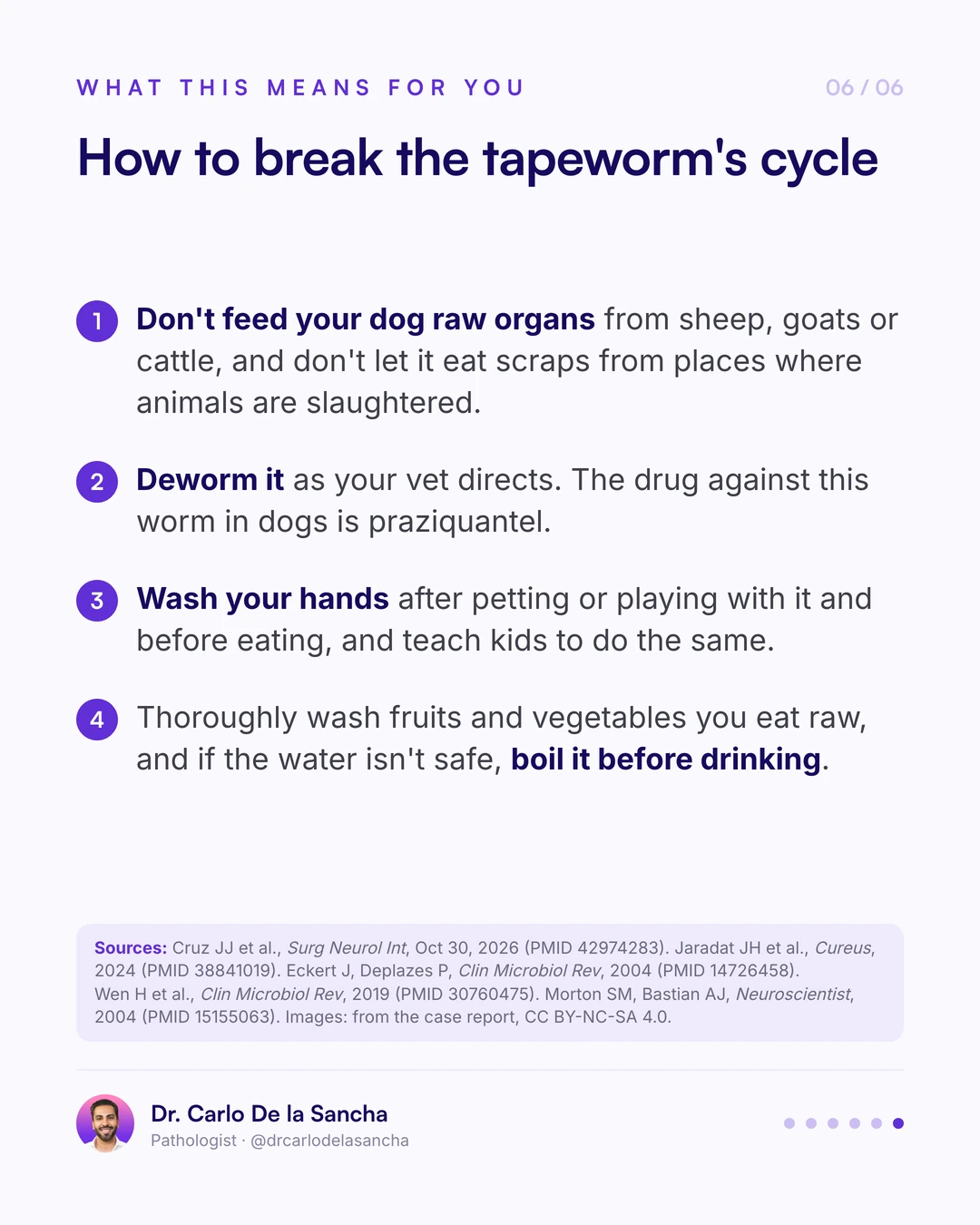
  • What this means for you 06 / 06 How to break the tapeworm's cycle Don't feed your dog raw organs from sheep, goats or cattle, and don't let it eat scraps from places where animals are slaughtered. Deworm it as your vet directs. The drug against this worm in dogs is praziquantel. Wash your hands after petting or playing with it and before eating, and teach kids to do the same. Thoroughly wash fruits and vegetables you eat raw, and if the water isn't safe, boil it before drinking. Sources: Cruz JJ et al., Surg Neurol Int, Oct 30, 2026 (PMID 42974283). Jaradat JH et al., Cureus, 2024 (PMID 38841019). Eckert J, Deplazes P, Clin Microbiol Rev, 2004 (PMID 14726458). Wen H et al., Clin Microbiol Rev, 2019 (PMID 30760475). Morton SM, Bastian AJ, Neuroscientist, 2004 (PMID 15155063). Images: from the case report, CC BY-NC-SA 4.0. Dr. Carlo De la Sancha Pathologist · @drcarlodelasancha
  • Want to understand your body? Subscribe to my newsletter: drcarlodelasancha.com/en/newsletter Save it, share it and follow me → @drcarlodelasancha Educational content. Not a substitute for a visit to your doctor.

Know someone who would find this helpful?

Share it with them.