
YOUR BODY · SLIDE BY SLIDE

What you see sharply fits behind your thumbnail at arm's length

How your brain builds everything else, in four steps.

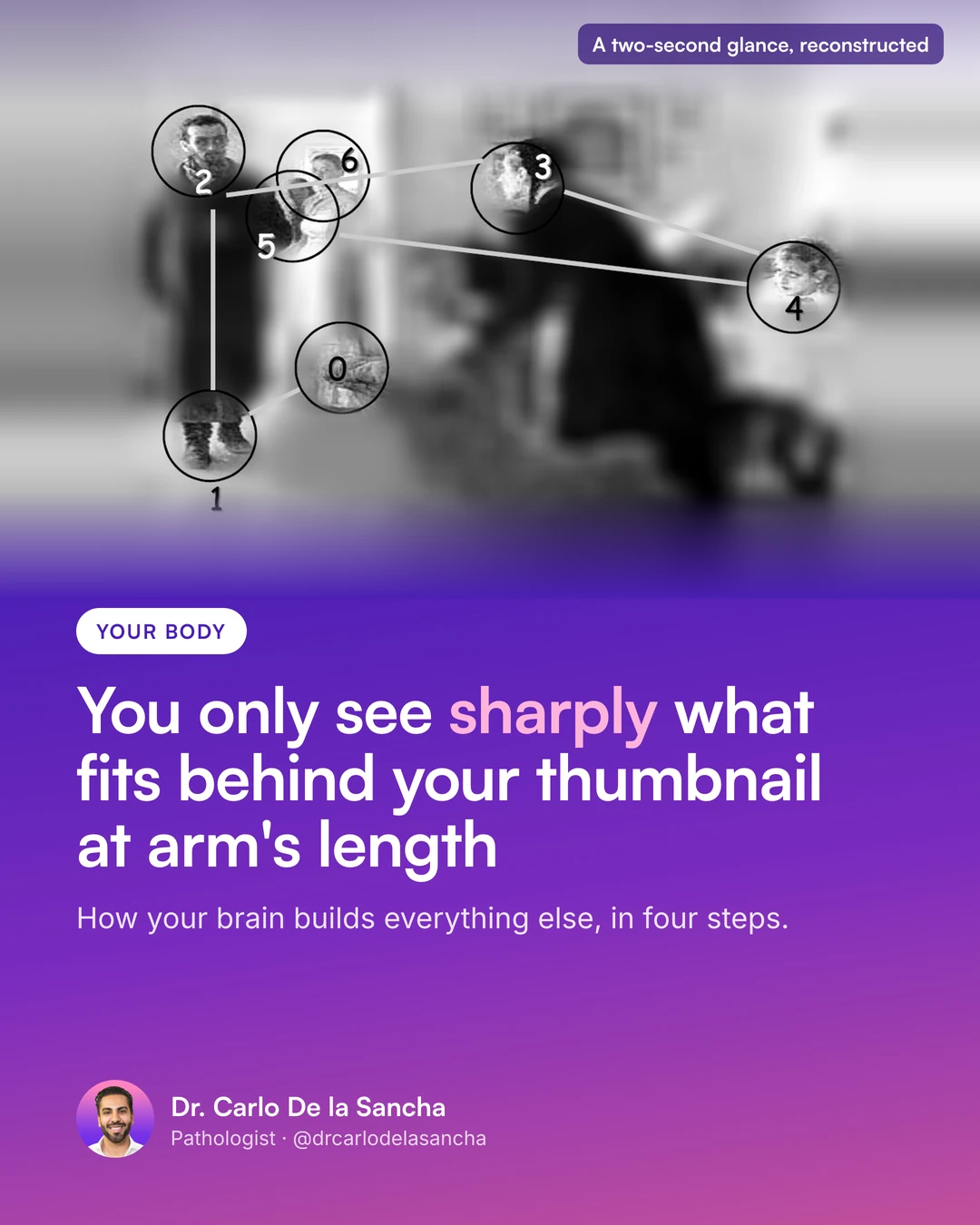
  • A two-second glance, reconstructed Your body You only see sharply what fits behind your thumbnail at arm's length How your brain builds everything else, in four steps. Dr. Carlo De la Sancha Pathologist · @drcarlodelasancha
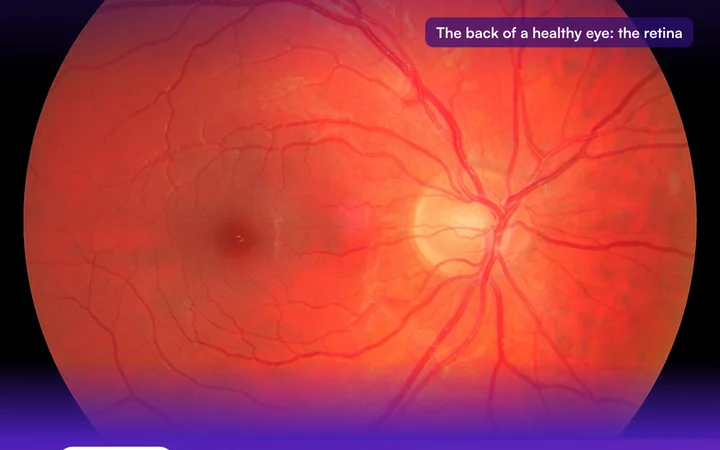
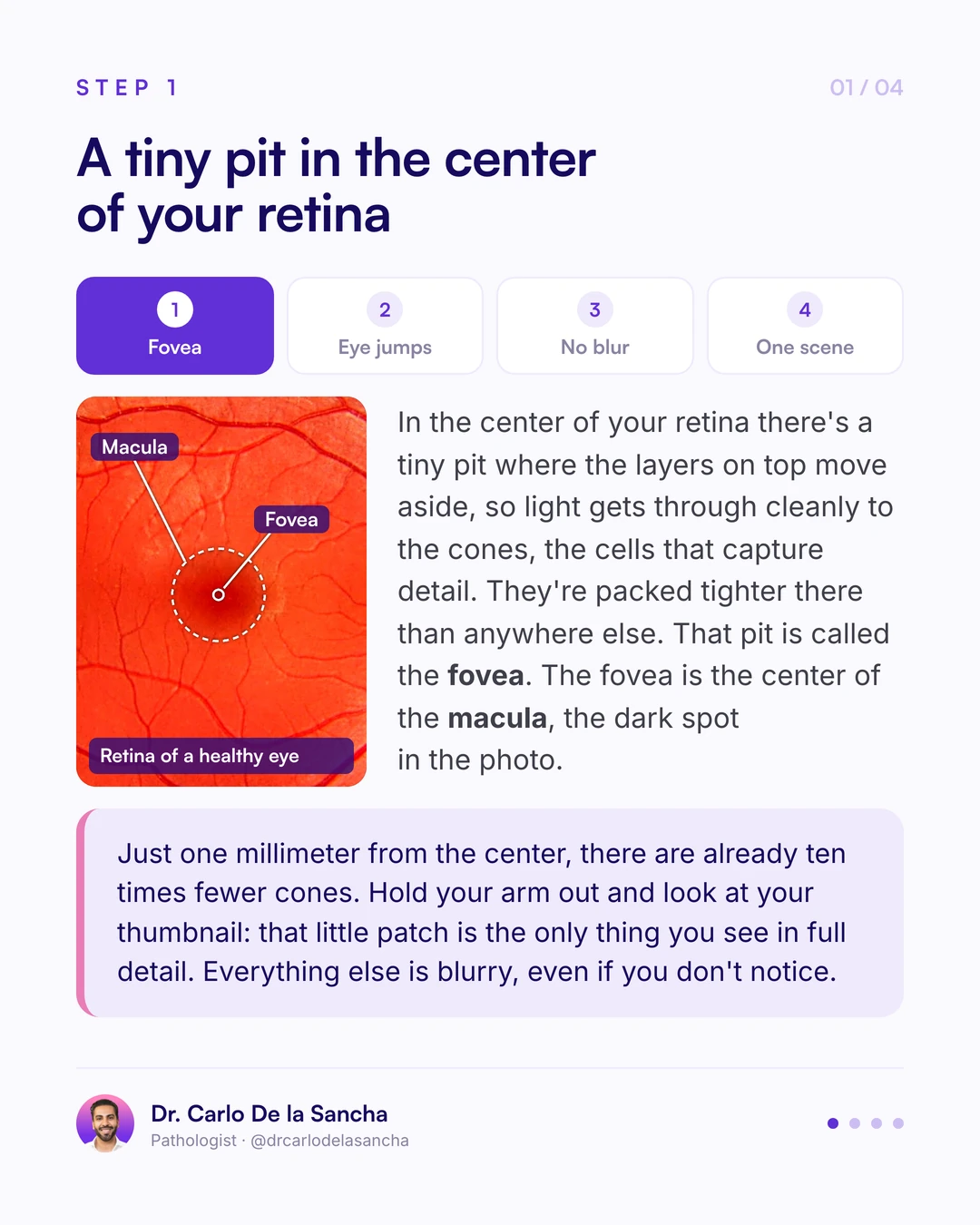
  • Step 1 01 / 04 A tiny pit in the center of your retina Fovea Eye jumps No blur One scene Retina of a healthy eye In the center of your retina there's a tiny pit where the layers on top move aside, so light gets through cleanly to the cones, the cells that capture detail. They're packed tighter there than anywhere else. That pit is called the fovea. The fovea is the center of the macula, the dark spot in the photo. Just one millimeter from the center, there are already ten times fewer cones. Hold your arm out and look at your thumbnail: that little patch is the only thing you see in full detail. Everything else is blurry, even if you don't notice. Dr. Carlo De la Sancha Pathologist · @drcarlodelasancha
  • Steps 2 and 3 02 / 04 Your eyes jump about three times a second Fovea Eye jumps No blur One scene Stare at your thumbnail and, without moving your eyes, try to read a word off to one side. You can't: outside that little patch, everything looks blurry. That's why your eyes jump about three times a second, to bring your fovea to what matters to you: a face, a word, a hand. If you saw during each jump, it would be like whipping a camera around: everything would look smeared. Your brain turns down the volume on whatever comes in at that instant, and that's why you don't notice it. Dr. Carlo De la Sancha Pathologist · @drcarlodelasancha
  • Step 4 03 / 04 Your brain joins the pieces Fovea Eye jumps No blur One scene Before each jump of your eyes, your brain anticipates what's about to change, and then it combines what your fovea saw before with what it sees after. That way, out of many small sharp pieces, it builds you a single scene, stable and continuous. It sounds like a flaw that so little is sharp, and it's just the opposite. Your brain devotes much more space to the center of your vision than to the edges: that way it packs the detail where your fovea lands, and your eyes aim it at what matters. Dr. Carlo De la Sancha Pathologist · @drcarlodelasancha
  • What helps you 04 / 04 Protect your central vision Your fovea is in the center of the macula, the area of your sharp vision. To check it, cover one eye and look at a door frame; then switch eyes. If the frame looks wavy, blurry or has a gap in it, see your ophthalmologist right away: if it's wet macular degeneration, there are treatments that can slow or stop the vision loss. Macular degeneration starts with no symptoms and is more common after 55: ask your doctor how often to get your eyes checked. If you smoke, quit: smoking raises your risk of macular damage. Sources: Curcio 1990 (PMID 2324310). O'Shea 1991 (PMID 1762884). Bringmann 2018 (PMID 29609042). Wismeijer 2012 (PMID 22366079). Binda 2018 (PMID 30222534). Himmelberg 2022 (PMID 35697680). Benson 2021 (PMID 34342581). National Eye Institute; American Academy of Ophthalmology. Images: gaze path, Hans-Werner Hunziker, CC BY 3.0; fundus photo, Mikael Häggström, CC0. Dr. Carlo De la Sancha Pathologist · @drcarlodelasancha
  • Want to understand your body? Subscribe to my newsletter: drcarlodelasancha.com/en/newsletter Save it, share it and follow me → @drcarlodelasancha Educational content. Not a substitute for a visit to your doctor.

Know someone who would find this helpful?

Share it with them.