
YOUR BODY · SLIDE BY SLIDE

You read in the car and get carsick; the driver almost never does

How your brain decides if you get carsick, in four steps.

  • A human otolith, under the microscope Your balance You read in the car and get carsick. The driver? Almost never. How your brain decides if you get carsick, in four steps. Dr. Carlo De la Sancha Pathologist · @drcarlodelasancha
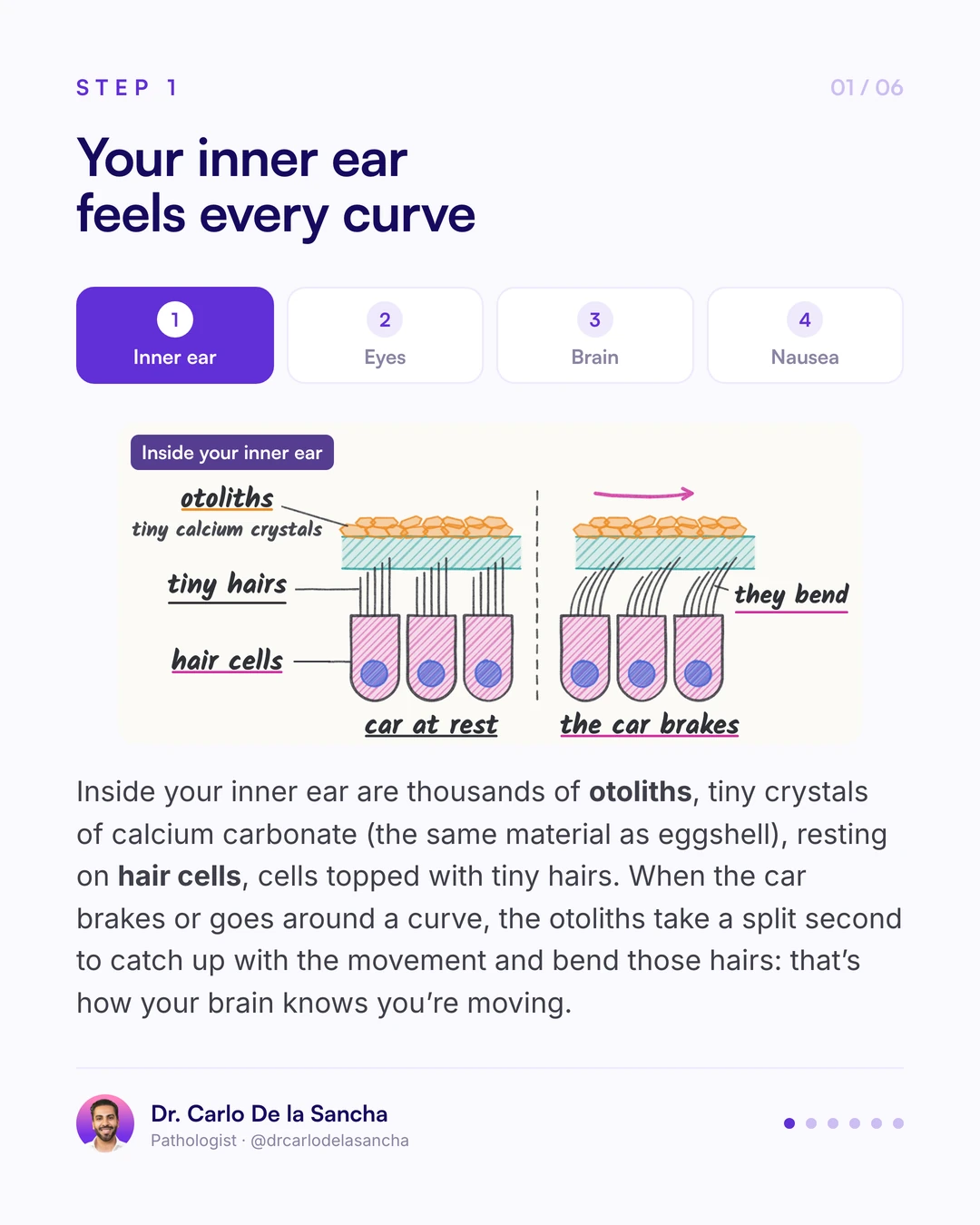
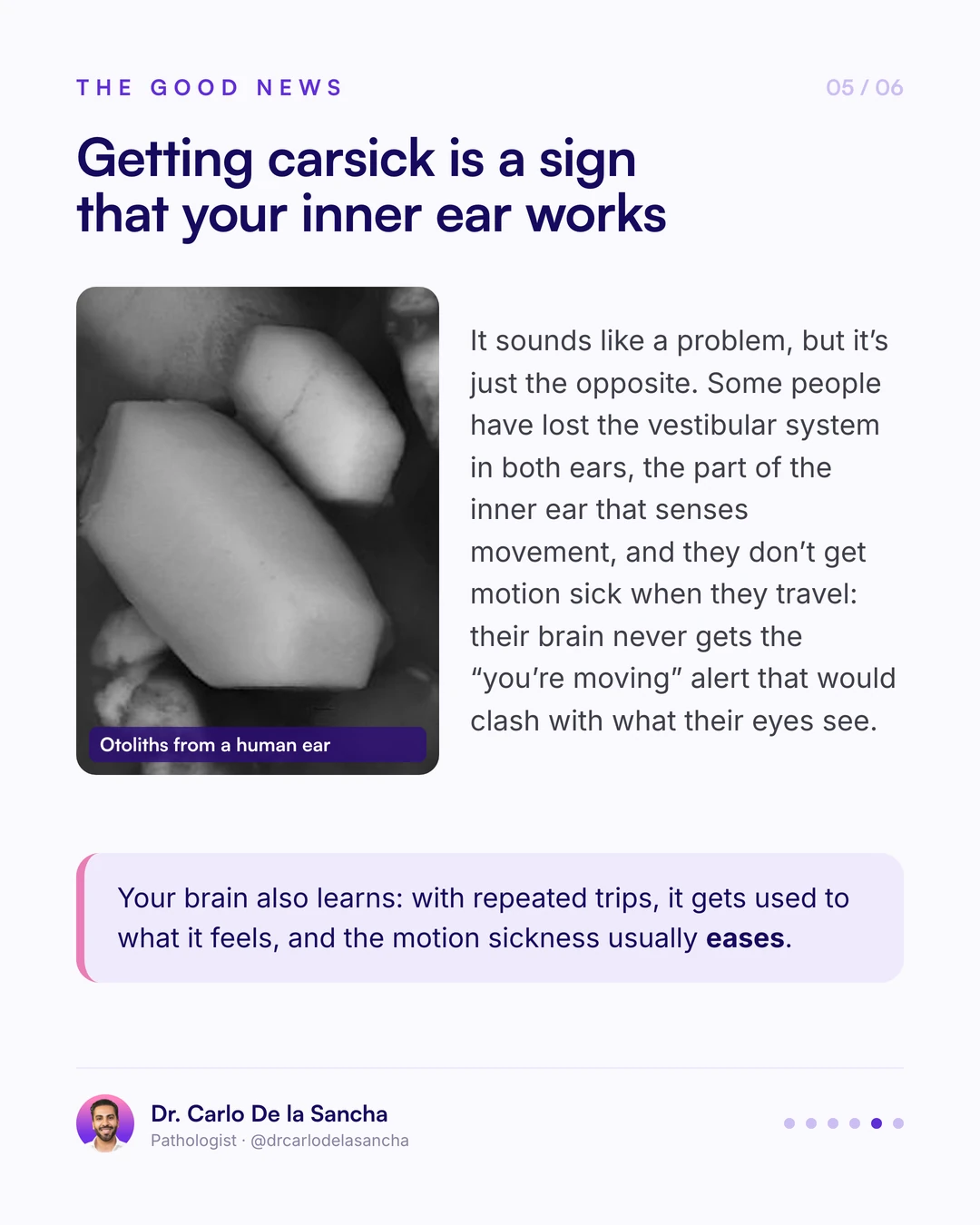
  • Step 1 01 / 06 Your inner ear feels every curve 1 Inner ear 2 Eyes 3 Brain 4 Nausea Inside your inner ear Inside your inner ear are thousands of otoliths, tiny crystals of calcium carbonate (the same material as eggshell), resting on hair cells, cells topped with tiny hairs. When the car brakes or goes around a curve, the otoliths take a split second to catch up with the movement and bend those hairs: that’s how your brain knows you’re moving. Dr. Carlo De la Sancha Pathologist · @drcarlodelasancha
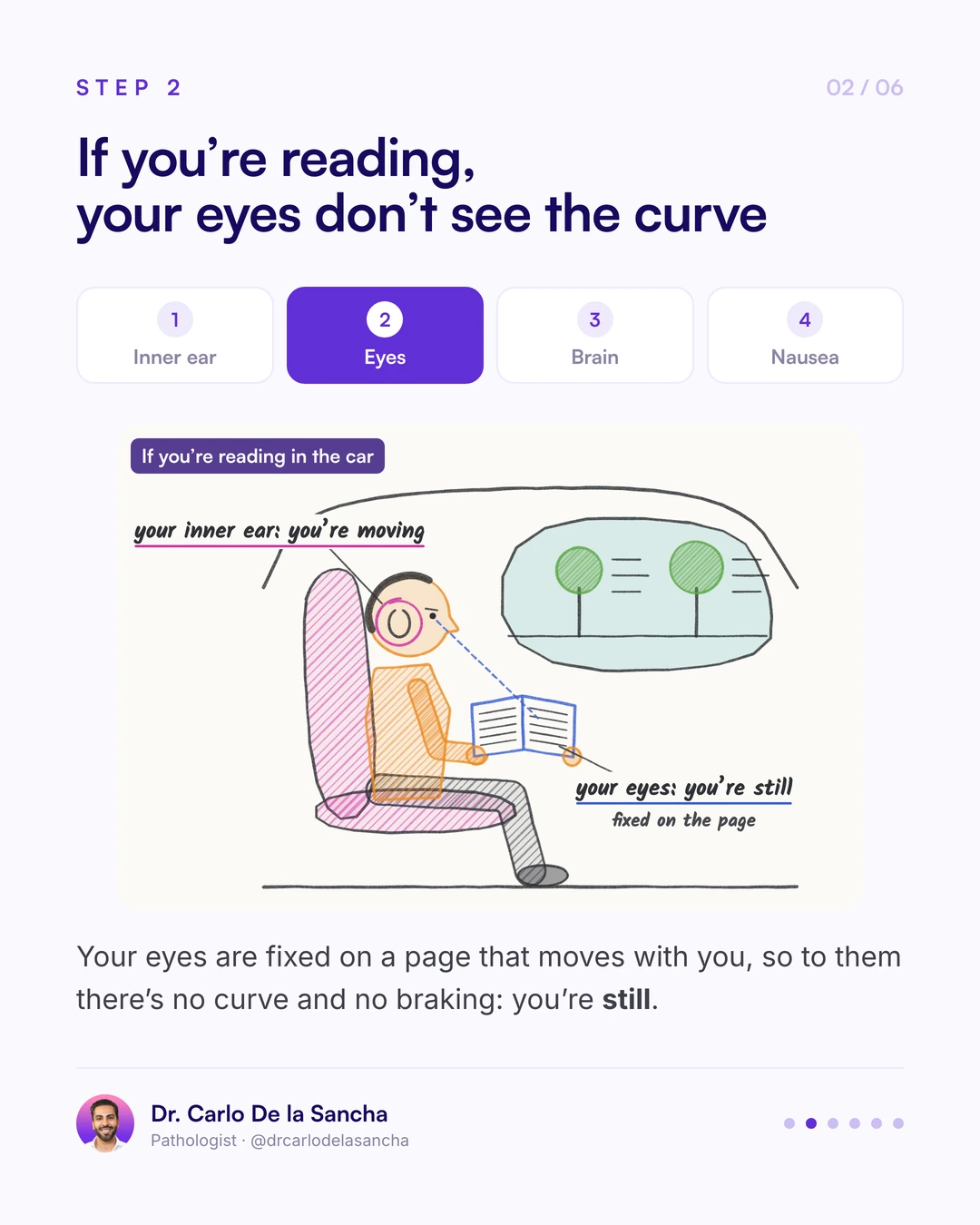
  • Step 2 02 / 06 If you’re reading, your eyes don’t see the curve 1 Inner ear 2 Eyes 3 Brain 4 Nausea If you’re reading in the car Your eyes are fixed on a page that moves with you, so to them there’s no curve and no braking: you’re still. Dr. Carlo De la Sancha Pathologist · @drcarlodelasancha
  • Steps 3 and 4 03 / 06 Your brain can’t make the two signals match 1 Inner ear 2 Eyes 3 Brain 4 Nausea Your brain pulls together what your inner ear, your eyes, your muscles and your joints are telling it. Then it compares that with what experience has taught it to expect. If your inner ear says “you’re moving” and your eyes say “you’re still,” the two stories clash. When the signals clash, motion sickness can set in: first a queasy feeling and cold sweats, then nausea and even vomiting. It’s a normal response of a healthy body. Dr. Carlo De la Sancha Pathologist · @drcarlodelasancha
  • Behind the wheel 04 / 06 The driver knows which curve is coming 1 Inner ear 2 Eyes 3 Brain 4 Nausea The driver decides every bit of braking and every turn of the wheel, so their brain knows what movement is coming before they feel it. When their inner ear reports the curve, the signals do match. Plus, their eyes are on the road, so they see the same movement their inner ear feels. Even their head helps them avoid getting sick: in a curve, the driver tends to tilt it toward the inside, while the passenger’s head goes the other way. Dr. Carlo De la Sancha Pathologist · @drcarlodelasancha
  • The good news 05 / 06 Getting carsick is a sign that your inner ear works Otoliths from a human ear It sounds like a problem, but it’s just the opposite. Some people have lost the vestibular system in both ears, the part of the inner ear that senses movement, and they don’t get motion sick when they travel: their brain never gets the “you’re moving” alert that would clash with what their eyes see. Your brain also learns: with repeated trips, it gets used to what it feels, and the motion sickness usually eases. Dr. Carlo De la Sancha Pathologist · @drcarlodelasancha
  • What helps 06 / 06 Let your eyes see the curve Sit where you can see the road ahead, and watch it: that way your eyes see what your ear feels. Kids under 13 always ride in the back, for safety: have them look forward, between the front seats. Save reading and your phone for when the car stops. If you have to look at it, hold it up at eye level: with your peripheral vision, out of the corner of your eye, you keep seeing the road move and you get less sick. In a curve, tilt your head toward the inside, as drivers do. In one study, passengers who did this got less carsick. If you get sick on every trip, your doctor can recommend a medicine to take before you go; it often makes you drowsy, so don’t drive until you know how it affects you. And if you get dizzy when you’re not moving, tell your doctor: there may be another cause. Sources: Kniep 2017 (PMID 28406968). Bertolini & Straumann 2016 (PMID 26913019). Rolnick & Lubow 1991 (PMID 1915252). Griffin & Newman 2004 (PMID 15460624). Wada 2012 (PMID 22624289). Kuiper 2018 (PMID 29409631). AAP 2018 (PMID 30166368). Gautron 2021 (PMID 33579194). MedlinePlus, NIH. Images: otolith, Kniep R et al., CC BY; otoliths, Kniep R et al., CC BY; otoliths and hair cells, original drawing; reading in the car, original drawing. Dr. Carlo De la Sancha Pathologist · @drcarlodelasancha
  • Want to understand your body? Subscribe to my newsletter: drcarlodelasancha.com/en/newsletter Save it, share it and follow me → @drcarlodelasancha Educational content. Not a substitute for a visit to your doctor.

Know someone who would find this helpful?

Share it with them.