
YOUR BODY · SLIDE BY SLIDE

A brain cyst that looked like a tumor

Under the microscope it was a parasite's larva, and it doesn't get there the way most people think.

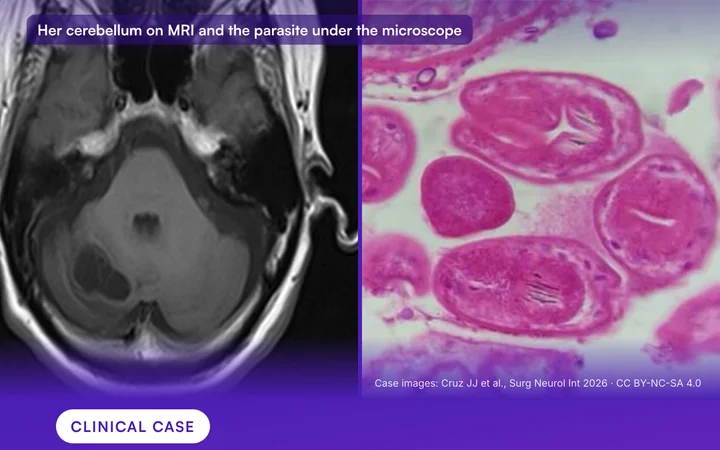
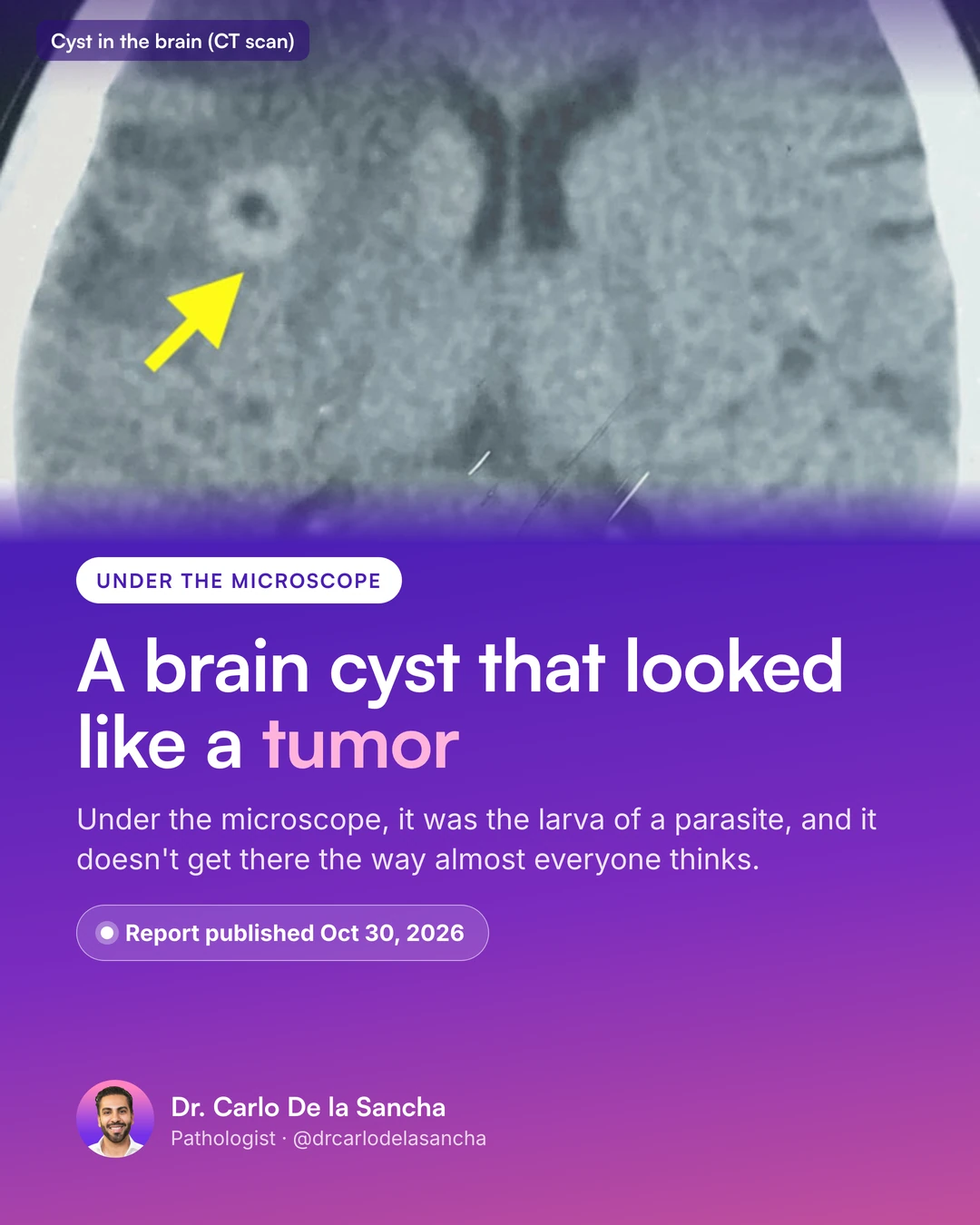
  • Cyst in the brain (CT scan) Under the microscope A brain cyst that looked like a tumor Under the microscope, it was the larva of a parasite, and it doesn't get there the way almost everyone thinks. Report published Oct 30, 2026 Dr. Carlo De la Sancha Pathologist · @drcarlodelasancha
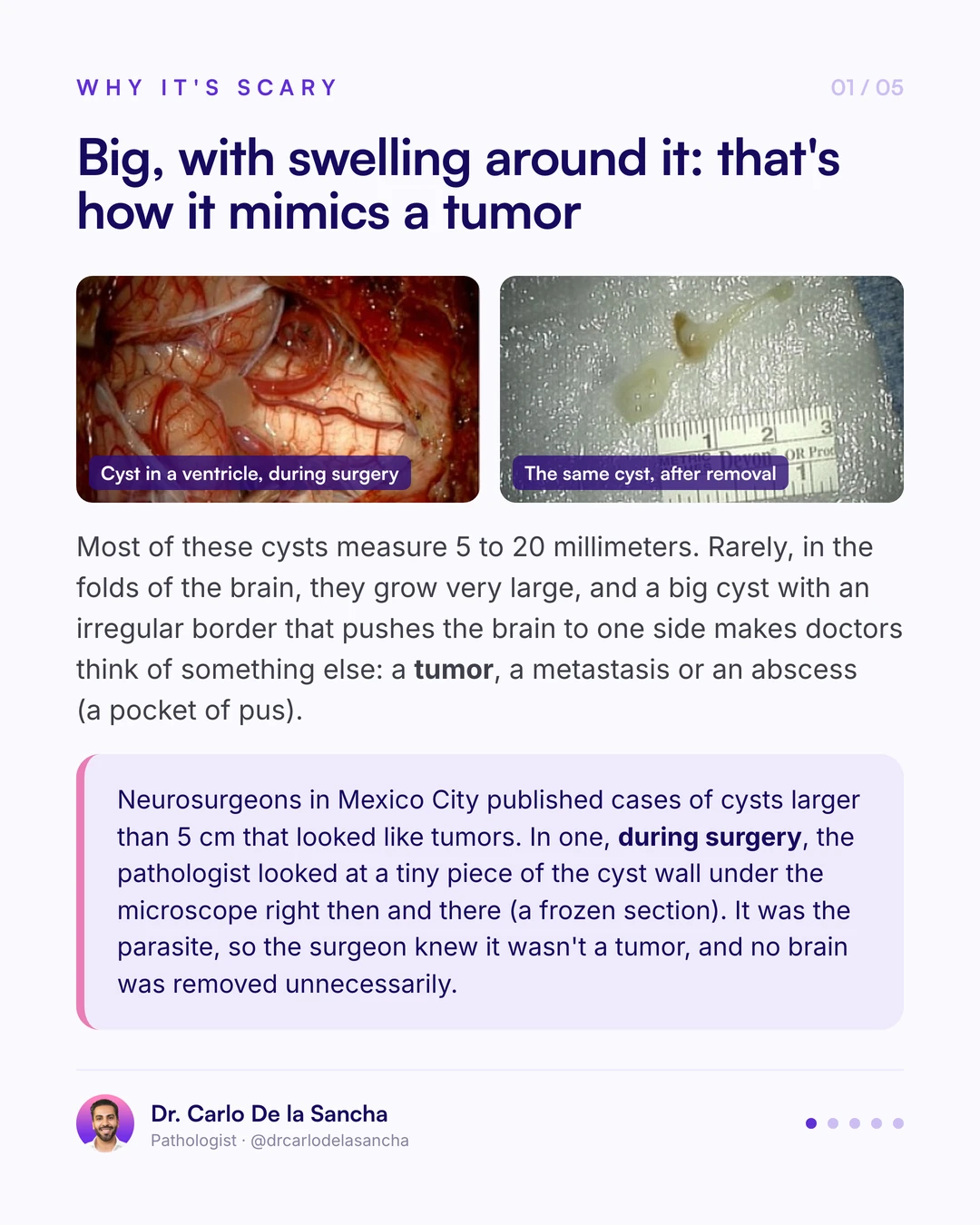
  • Why it's scary 01 / 05 Big, with swelling around it: that's how it mimics a tumor Cyst in a ventricle, during surgery The same cyst, after removal Most of these cysts measure 5 to 20 millimeters. Rarely, in the folds of the brain, they grow very large, and a big cyst with an irregular border that pushes the brain to one side makes doctors think of something else: a tumor, a metastasis or an abscess (a pocket of pus). Neurosurgeons in Mexico City published cases of cysts larger than 5 cm that looked like tumors. In one, during surgery, the pathologist looked at a tiny piece of the cyst wall under the microscope right then and there (a frozen section). It was the parasite, so the surgeon knew it wasn't a tumor, and no brain was removed unnecessarily. Dr. Carlo De la Sancha Pathologist · @drcarlodelasancha
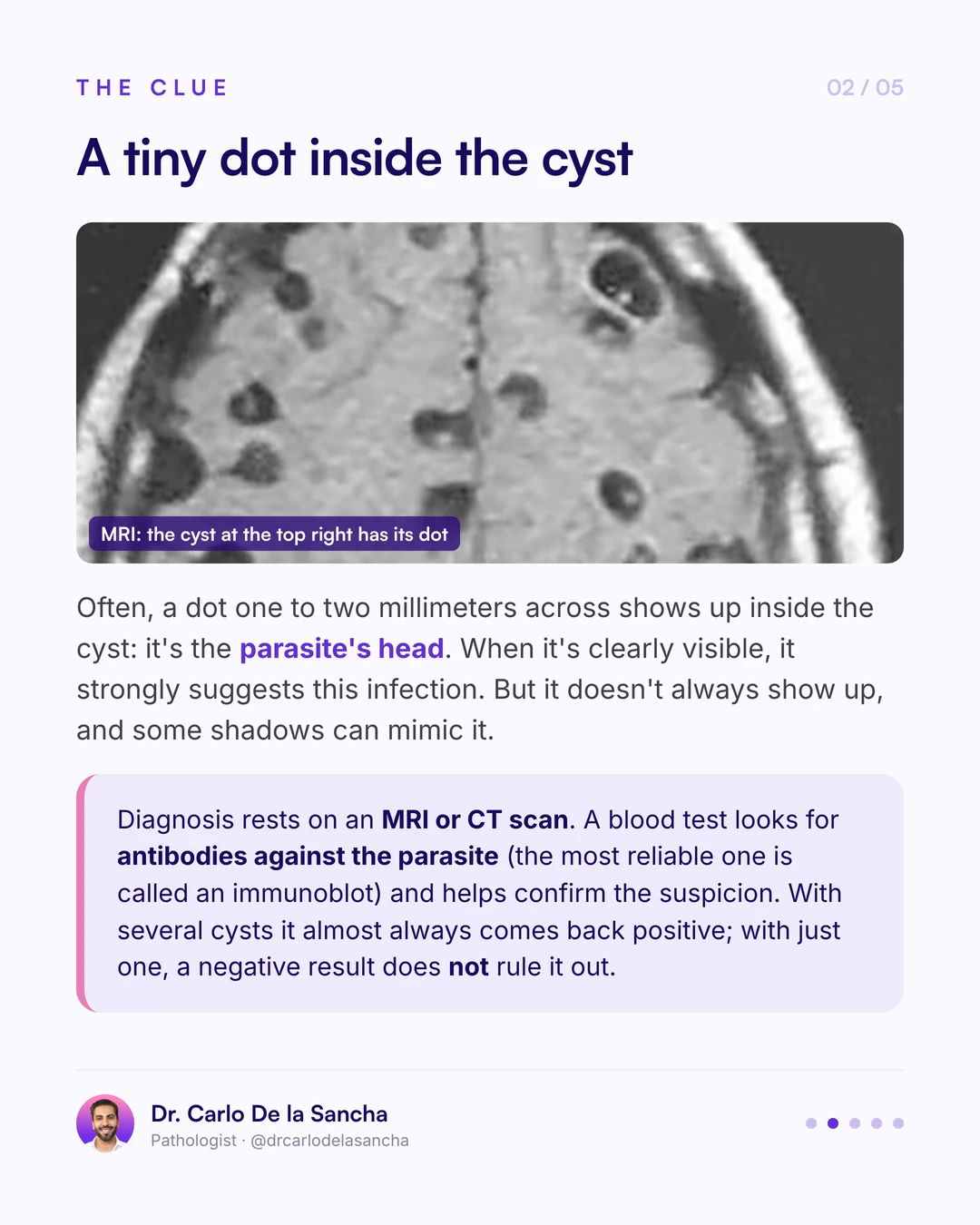
  • The clue 02 / 05 A tiny dot inside the cyst MRI: the cyst at the top right has its dot Often, a dot one to two millimeters across shows up inside the cyst: it's the parasite's head. When it's clearly visible, it strongly suggests this infection. But it doesn't always show up, and some shadows can mimic it. Diagnosis rests on an MRI or CT scan. A blood test looks for antibodies against the parasite (the most reliable one is called an immunoblot) and helps confirm the suspicion. With several cysts it almost always comes back positive; with just one, a negative result does not rule it out. Dr. Carlo De la Sancha Pathologist · @drcarlodelasancha
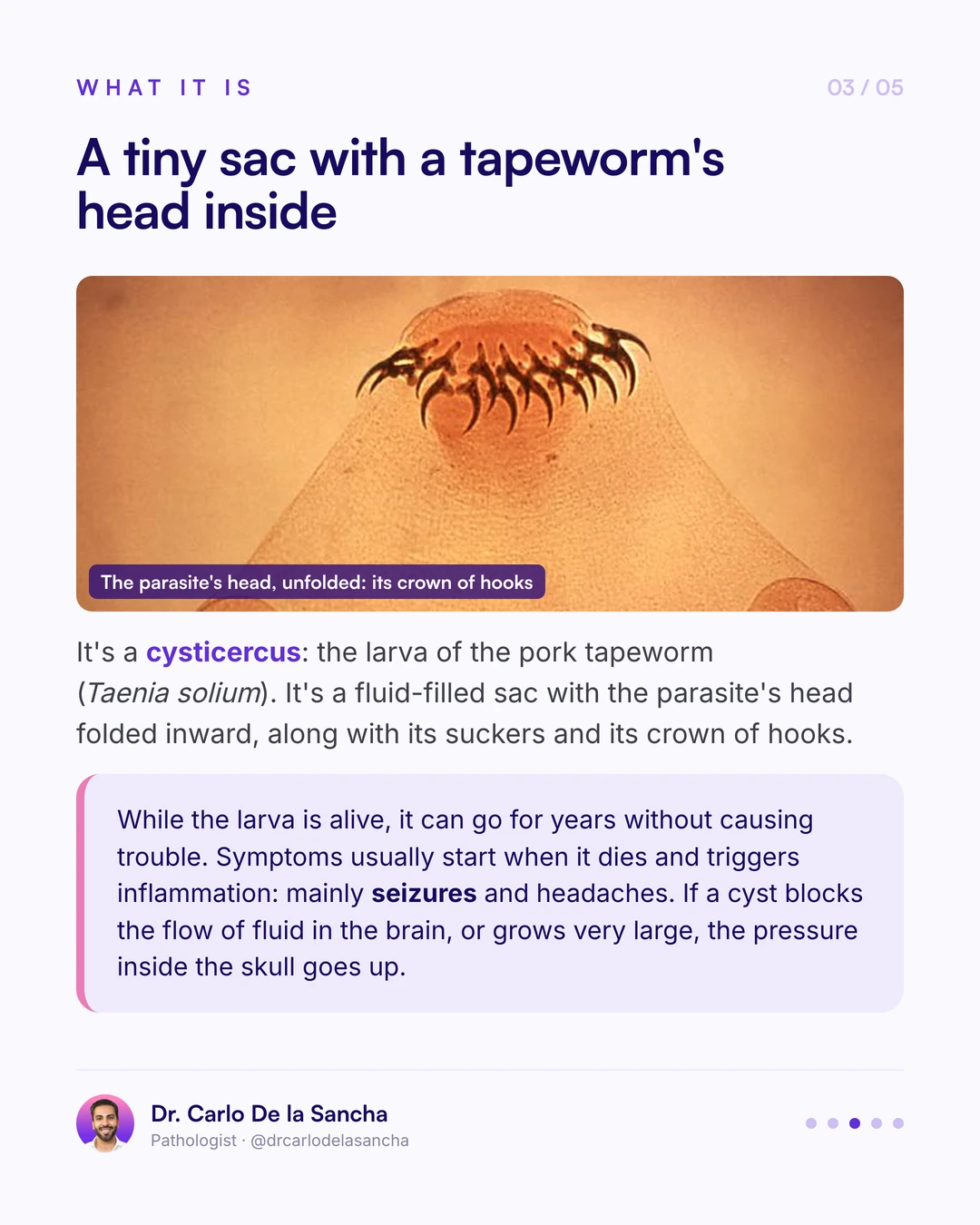
  • What it is 03 / 05 A tiny sac with a tapeworm's head inside The parasite's head, unfolded: its crown of hooks It's a cysticercus: the larva of the pork tapeworm (Taenia solium). It's a fluid-filled sac with the parasite's head folded inward, along with its suckers and its crown of hooks. While the larva is alive, it can go for years without causing trouble. Symptoms usually start when it dies and triggers inflammation: mainly seizures and headaches. If a cyst blocks the flow of fluid in the brain, or grows very large, the pressure inside the skull goes up. Dr. Carlo De la Sancha Pathologist · @drcarlodelasancha
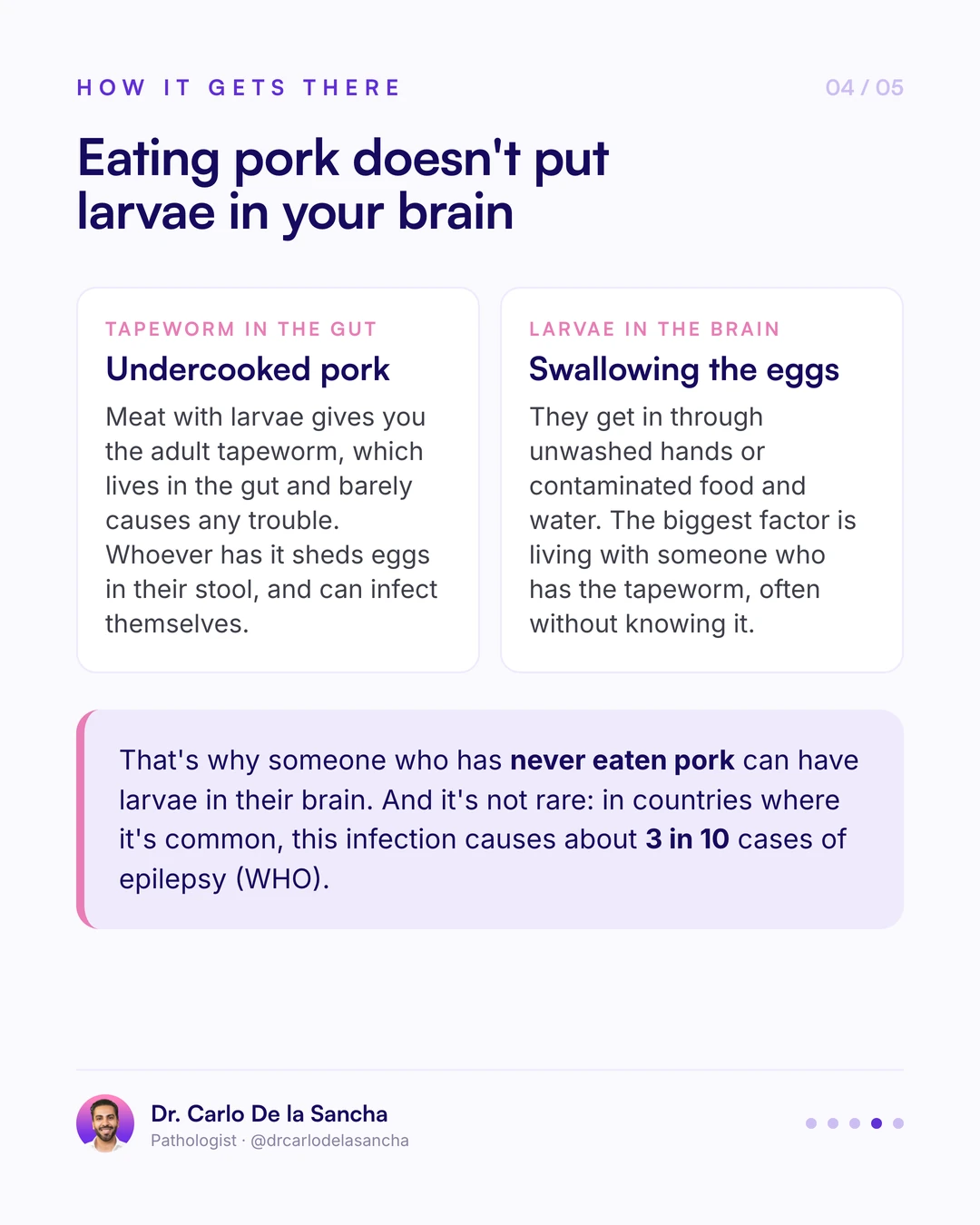
  • How it gets there 04 / 05 Eating pork doesn't put larvae in your brain Tapeworm in the gut Undercooked pork Meat with larvae gives you the adult tapeworm, which lives in the gut and barely causes any trouble. Whoever has it sheds eggs in their stool, and can infect themselves. Larvae in the brain Swallowing the eggs They get in through unwashed hands or contaminated food and water. The biggest factor is living with someone who has the tapeworm, often without knowing it. That's why someone who has never eaten pork can have larvae in their brain. And it's not rare: in countries where it's common, this infection causes about 3 in 10 cases of epilepsy (WHO). Dr. Carlo De la Sancha Pathologist · @drcarlodelasancha
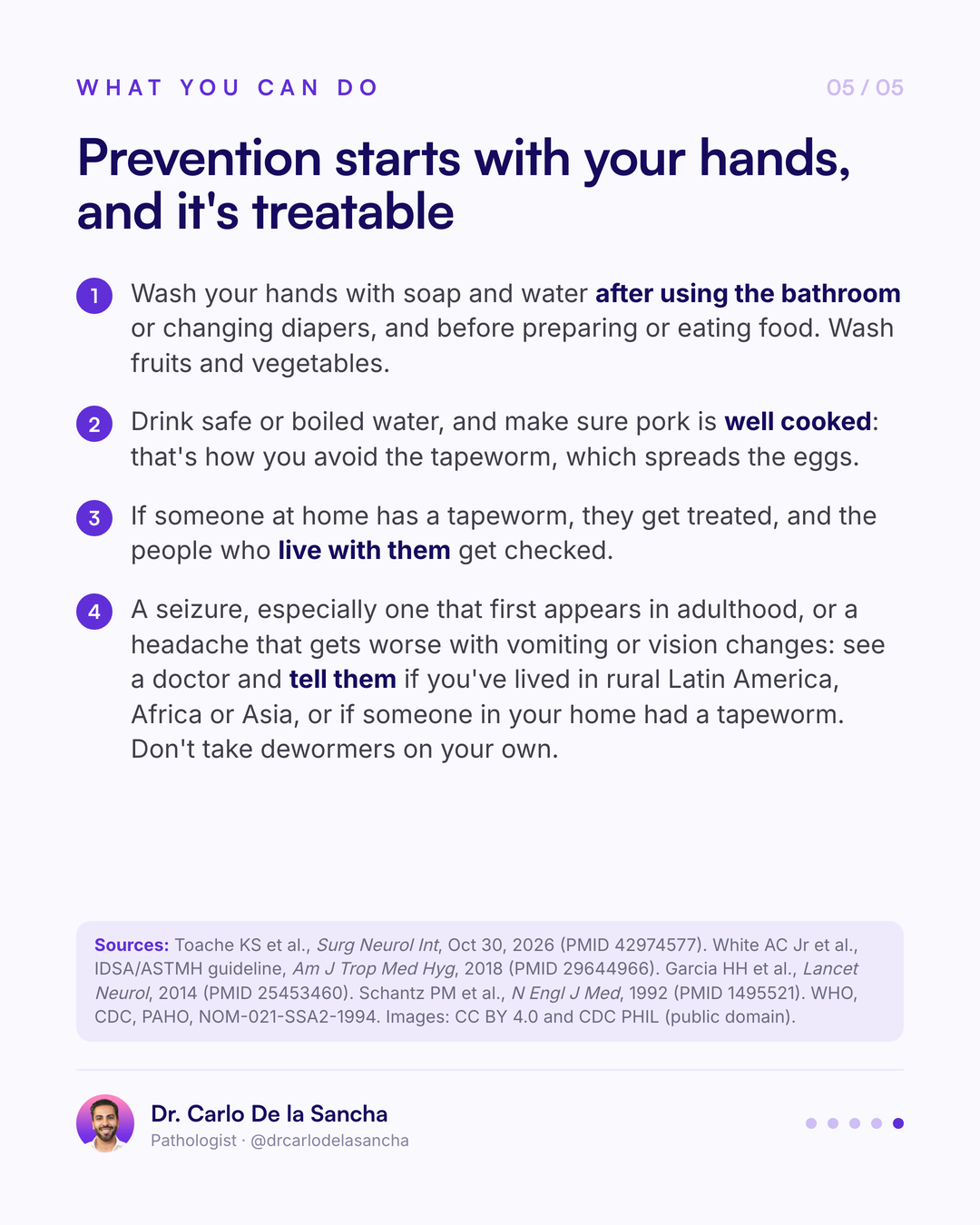
  • What you can do 05 / 05 Prevention starts with your hands, and it's treatable Wash your hands with soap and water after using the bathroom or changing diapers, and before preparing or eating food. Wash fruits and vegetables. Drink safe or boiled water, and make sure pork is well cooked: that's how you avoid the tapeworm, which spreads the eggs. If someone at home has a tapeworm, they get treated, and the people who live with them get checked. A seizure, especially one that first appears in adulthood, or a headache that gets worse with vomiting or vision changes: see a doctor and tell them if you've lived in rural Latin America, Africa or Asia, or if someone in your home had a tapeworm. Don't take dewormers on your own. Sources: Toache KS et al., Surg Neurol Int, Oct 30, 2026 (PMID 42974577). White AC Jr et al., IDSA/ASTMH guideline, Am J Trop Med Hyg, 2018 (PMID 29644966). Garcia HH et al., Lancet Neurol, 2014 (PMID 25453460). Schantz PM et al., N Engl J Med, 1992 (PMID 1495521). WHO, CDC, PAHO, NOM-021-SSA2-1994. Images: CC BY 4.0 and CDC PHIL (public domain). Dr. Carlo De la Sancha Pathologist · @drcarlodelasancha
  • Want to understand your body? Subscribe to my newsletter: drcarlodelasancha.com/en/newsletter Save it, share it and follow me → @drcarlodelasancha Educational content. Not a substitute for a visit to your doctor.

Know someone who would find this helpful?

Share it with them.