
YOUR BODY · SLIDE BY SLIDE

Your nose breathes in shifts

One side swells, the other opens up, and every few hours they switch.

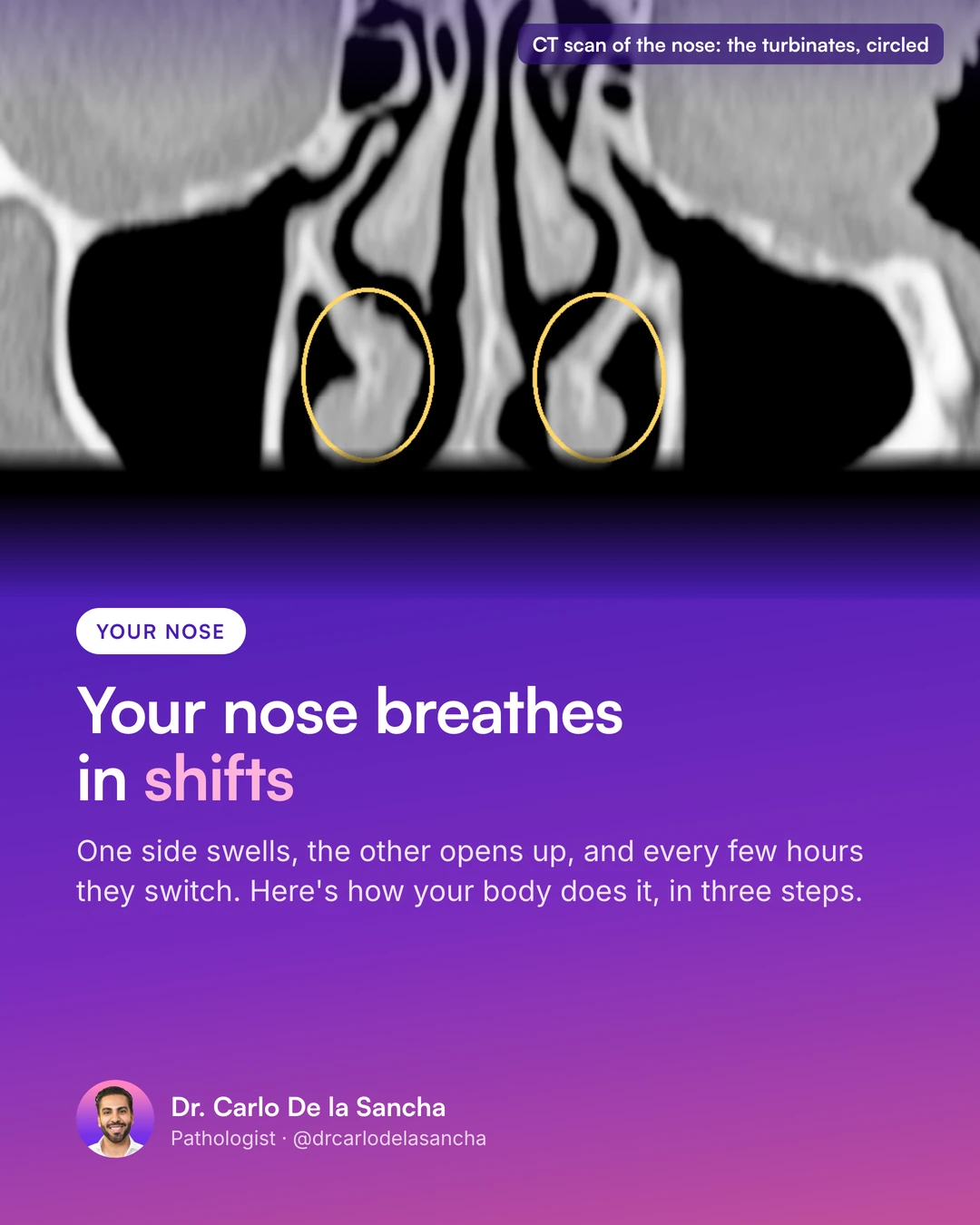
  • CT scan of the nose: the turbinates, circled Your nose Your nose breathes in shifts One side swells, the other opens up, and every few hours they switch. Here's how your body does it, in three steps. Dr. Carlo De la Sancha Pathologist · @drcarlodelasancha
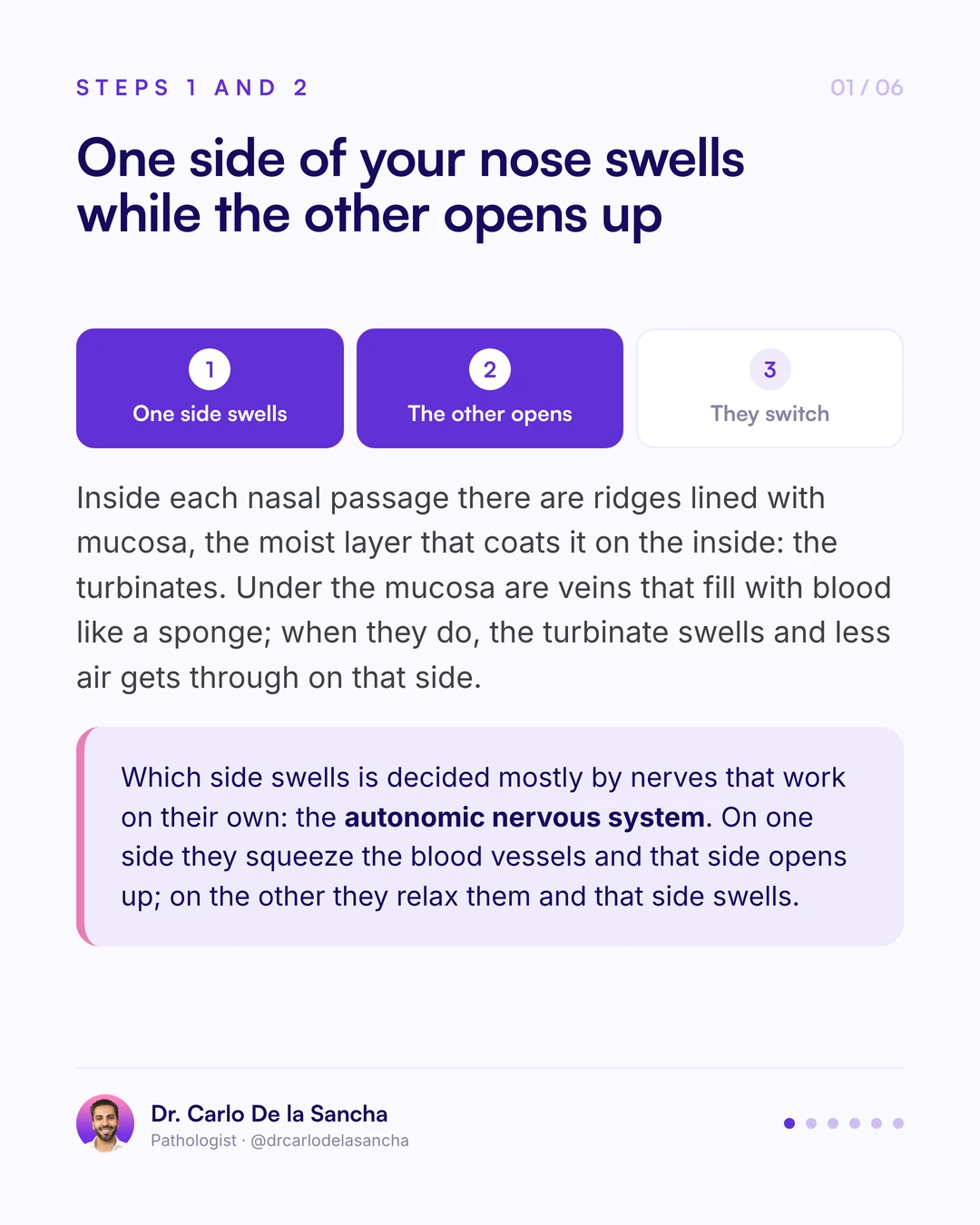
  • Steps 1 and 2 01 / 06 One side of your nose swells while the other opens up 1 One side swells 2 The other opens 3 They switch Inside each nasal passage there are ridges lined with mucosa, the moist layer that coats it on the inside: the turbinates. Under the mucosa are veins that fill with blood like a sponge; when they do, the turbinate swells and less air gets through on that side. Which side swells is decided mostly by nerves that work on their own: the autonomic nervous system. On one side they squeeze the blood vessels and that side opens up; on the other they relax them and that side swells. Dr. Carlo De la Sancha Pathologist · @drcarlodelasancha
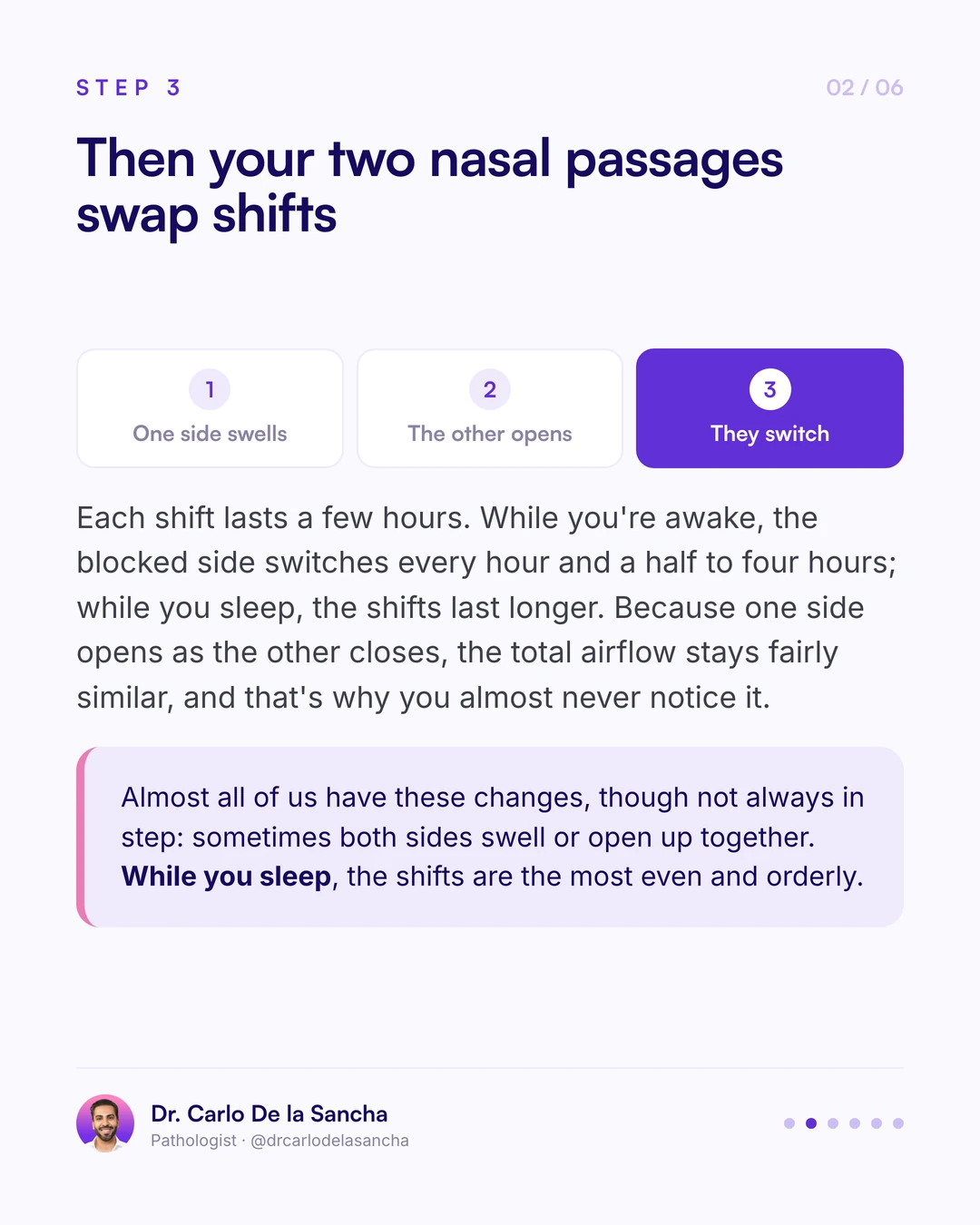
  • Step 3 02 / 06 Then your two nasal passages swap shifts 1 One side swells 2 The other opens 3 They switch Each shift lasts a few hours. While you're awake, the blocked side switches every hour and a half to four hours; while you sleep, the shifts last longer. Because one side opens as the other closes, the total airflow stays fairly similar, and that's why you almost never notice it. Almost all of us have these changes, though not always in step: sometimes both sides swell or open up together. While you sleep, the shifts are the most even and orderly. Dr. Carlo De la Sancha Pathologist · @drcarlodelasancha
  • When you notice it 03 / 06 Lying down or with a cold, you can feel the shifts When you lie on your side, the lower nasal passage swells and the upper one clears. And with a cold, the shifts become more pronounced: the swollen side can get almost completely blocked, especially if you lie on that side. That's why you feel one side get stuffed up, and hours later the other. Few people know these shifts exist, and many who feel that back-and-forth think something is wrong. It isn't: it's your nose doing its usual shifts, only now you notice them more. Dr. Carlo De la Sancha Pathologist · @drcarlodelasancha
  • What it's for 04 / 06 The shifts are thought to give your nose a rest No one knows for sure. One idea is that the side with more airflow dries out a little, while the swollen side gets its moisture back. That matters because this mucosa has tiny hairs, the cilia, that sweep away mucus along with whatever gets trapped as you breathe, and they need that moisture to keep sweeping. Something else that has actually been measured: because a different amount of air flows through each nasal passage, each side of your nose is better at picking up different smells. That's real, but it doesn't explain why they take turns. Dr. Carlo De la Sancha Pathologist · @drcarlodelasancha
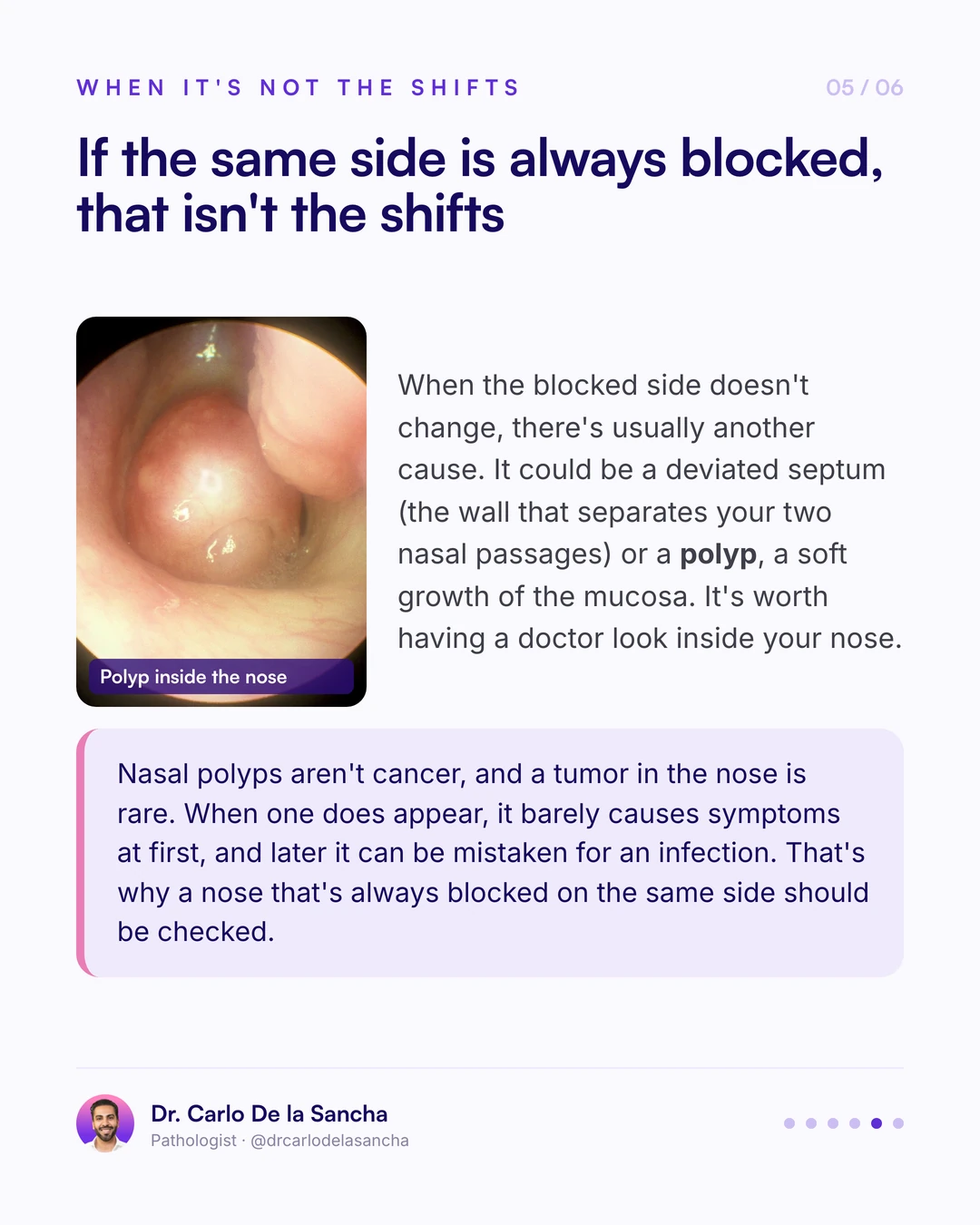
  • When it's not the shifts 05 / 06 If the same side is always blocked, that isn't the shifts Polyp inside the nose When the blocked side doesn't change, there's usually another cause. It could be a deviated septum (the wall that separates your two nasal passages) or a polyp, a soft growth of the mucosa. It's worth having a doctor look inside your nose. Nasal polyps aren't cancer, and a tumor in the nose is rare. When one does appear, it barely causes symptoms at first, and later it can be mistaken for an infection. That's why a nose that's always blocked on the same side should be checked. Dr. Carlo De la Sancha Pathologist · @drcarlodelasancha
  • What you can do 06 / 06 Your nose takes turns on its own; this part is up to you If one nostril gets blocked at night, lie on your other side, with the blocked nostril facing up: it usually clears. See a doctor if your stuffy nose lasts more than three weeks, or if the mucus smells bad, comes out of only one side, or has blood in it. See a doctor soon if, along with a stuffy nose, your face or eyes swell or your vision gets blurry. In children, if only one side of the nose is blocked, they may have put something in it: have their doctor check them. Sources: Kahana-Zweig R et al., PLoS One 2016 (PMID 27711189). Hasegawa M, Kern EB, Mayo Clin Proc 1977 (PMID 609283). Lindemann J et al., Rhinology 2024 (PMID 38088419). Eccles R, Clin Otolaryngol 2021 (PMID 33064350). MedlinePlus, NIH. Images: CT scan of the nose (cropped, with the inferior turbinates marked), Häggström M, CC BY 4.0; nasal polyp (cropped; an author's mark was removed), Hawke M, CC BY 4.0. Dr. Carlo De la Sancha Pathologist · @drcarlodelasancha
  • Want to understand your body? Subscribe to my newsletter: drcarlodelasancha.com/en/newsletter Save it, share it and follow me → @drcarlodelasancha Educational content. Not a substitute for a visit to your doctor.

Know someone who would find this helpful?

Share it with them.