

YOUR BODY · SLIDE BY SLIDE

Months of a sore throat and a black plaque on her tonsil

Antibiotics weren't helping, and the microscope showed why.

  • A plaque like hers, but on the palate The cause, seen under the microscope Katsitadze L et al., Cureus 2024 · CC BY 4.0 CDC / L. Georg Clinical case Her throat had hurt for months, and she had a black plaque on her tonsil A 33-year-old woman with no known medical conditions. Antibiotics weren't easing the pain. Dr. Carlo De la Sancha Pathologist · @drcarlodelasancha
  • What brought her in 01 / 06 Five months of a sore throat that wouldn't go away A 33-year-old woman had had a sore throat for five months, and it kept getting worse. She had no known medical conditions and wasn't taking any medications that weaken the immune system, like corticosteroids (powerful anti-inflammatory drugs, such as prednisone). She had been given several courses of antibiotics and wasn't getting better. She had no fever, hadn't lost weight, and could swallow without any trouble. Then she saw an otolaryngologist, an ear, nose and throat (ENT) specialist. Dr. Carlo De la Sancha Pathologist · @drcarlodelasancha
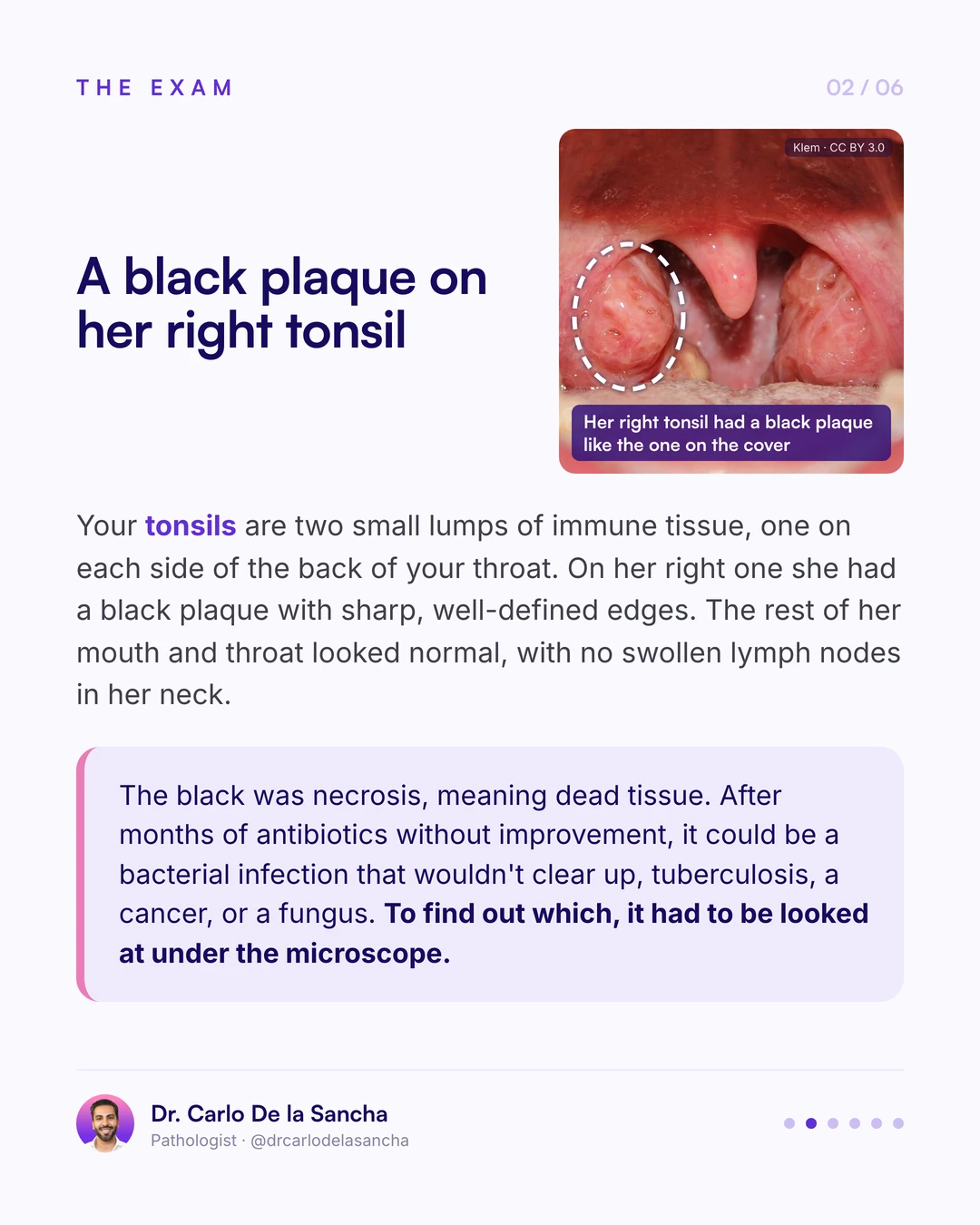
  • The exam 02 / 06 A black plaque on her right tonsil Klem · CC BY 3.0 Her right tonsil had a black plaque like the one on the cover Your tonsils are two small lumps of immune tissue, one on each side of the back of your throat. On her right one she had a black plaque with sharp, well-defined edges. The rest of her mouth and throat looked normal, with no swollen lymph nodes in her neck. The black was necrosis, meaning dead tissue. After months of antibiotics without improvement, it could be a bacterial infection that wouldn't clear up, tuberculosis, a cancer, or a fungus. To find out which, it had to be looked at under the microscope. Dr. Carlo De la Sancha Pathologist · @drcarlodelasancha
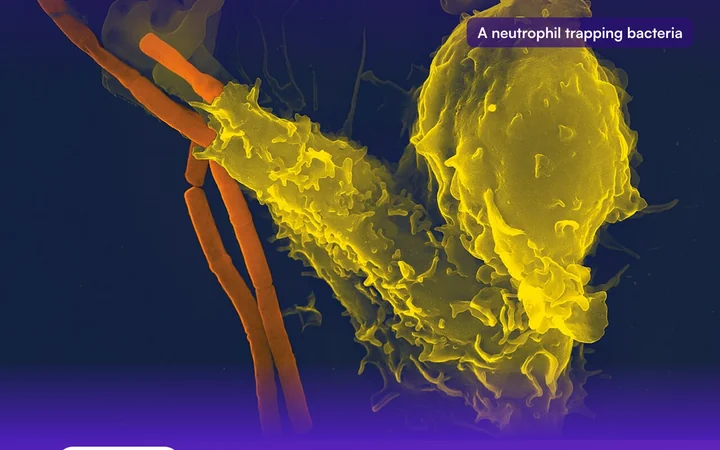
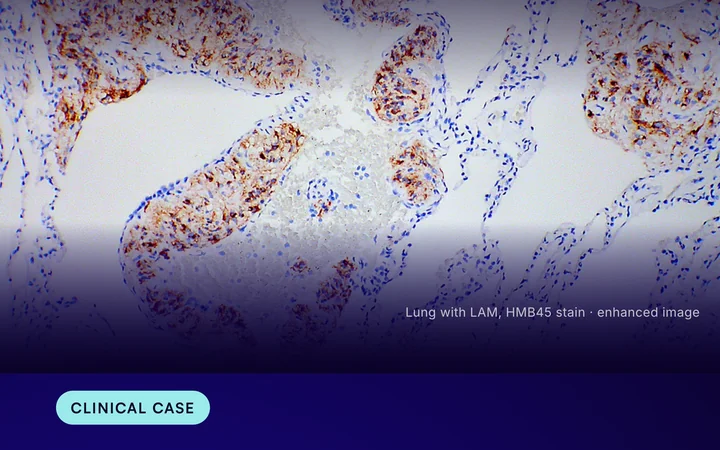
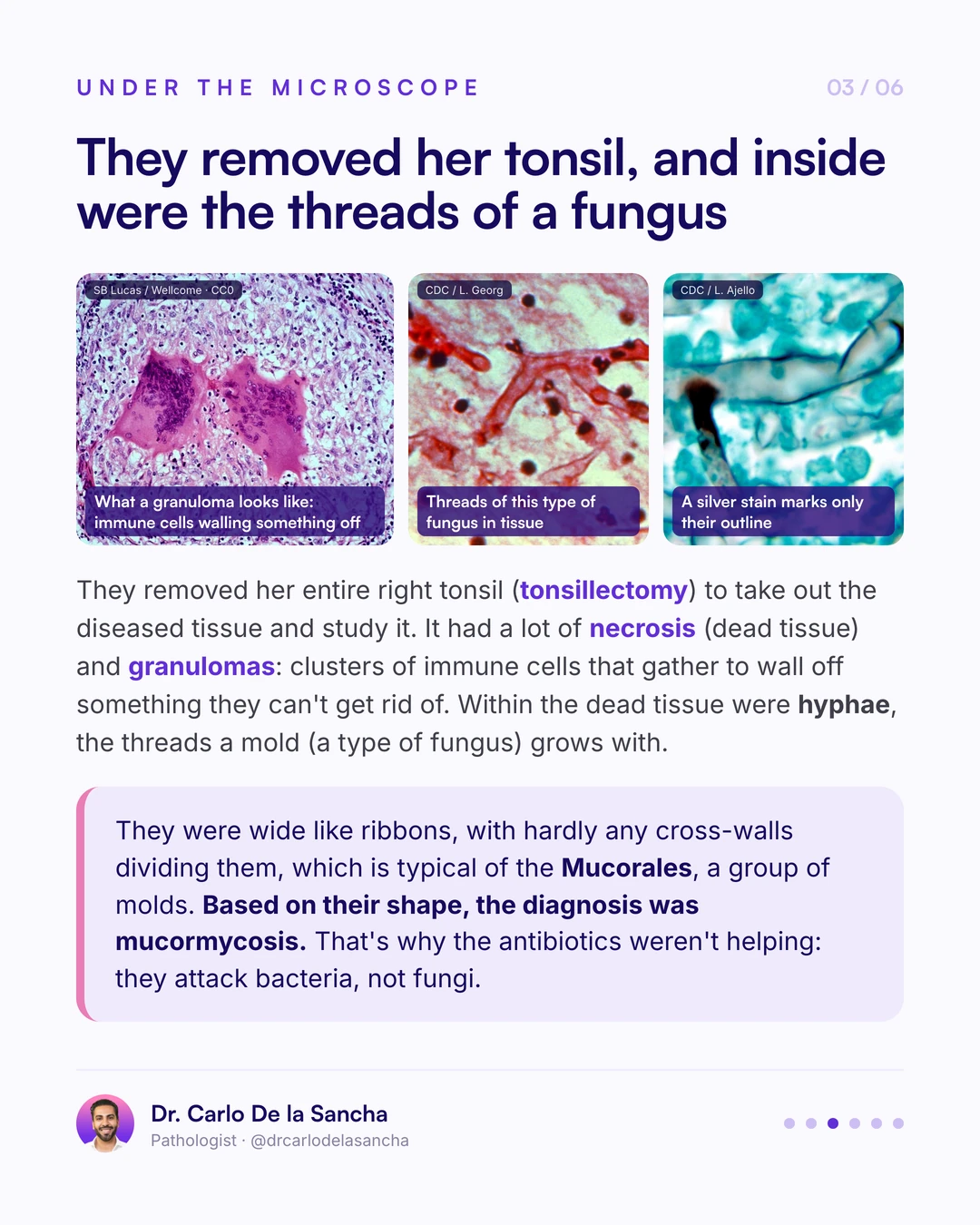
  • Under the microscope 03 / 06 They removed her tonsil, and inside were the threads of a fungus SB Lucas / Wellcome · CC0 What a granuloma looks like: immune cells walling something off CDC / L. Georg Threads of this type of fungus in tissue CDC / L. Ajello A silver stain marks only their outline They removed her entire right tonsil (tonsillectomy) to take out the diseased tissue and study it. It had a lot of necrosis (dead tissue) and granulomas: clusters of immune cells that gather to wall off something they can't get rid of. Within the dead tissue were hyphae, the threads a mold (a type of fungus) grows with. They were wide like ribbons, with hardly any cross-walls dividing them, which is typical of the Mucorales, a group of molds. Based on their shape, the diagnosis was mucormycosis. That's why the antibiotics weren't helping: they attack bacteria, not fungi. Dr. Carlo De la Sancha Pathologist · @drcarlodelasancha
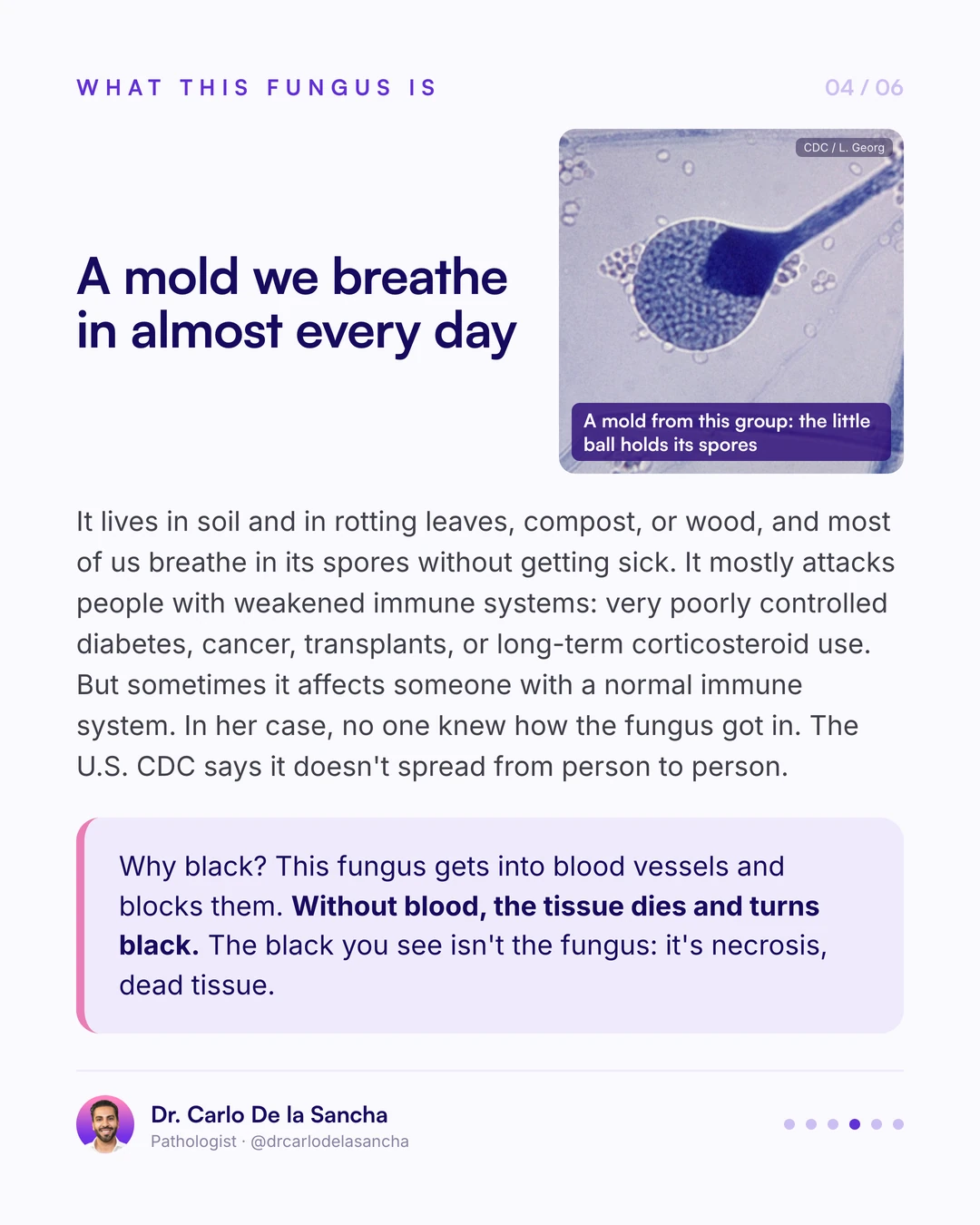
  • What this fungus is 04 / 06 A mold we breathe in almost every day CDC / L. Georg A mold from this group: the little ball holds its spores It lives in soil and in rotting leaves, compost, or wood, and most of us breathe in its spores without getting sick. It mostly attacks people with weakened immune systems: very poorly controlled diabetes, cancer, transplants, or long-term corticosteroid use. But sometimes it affects someone with a normal immune system. In her case, no one knew how the fungus got in. The U.S. CDC says it doesn't spread from person to person. Why black? This fungus gets into blood vessels and blocks them. Without blood, the tissue dies and turns black. The black you see isn't the fungus: it's necrosis, dead tissue. Dr. Carlo De la Sancha Pathologist · @drcarlodelasancha
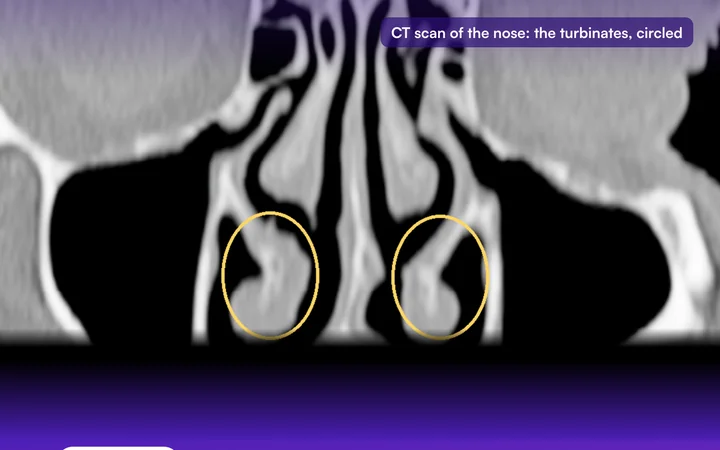
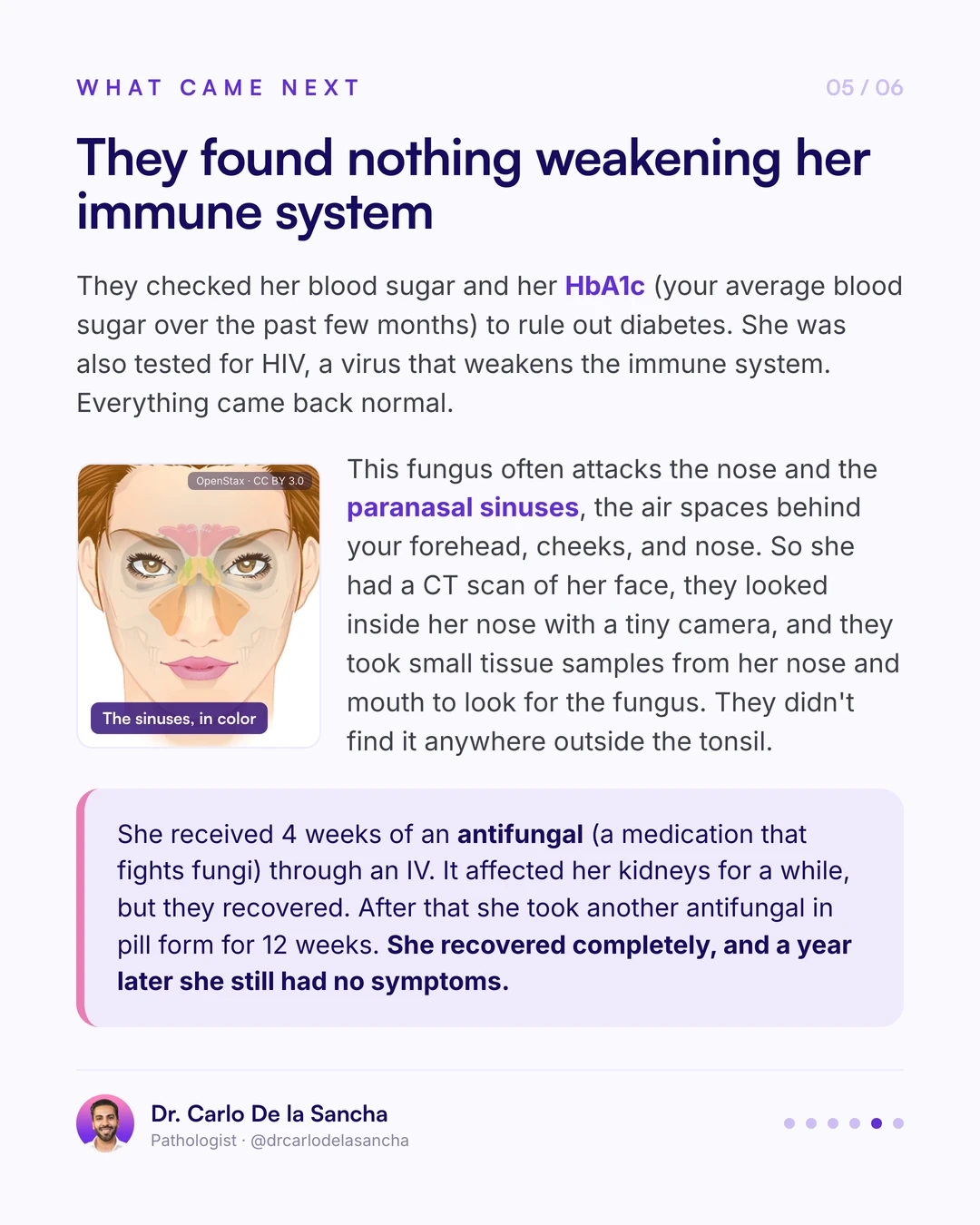
  • What came next 05 / 06 They found nothing weakening her immune system They checked her blood sugar and her HbA1c (your average blood sugar over the past few months) to rule out diabetes. She was also tested for HIV, a virus that weakens the immune system. Everything came back normal. OpenStax · CC BY 3.0 The sinuses, in color This fungus often attacks the nose and the paranasal sinuses, the air spaces behind your forehead, cheeks, and nose. So she had a CT scan of her face, they looked inside her nose with a tiny camera, and they took small tissue samples from her nose and mouth to look for the fungus. They didn't find it anywhere outside the tonsil. She received 4 weeks of an antifungal (a medication that fights fungi) through an IV. It affected her kidneys for a while, but they recovered. After that she took another antifungal in pill form for 12 weeks. She recovered completely, and a year later she still had no symptoms. Dr. Carlo De la Sancha Pathologist · @drcarlodelasancha
  • What this means for you 06 / 06 When a sore throat deserves a second look A common sore throat usually goes away within a week. If it doesn't get better in that time, or keeps coming back, have your throat checked. If you've already taken an antibiotic and you're no better, don't take another one on your own: if the cause isn't bacteria, it won't help. Go back to your doctor. A sore, spot, or lump in your mouth or throat that hasn't healed in 3 weeks: mention it to your doctor or dentist, because sometimes it's an infection or a tumor, and it's easier to treat if caught early. If it's black and new, get it checked right away. If you have uncontrolled diabetes or take corticosteroids, and one side of your face swells, your vision blurs, or a black crust appears in your nose or on the roof of your mouth: go to the ER, because this infection can progress quickly. Sources: Haddad M et al., IDCases, Oct 28, 2026 (PMID 42999891). Cornely OA et al., Lancet Infect Dis, 2019 (PMID 31699664). Skiada A et al., J Fungi, 2020 (PMID 33147877). Prakash H, Chakrabarti A, J Fungi, 2019 (PMID 30901907). CDC, Mucormycosis, 2026. NHS, Sore throat; Mouth ulcers, 2024. Images: Katsitadze L et al., Cureus 2024, CC BY 4.0; Klem, Wikimedia Commons, CC BY 3.0; SB Lucas, Wellcome Collection, CC0; OpenStax, Anatomy & Physiology, CC BY 3.0; CDC Public Health Image Library (14551, 19132, 4233, 3960). Dr. Carlo De la Sancha Pathologist · @drcarlodelasancha
  • Want to understand your body? Subscribe to my newsletter: drcarlodelasancha.com/en/newsletter Save it, share it and follow me → @drcarlodelasancha Educational content. Not a substitute for a visit to your doctor.

Know someone who would find this helpful?

Share it with them.