
YOUR BODY · SLIDE BY SLIDE

They removed over 100 worms from his gut

A two-and-a-half-year-old, a ball of roundworms, and how they spread.

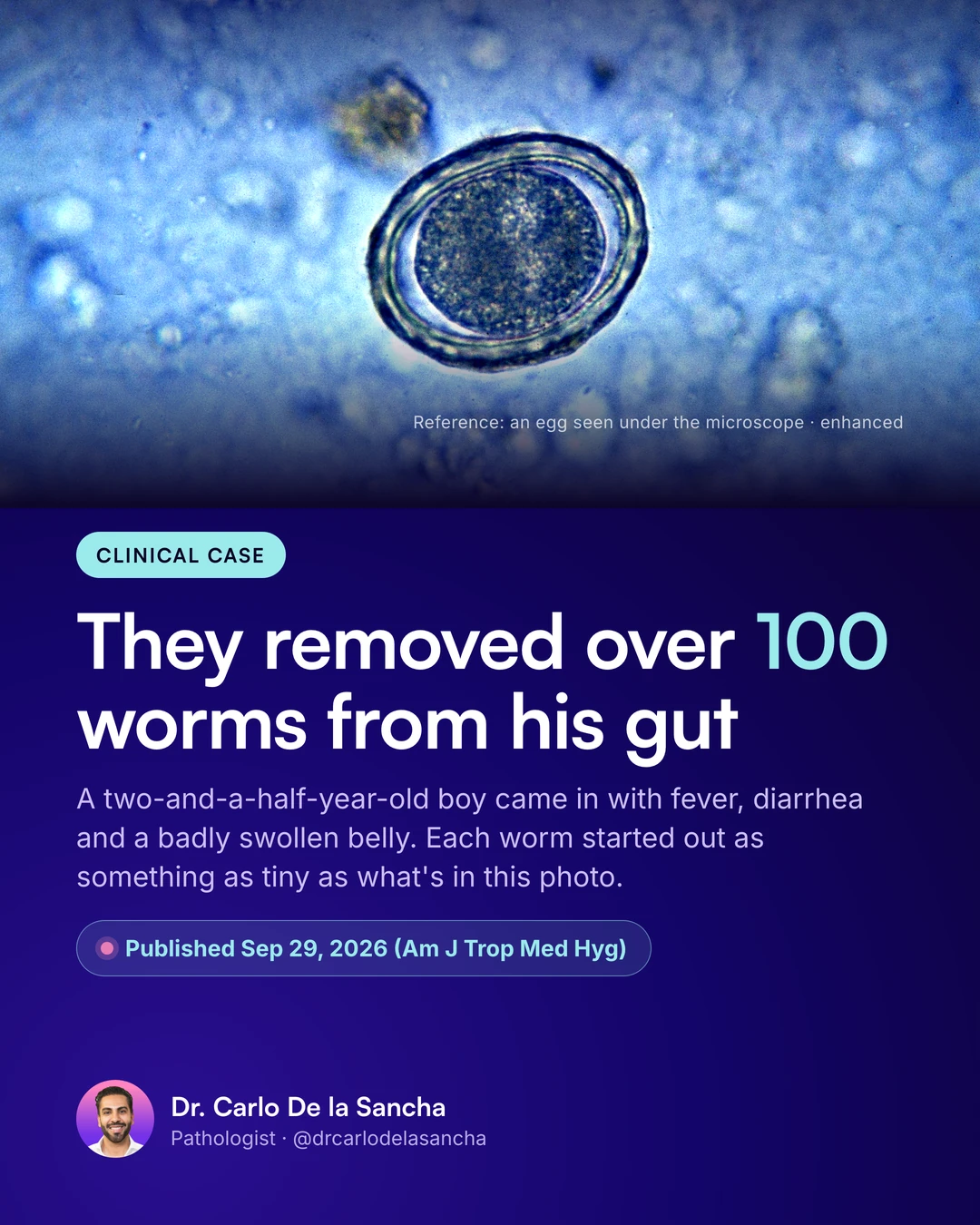
  • Reference: an egg seen under the microscope · enhanced Clinical case They removed over 100 worms from his gut A two-and-a-half-year-old boy came in with fever, diarrhea and a badly swollen belly. Each worm started out as something as tiny as what's in this photo. Published Sep 29, 2026 (Am J Trop Med Hyg) Dr. Carlo De la Sancha Pathologist · @drcarlodelasancha
  • What happened 01 / 03 He arrived very sick, and something was blocking his intestine He had recently moved from the mountainous north of Vietnam to the south of the country. Besides the fever and diarrhea, he was having more and more trouble breathing. He was transferred in septic shock: a severe infection had dropped his blood pressure so low that his organs were at risk. He needed a ventilator and two medications to hold his blood pressure up. He had emergency surgery. His small intestine was completely blocked. Dr. Carlo De la Sancha Pathologist · @drcarlodelasancha
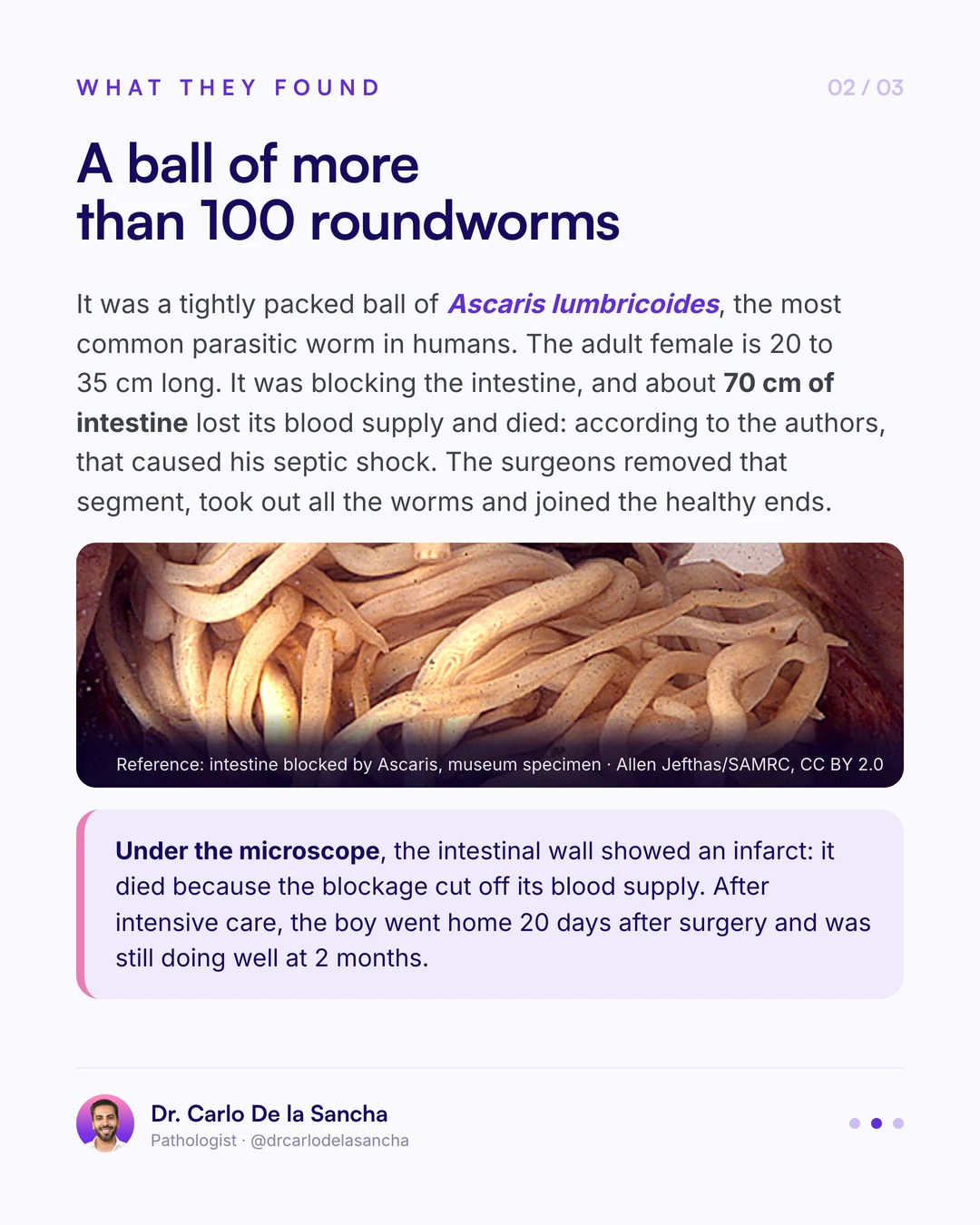
  • What they found 02 / 03 A ball of more than 100 roundworms It was a tightly packed ball of Ascaris lumbricoides, the most common parasitic worm in humans. The adult female is 20 to 35 cm long. It was blocking the intestine, and about 70 cm of intestine lost its blood supply and died: according to the authors, that caused his septic shock. The surgeons removed that segment, took out all the worms and joined the healthy ends. Reference: intestine blocked by Ascaris, museum specimen · Allen Jefthas/SAMRC, CC BY 2.0 Under the microscope, the intestinal wall showed an infarct: it died because the blockage cut off its blood supply. After intensive care, the boy went home 20 days after surgery and was still doing well at 2 months. Dr. Carlo De la Sancha Pathologist · @drcarlodelasancha
  • What this means for you 03 / 03 How it spreads and which signs to watch for ✓ You get it by swallowing eggs like the one on the cover, which come from soil contaminated with feces: on poorly washed vegetables, in contaminated water, or on the hands of a child who plays in the dirt and puts them in their mouth. It doesn't spread directly from person to person, because the egg needs about 3 weeks in the soil before it can infect. ✓ Wash your hands with soap and water after using the bathroom and before eating, and teach your kids to do it too. Wash, peel or cook fruits and vegetables. ✓ Many people feel nothing. If your child passes a worm, vomits it or coughs it up, bring the worm to their doctor: there are effective medicines. ✓ Get medical care right away, from their pediatrician or at the ER, if a child vomits something green or bloody, has a swollen belly that won't go down, severe belly pain that won't go away, or can't poop or pass gas. Sources: Nhan, Pham and Hoang, Am J Trop Med Hyg, Sep 29, 2026 (PMID 42810329); WHO, soil-transmitted helminth infections fact sheet, 2023; CDC, About Ascariasis, 2024, and DPDx, 2019; AAP, HealthyChildren.org, 2024; MedlinePlus, 2024 and 2026. Reference images, enhanced: Ascaris egg, CDC/Dr. Mae Melvin, public domain (cover); intestine, Allen Jefthas/SAMRC via SuSanA, CC BY 2.0 (slide 02). Dr. Carlo De la Sancha Pathologist · @drcarlodelasancha
  • Want to understand your body? Subscribe to my newsletter: drcarlodelasancha.com/en/newsletter Save it, share it and follow me → @drcarlodelasancha Educational content. Not a substitute for a visit to your doctor.

Know someone who would find this helpful?

Share it with them.