
YOUR BODY · SLIDE BY SLIDE

Gilbert syndrome: yellow eyes when you go hours without eating

A liver enzyme that works more slowly your whole life, and how it gets confirmed.

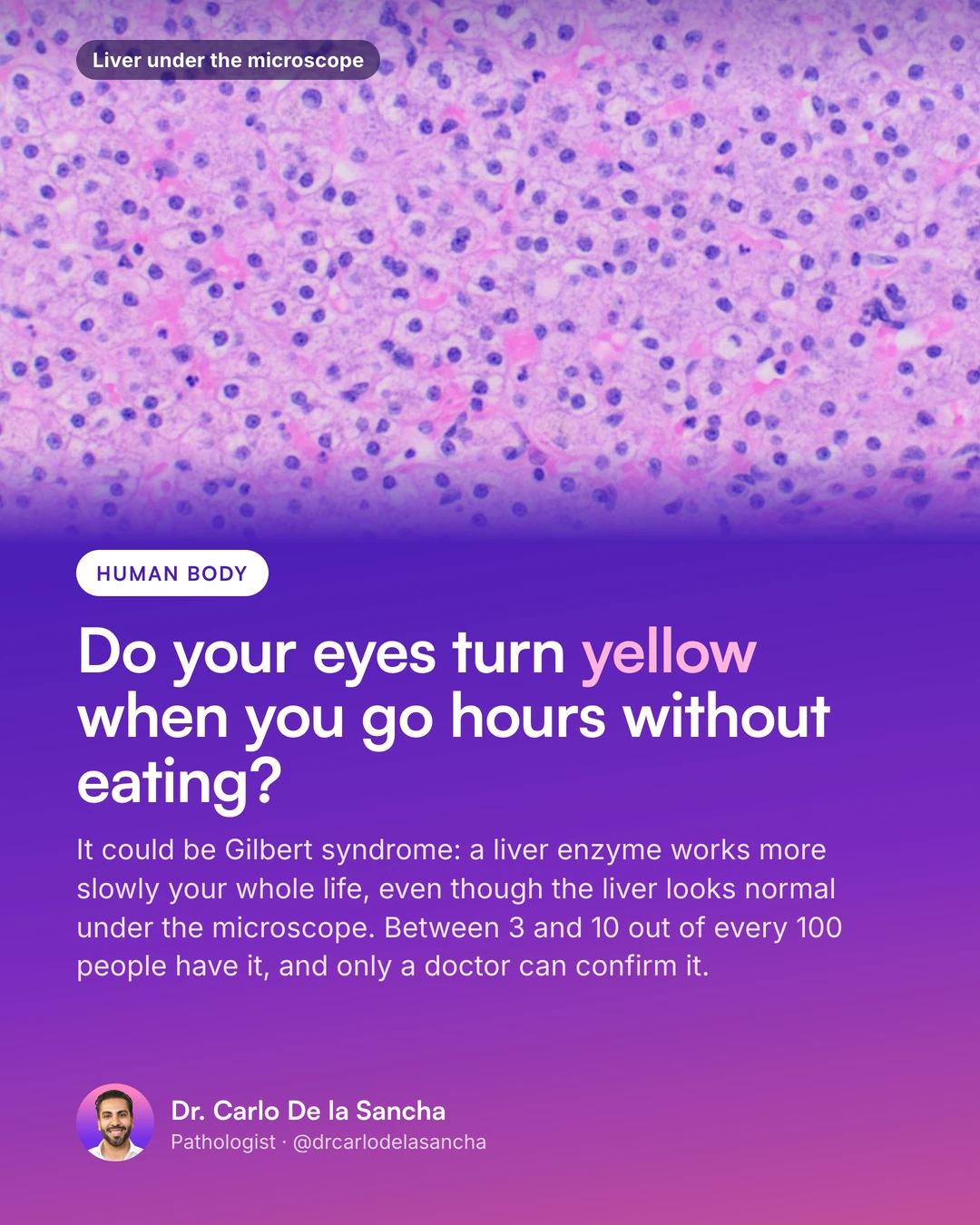
  • Liver under the microscope Human body Do your eyes turn yellow when you go hours without eating? It could be Gilbert syndrome: a liver enzyme works more slowly your whole life, even though the liver looks normal under the microscope. Between 3 and 10 out of every 100 people have it, and only a doctor can confirm it. Dr. Carlo De la Sancha Pathologist · @drcarlodelasancha
  • What happens 01 / 03 The same tailor, just slower Your liver has an enzyme, UGT1A1, that works like a tailor: it dresses bilirubin (the yellow pigment left over from old red blood cells) so it can leave through the bile. In Gilbert syndrome, an inherited change in its gene leaves it working more slowly for life. 30% of its normal activity is what the enzyme has left, more or less That's why indirect bilirubin, the kind that hasn't been through the tailor yet, runs a little high. It rises more with fasting, stress, dehydration, an illness, intense exercise or menstruation. It usually shows up in the teen years and is found more often in men. Dr. Carlo De la Sancha Pathologist · @drcarlodelasancha
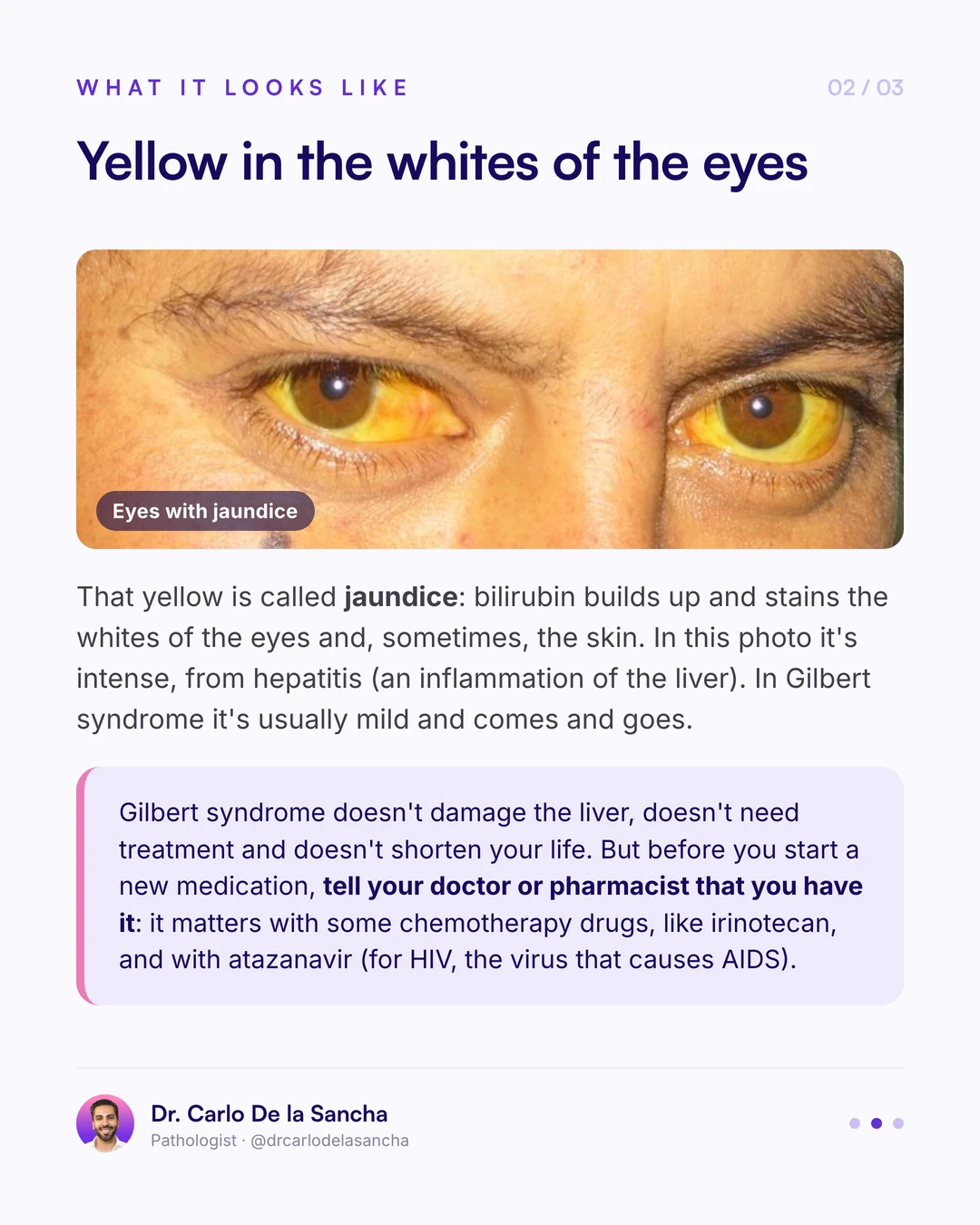
  • What it looks like 02 / 03 Yellow in the whites of the eyes Eyes with jaundice That yellow is called jaundice: bilirubin builds up and stains the whites of the eyes and, sometimes, the skin. In this photo it's intense, from hepatitis (an inflammation of the liver). In Gilbert syndrome it's usually mild and comes and goes. Gilbert syndrome doesn't damage the liver, doesn't need treatment and doesn't shorten your life. But before you start a new medication, tell your doctor or pharmacist that you have it: it matters with some chemotherapy drugs, like irinotecan, and with atazanavir (for HIV, the virus that causes AIDS). Dr. Carlo De la Sancha Pathologist · @drcarlodelasancha
  • How it's found 03 / 03 How Gilbert syndrome is identified Indirect bilirubin comes back slightly high on more than one test, and it goes up and down. Some people find out by chance, from tests done for something else. The other liver tests come back normal, and blood tests show no sign of red blood cells breaking down faster than usual. Indirect bilirubin can go up for many reasons, so your doctor rules out the others before saying it's Gilbert syndrome. The genetic test (for the UGT1A1 gene) is only ordered sometimes, to confirm it. If your eyes turn yellow and no doctor has told you it's Gilbert syndrome, see a doctor. If you already know you have it, still see a doctor when the yellow is stronger than usual, doesn't clear up in a few days, or comes with dark urine, pale stools, itching, fever or belly pain. Sources: MedlinePlus (NIH); NHS, 2025; De Silva et al., World J Hepatol 2025 (PMID 40027563); Wagner et al., Crit Rev Clin Lab Sci 2018 (PMID 29390925); Cleveland Clinic; FDA; Gammal et al., CPIC 2016 (PMID 26417955). Images from Wikimedia Commons: micrograph by Mikael Häggström, CC0; photo by Sheila J. Toro, CC BY 4.0, cropped. Dr. Carlo De la Sancha Pathologist · @drcarlodelasancha
  • Want to understand your body? Subscribe to my newsletter: drcarlodelasancha.com/en/newsletter Save it, share it and follow me → @drcarlodelasancha Educational content. Not a substitute for a visit to your doctor.

Know someone who would find this helpful?

Share it with them.