
YOUR BODY · SLIDE BY SLIDE

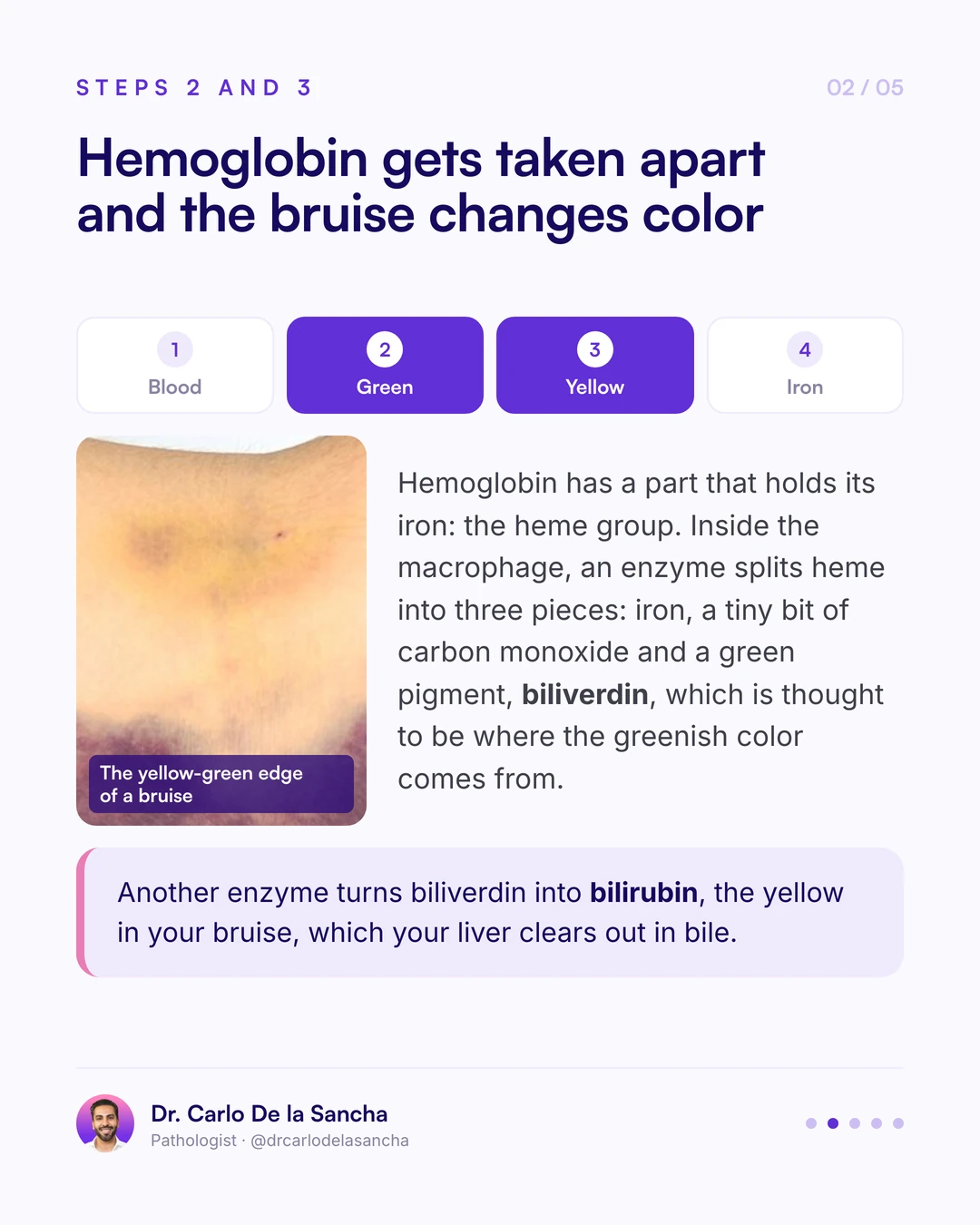
Your bruise changes color because your body is recycling the blood

Here's how your body clears away that blood, in four steps.

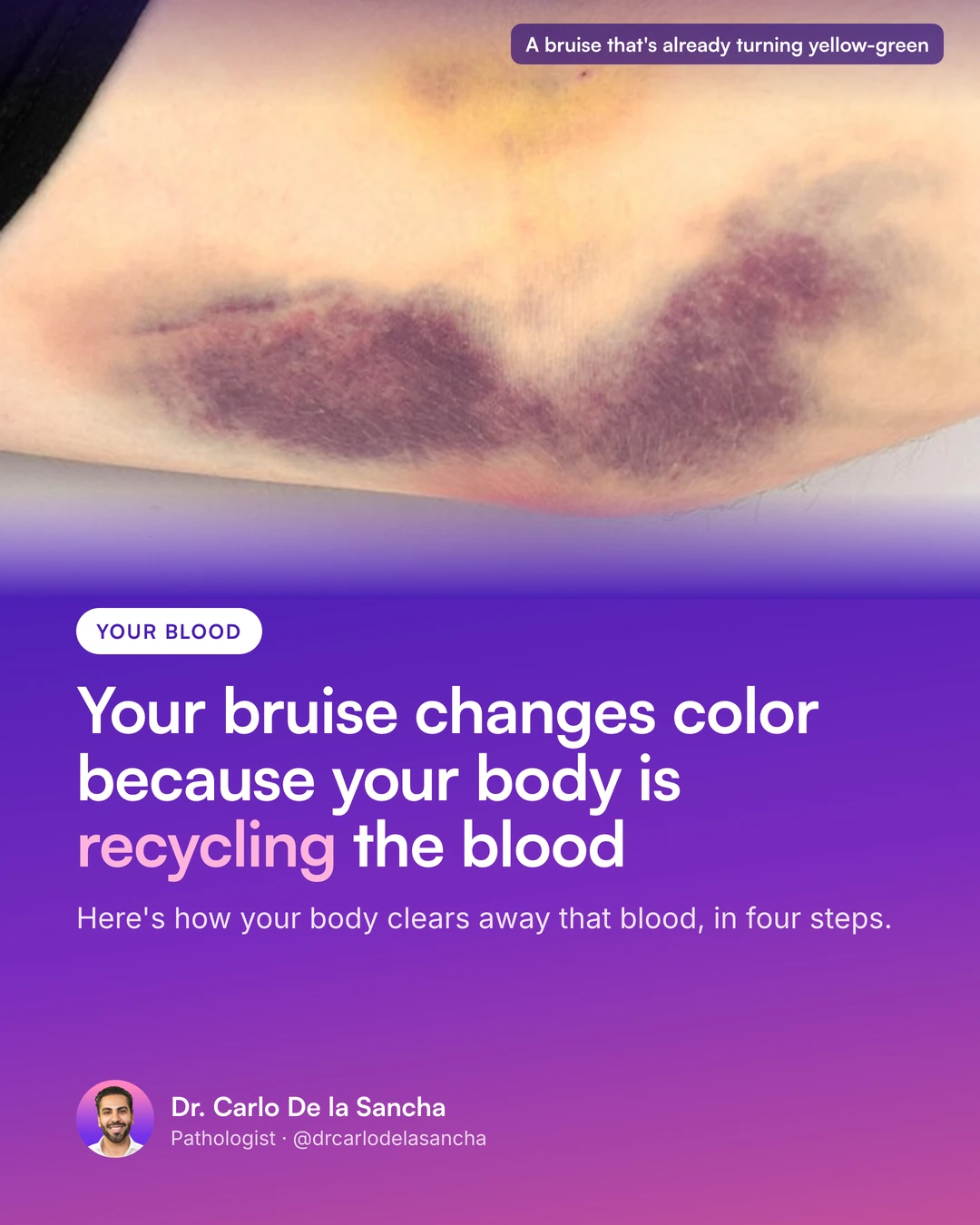
  • A bruise that's already turning yellow-green Your blood Your bruise changes color because your body is recycling the blood Here's how your body clears away that blood, in four steps. Dr. Carlo De la Sancha Pathologist · @drcarlodelasancha
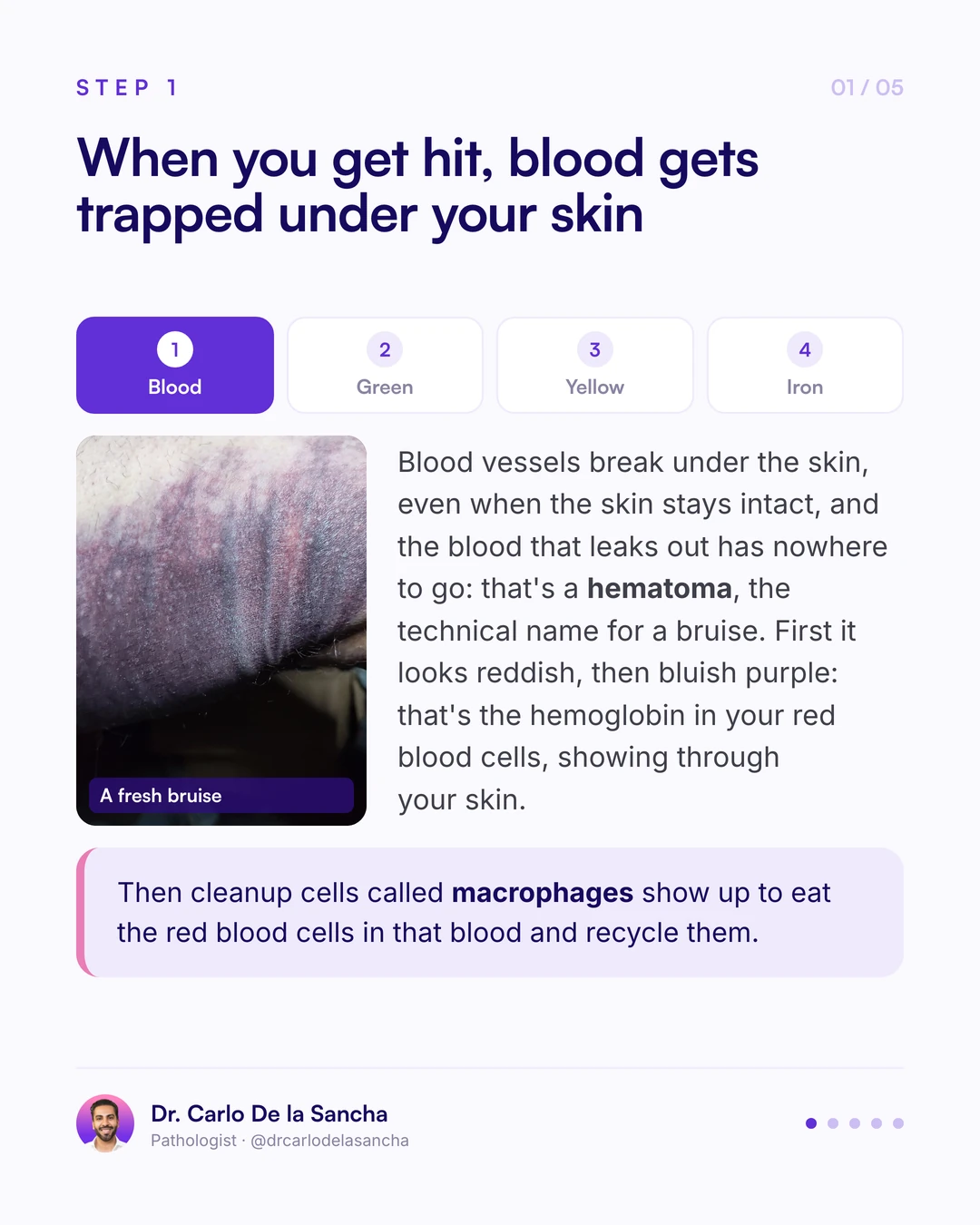
  • Step 1 01 / 05 When you get hit, blood gets trapped under your skin 1 Blood 2 Green 3 Yellow 4 Iron A fresh bruise Blood vessels break under the skin, even when the skin stays intact, and the blood that leaks out has nowhere to go: that's a hematoma, the technical name for a bruise. First it looks reddish, then bluish purple: that's the hemoglobin in your red blood cells, showing through your skin. Then cleanup cells called macrophages show up to eat the red blood cells in that blood and recycle them. Dr. Carlo De la Sancha Pathologist · @drcarlodelasancha
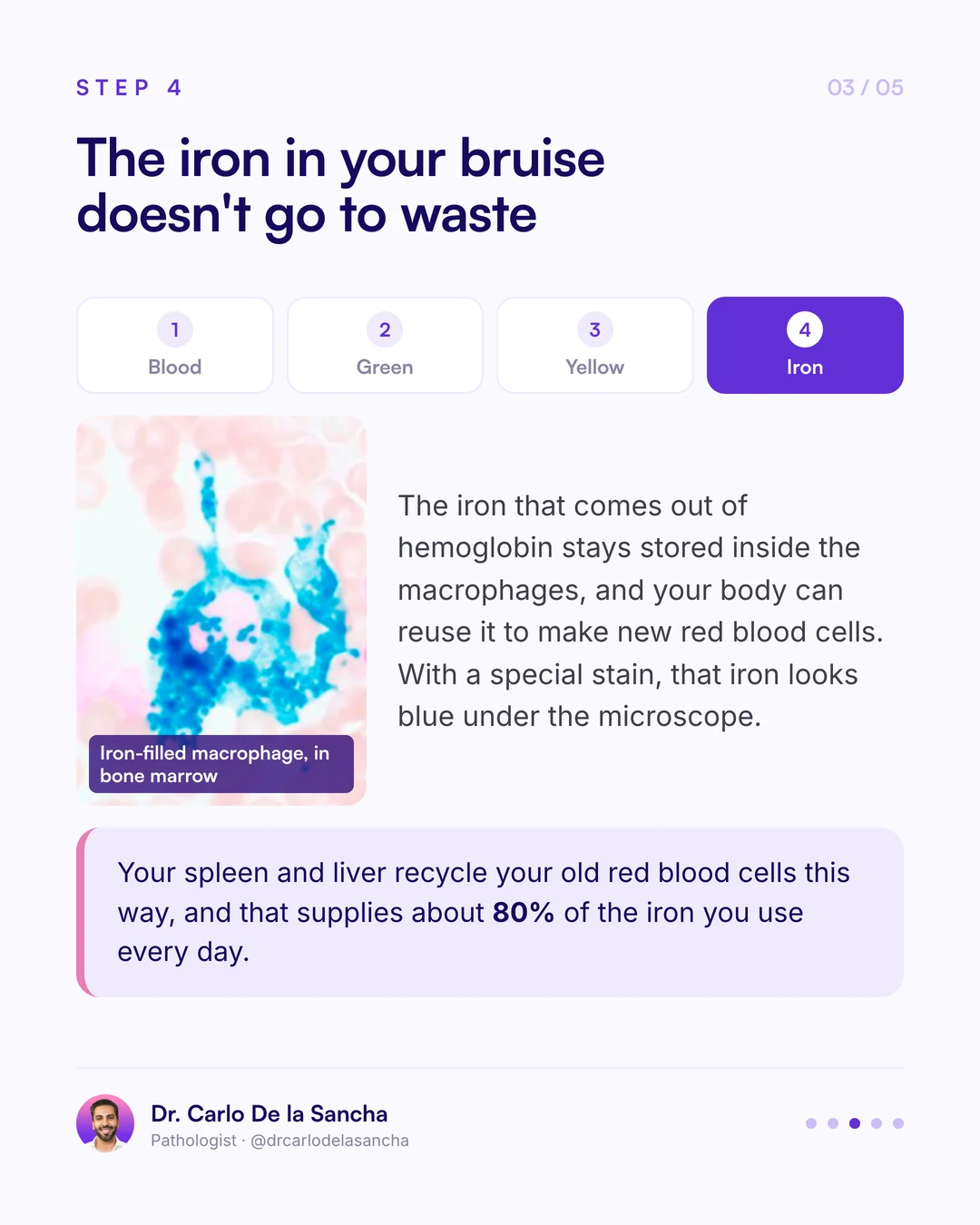
  • Steps 2 and 3 02 / 05 Hemoglobin gets taken apart and the bruise changes color 1 Blood 2 Green 3 Yellow 4 Iron The yellow-green edge of a bruise Hemoglobin has a part that holds its iron: the heme group. Inside the macrophage, an enzyme splits heme into three pieces: iron, a tiny bit of carbon monoxide and a green pigment, biliverdin, which is thought to be where the greenish color comes from. Another enzyme turns biliverdin into bilirubin, the yellow in your bruise, which your liver clears out in bile. Dr. Carlo De la Sancha Pathologist · @drcarlodelasancha
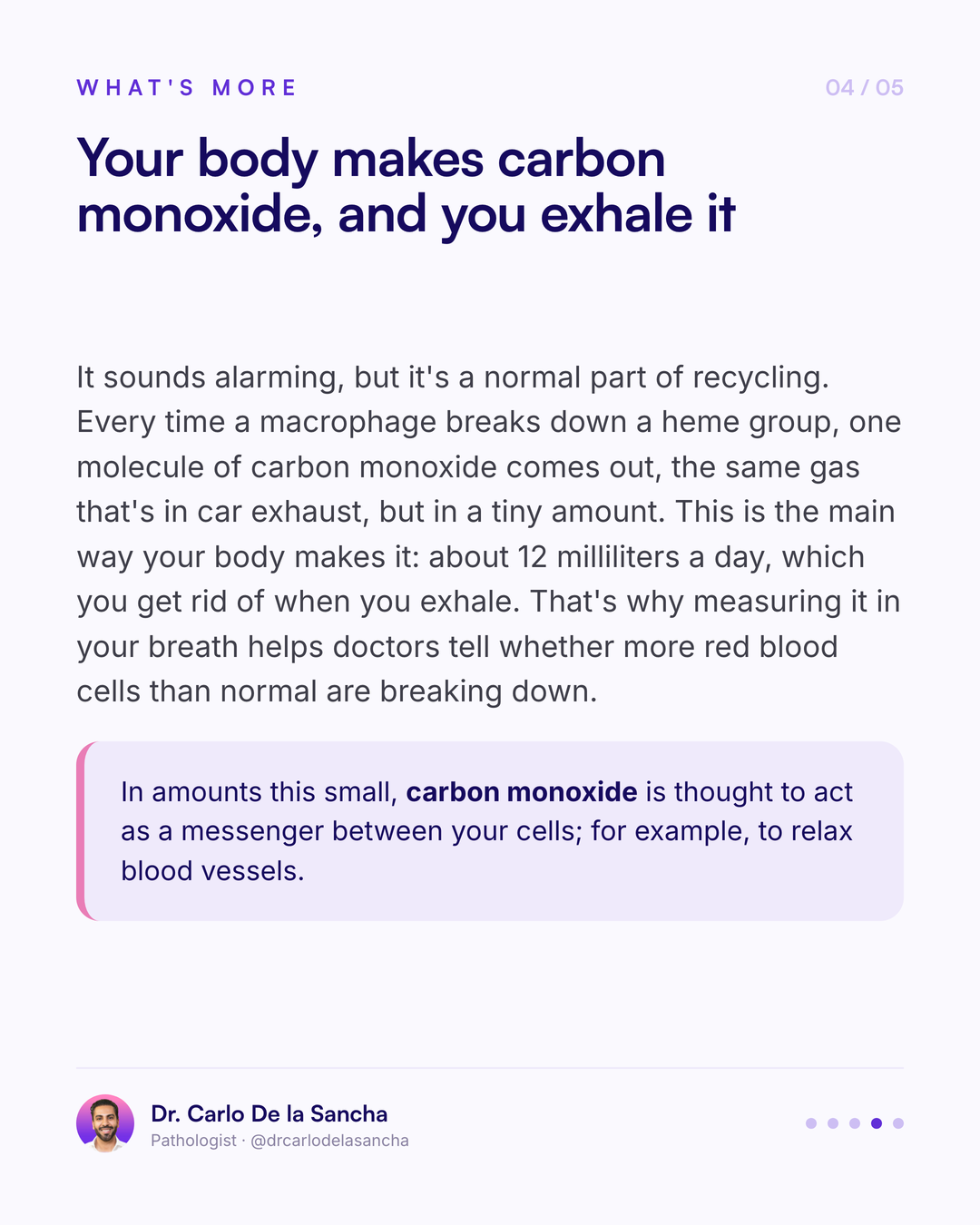
  • Step 4 03 / 05 The iron in your bruise doesn't go to waste 1 Blood 2 Green 3 Yellow 4 Iron Iron-filled macrophage, in bone marrow The iron that comes out of hemoglobin stays stored inside the macrophages, and your body can reuse it to make new red blood cells. With a special stain, that iron looks blue under the microscope. Your spleen and liver recycle your old red blood cells this way, and that supplies about 80% of the iron you use every day. Dr. Carlo De la Sancha Pathologist · @drcarlodelasancha
  • What's more 04 / 05 Your body makes carbon monoxide, and you exhale it It sounds alarming, but it's a normal part of recycling. Every time a macrophage breaks down a heme group, one molecule of carbon monoxide comes out, the same gas that's in car exhaust, but in a tiny amount. This is the main way your body makes it: about 12 milliliters a day, which you get rid of when you exhale. That's why measuring it in your breath helps doctors tell whether more red blood cells than normal are breaking down. In amounts this small, carbon monoxide is thought to act as a messenger between your cells; for example, to relax blood vessels. Dr. Carlo De la Sancha Pathologist · @drcarlodelasancha
  • What this means for you 05 / 05 Your bruise fades on its own; here's what helps Right after you get hit, apply ice wrapped in a cloth for up to 15 minutes each hour, and raise the area above your heart: the bruise usually ends up smaller. You can't tell how many days old a bruise is from its color: it changes at a different pace in each person. Most fade in about two weeks; others take months. See your doctor if you get bruises without being hit or if your nose or gums bleed: your blood may not be clotting properly. Also see your doctor if there's pus, red streaks spreading from the bruise, or fever: those are signs of infection. Go to the emergency room if you feel severe pressure in the bruised area, or if you take a blood thinner (anticoagulant) and hit your head. Sources: MedlinePlus, NIH. Randeberg 2006 (PMID 16538661). Ryter 2006 (PMID 16601269). Montalbetti 2013 (PMID 23506870). Huang 2021 (PMID 34302694). Nagasaki 2026 (doi:10.3390/ph19040634). Images: bruise, MajorB, CC0; fresh bruise, Akecheta1068, CC0; edge of the bruise, MajorB, CC0; iron-laden macrophage (cropped), Lours C et al., CC BY 4.0. Dr. Carlo De la Sancha Pathologist · @drcarlodelasancha
  • Want to understand your body? Subscribe to my newsletter: drcarlodelasancha.com/en/newsletter Save it, share it and follow me → @drcarlodelasancha Educational content. Not a substitute for a visit to your doctor.

Know someone who would find this helpful?

Share it with them.