
YOUR BODY · SLIDE BY SLIDE

Butterfly skin: the answer was in their own skin

Two teens in Japan got new skin grown from a patch that corrected itself.

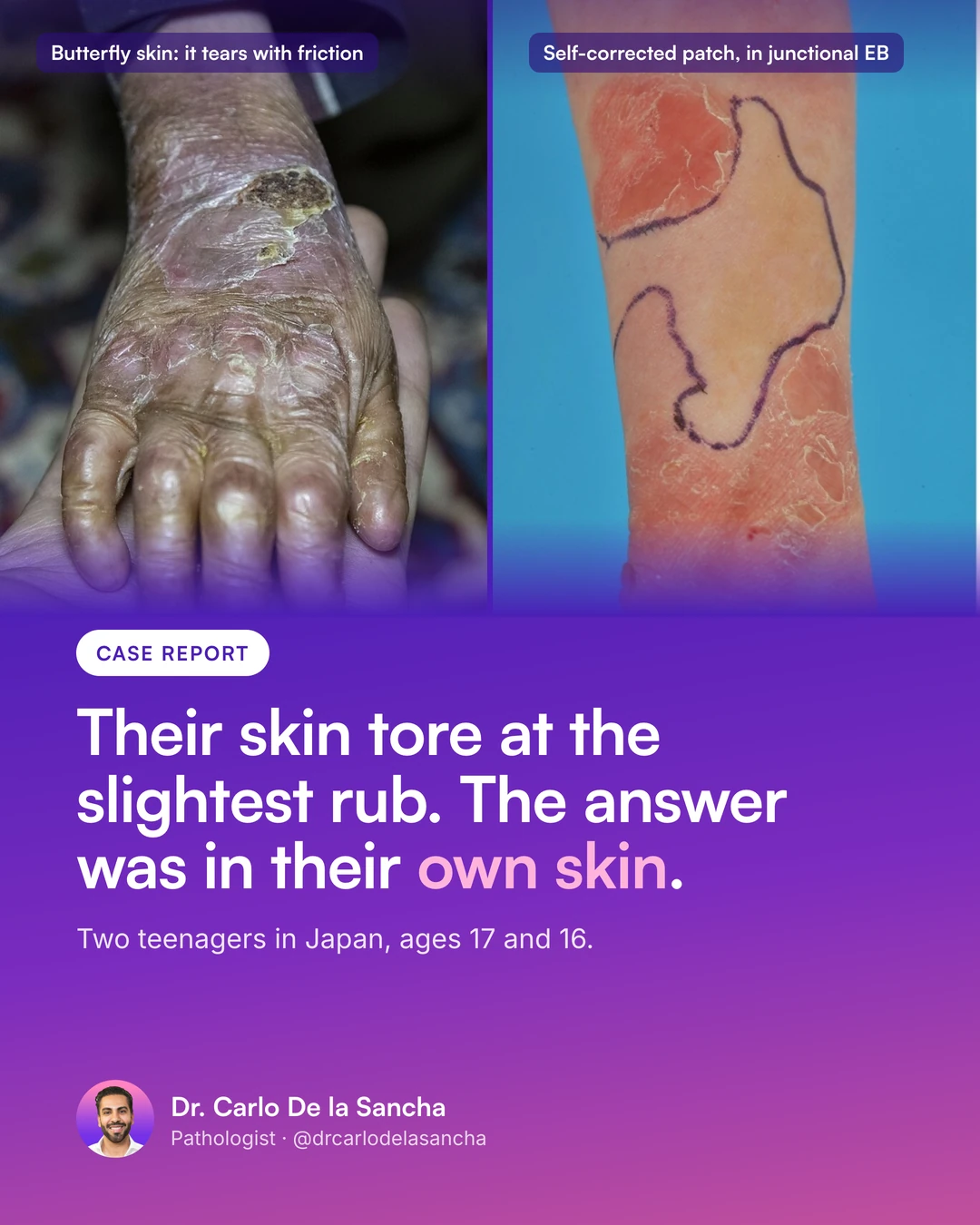
  • Butterfly skin: it tears with friction Self-corrected patch, in junctional EB Case report Their skin tore at the slightest rub. The answer was in their own skin. Two teenagers in Japan, ages 17 and 16. Dr. Carlo De la Sancha Pathologist · @drcarlodelasancha
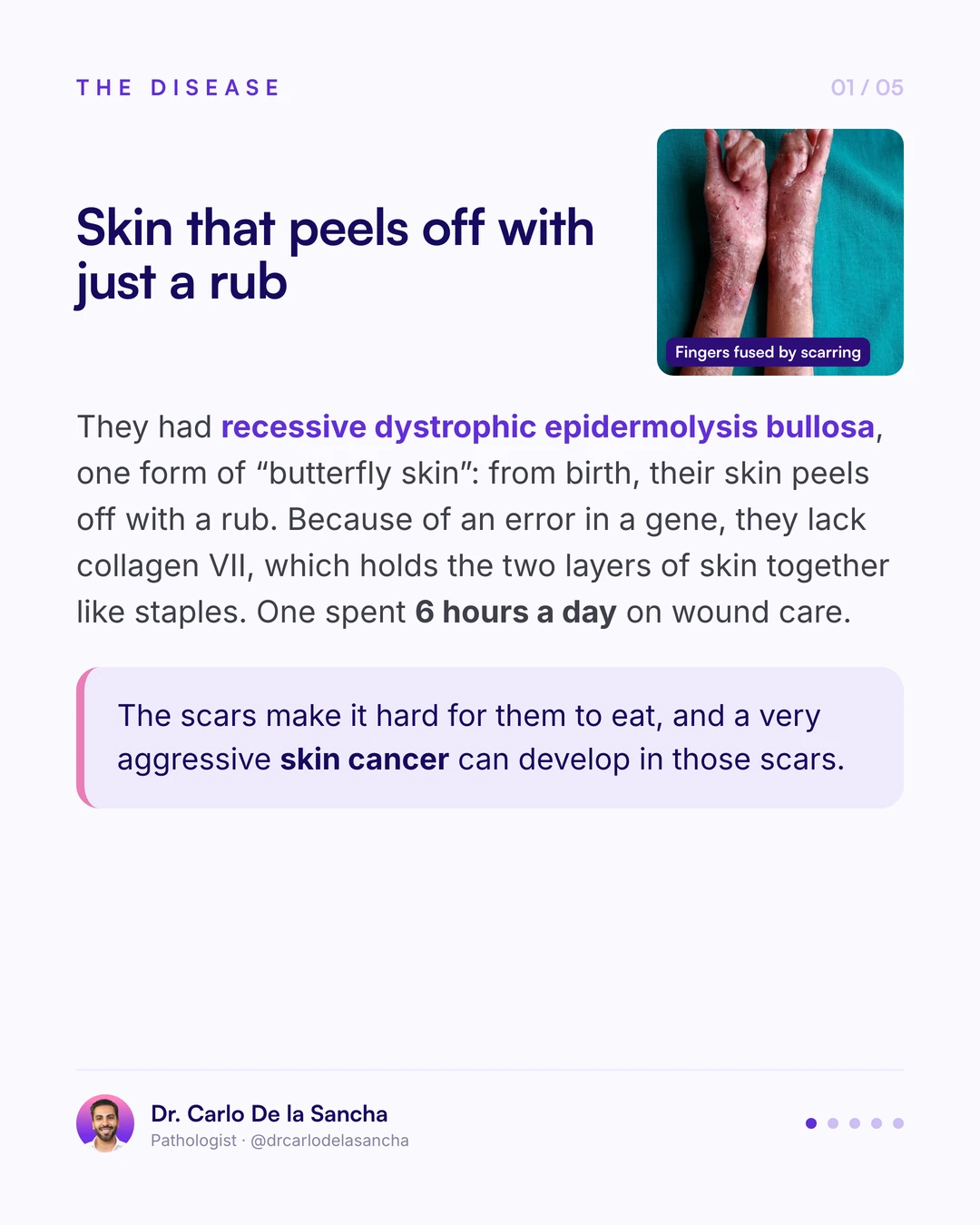
  • The disease 01 / 05 Skin that peels off with just a rub Fingers fused by scarring They had recessive dystrophic epidermolysis bullosa, one form of “butterfly skin”: from birth, their skin peels off with a rub. Because of an error in a gene, they lack collagen VII, which holds the two layers of skin together like staples. One spent 6 hours a day on wound care. The scars make it hard for them to eat, and a very aggressive skin cancer can develop in those scars. Dr. Carlo De la Sancha Pathologist · @drcarlodelasancha
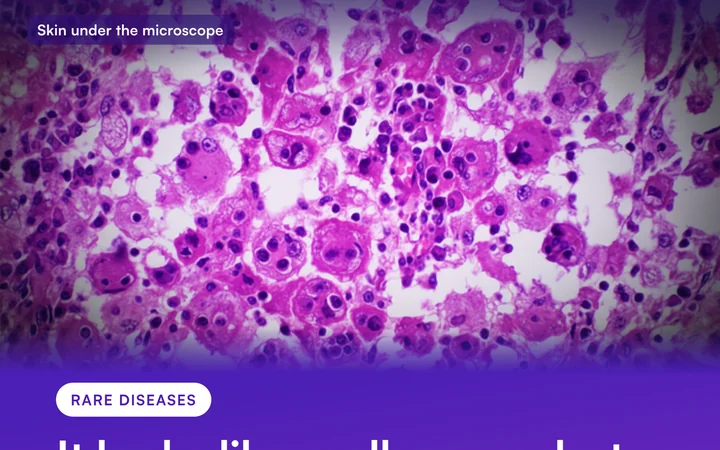
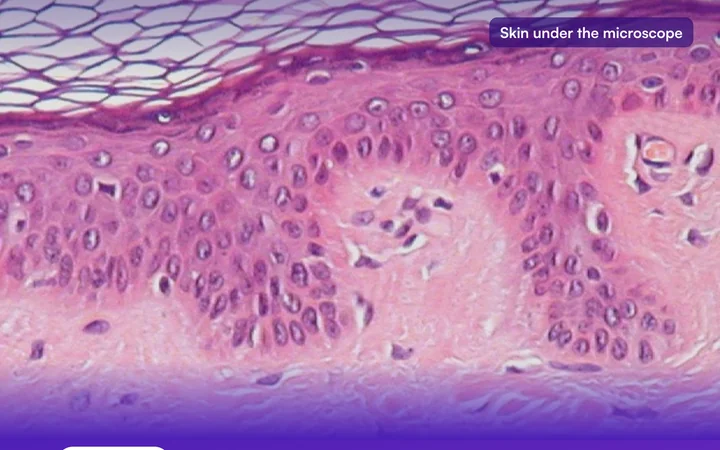
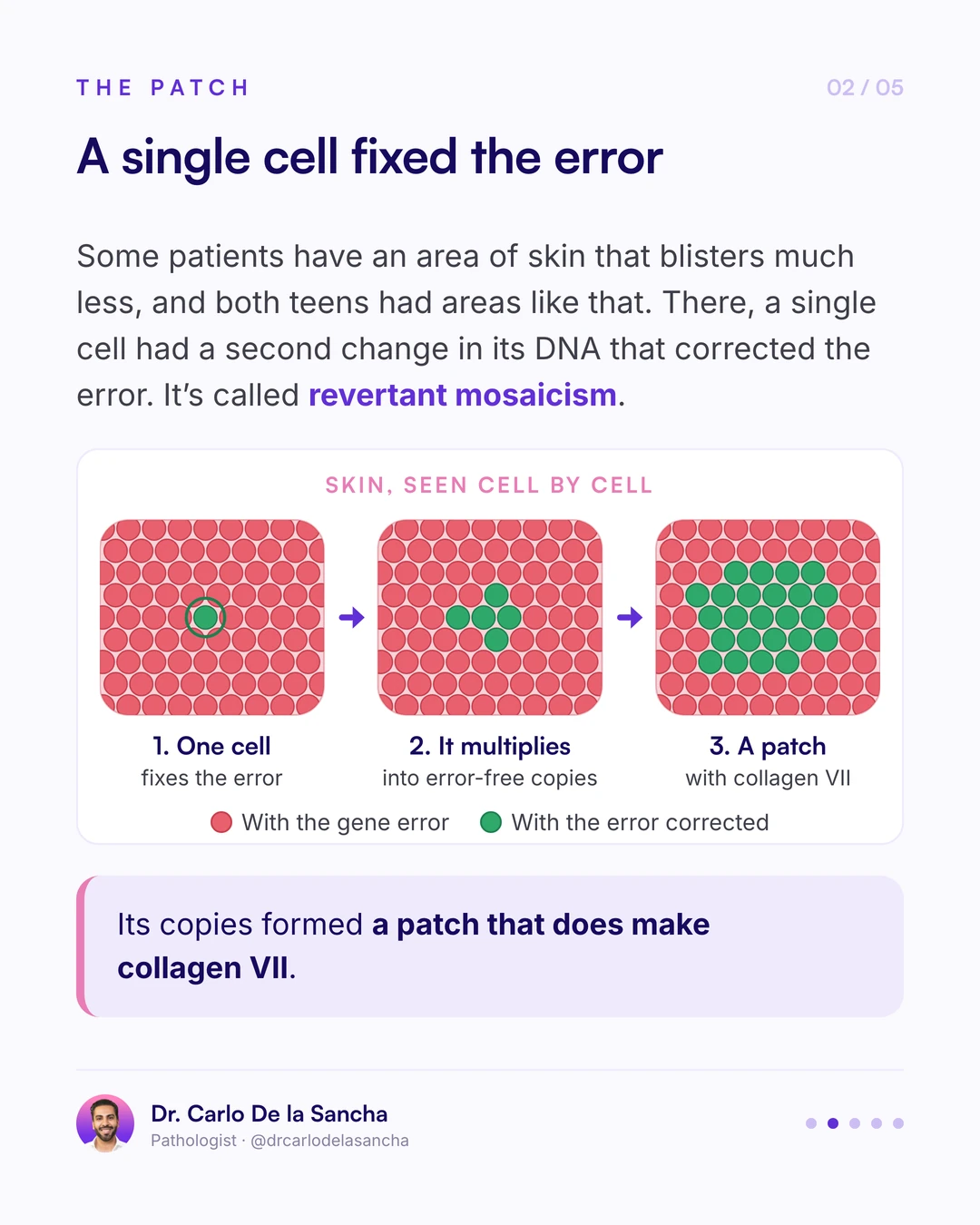
  • The patch 02 / 05 A single cell fixed the error Some patients have an area of skin that blisters much less, and both teens had areas like that. There, a single cell had a second change in its DNA that corrected the error. It’s called revertant mosaicism. Skin, seen cell by cell 1. One cell fixes the error 2. It multiplies into error-free copies 3. A patch with collagen VII With the gene error With the error corrected Its copies formed a patch that does make collagen VII. Dr. Carlo De la Sancha Pathologist · @drcarlodelasancha
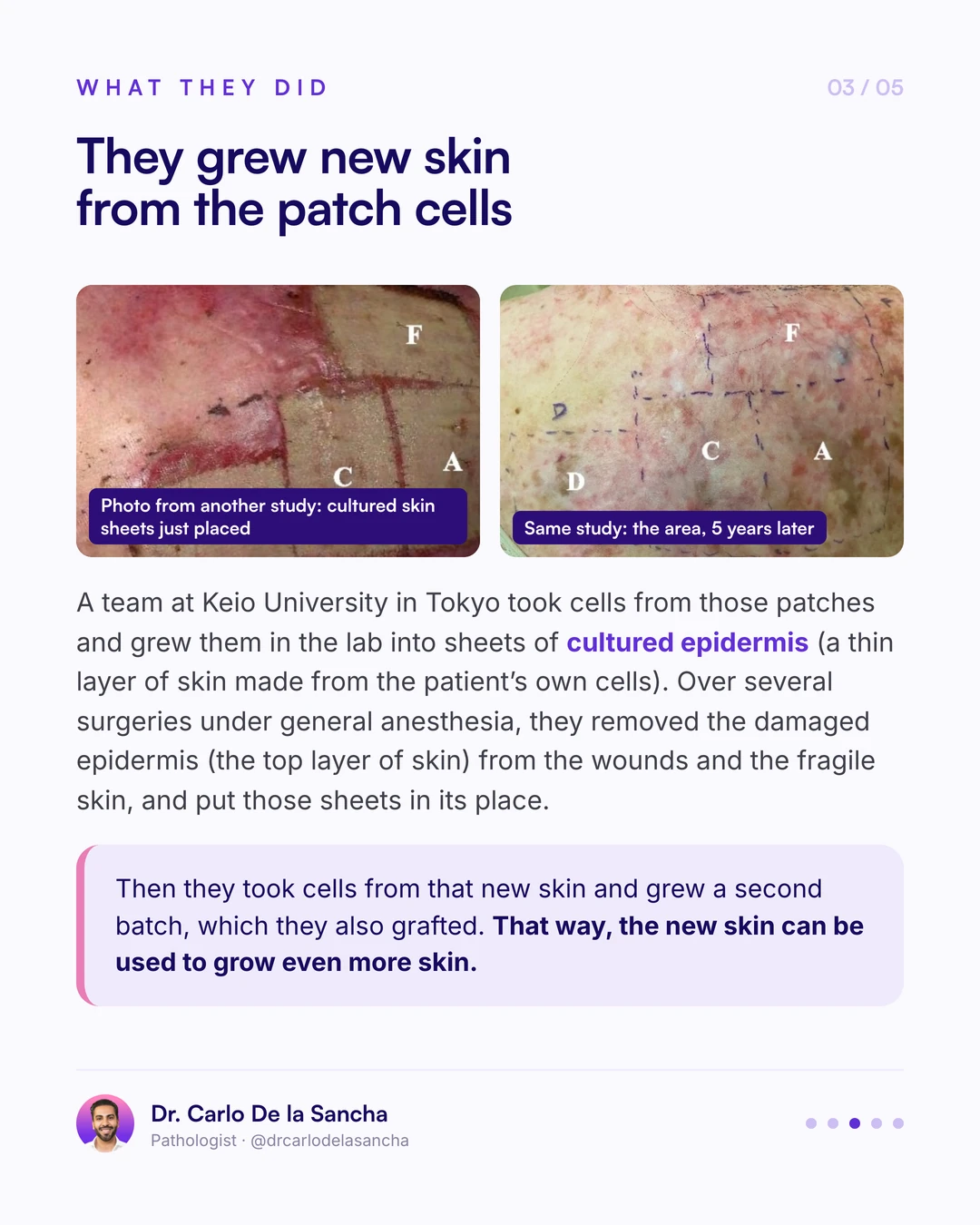
  • What they did 03 / 05 They grew new skin from the patch cells Photo from another study: cultured skin sheets just placed Same study: the area, 5 years later A team at Keio University in Tokyo took cells from those patches and grew them in the lab into sheets of cultured epidermis (a thin layer of skin made from the patient’s own cells). Over several surgeries under general anesthesia, they removed the damaged epidermis (the top layer of skin) from the wounds and the fragile skin, and put those sheets in its place. Then they took cells from that new skin and grew a second batch, which they also grafted. That way, the new skin can be used to grow even more skin. Dr. Carlo De la Sancha Pathologist · @drcarlodelasancha
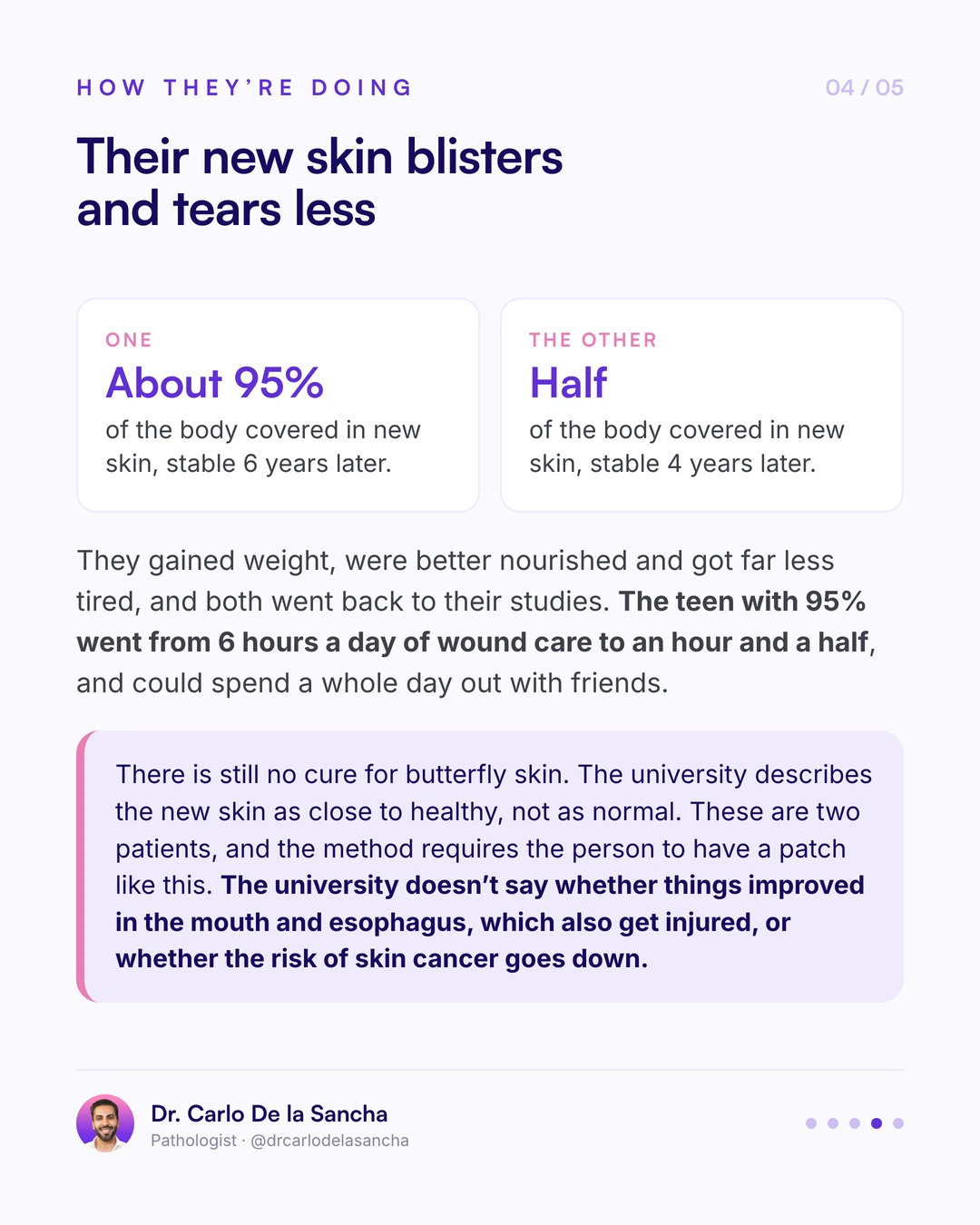
  • How they’re doing 04 / 05 Their new skin blisters and tears less One About 95% of the body covered in new skin, stable 6 years later. The other Half of the body covered in new skin, stable 4 years later. They gained weight, were better nourished and got far less tired, and both went back to their studies. The teen with 95% went from 6 hours a day of wound care to an hour and a half, and could spend a whole day out with friends. There is still no cure for butterfly skin. The university describes the new skin as close to healthy, not as normal. These are two patients, and the method requires the person to have a patch like this. The university doesn’t say whether things improved in the mouth and esophagus, which also get injured, or whether the risk of skin cancer goes down. Dr. Carlo De la Sancha Pathologist · @drcarlodelasancha
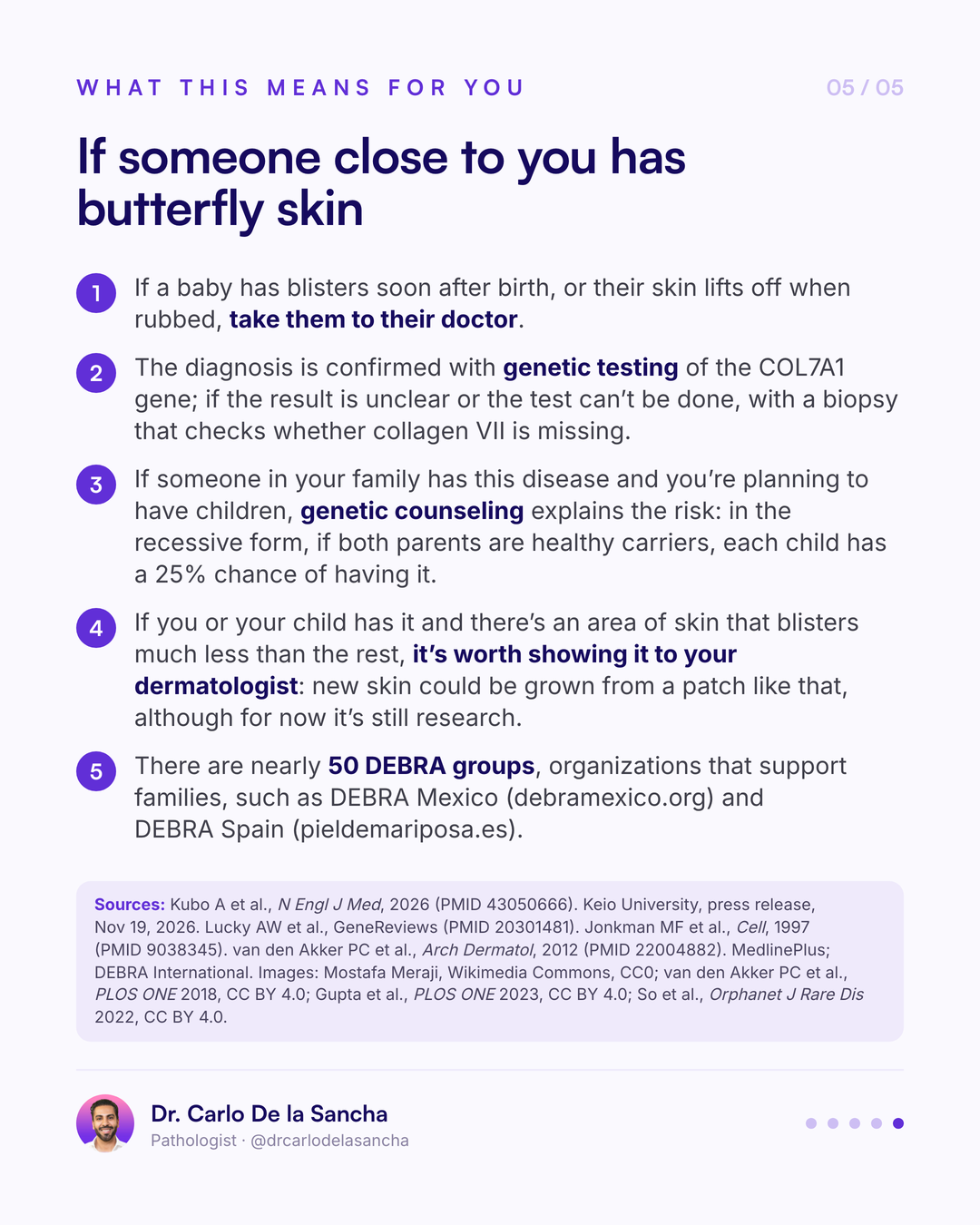
  • What this means for you 05 / 05 If someone close to you has butterfly skin If a baby has blisters soon after birth, or their skin lifts off when rubbed, take them to their doctor. The diagnosis is confirmed with genetic testing of the COL7A1 gene; if the result is unclear or the test can’t be done, with a biopsy that checks whether collagen VII is missing. If someone in your family has this disease and you’re planning to have children, genetic counseling explains the risk: in the recessive form, if both parents are healthy carriers, each child has a 25% chance of having it. If you or your child has it and there’s an area of skin that blisters much less than the rest, it’s worth showing it to your dermatologist: new skin could be grown from a patch like that, although for now it’s still research. There are nearly 50 DEBRA groups, organizations that support families, such as DEBRA Mexico (debramexico.org) and DEBRA Spain (pieldemariposa.es). Sources: Kubo A et al., N Engl J Med, 2026 (PMID 43050666). Keio University, press release, Nov 19, 2026. Lucky AW et al., GeneReviews (PMID 20301481). Jonkman MF et al., Cell, 1997 (PMID 9038345). van den Akker PC et al., Arch Dermatol, 2012 (PMID 22004882). MedlinePlus; DEBRA International. Images: Mostafa Meraji, Wikimedia Commons, CC0; van den Akker PC et al., PLOS ONE 2018, CC BY 4.0; Gupta et al., PLOS ONE 2023, CC BY 4.0; So et al., Orphanet J Rare Dis 2022, CC BY 4.0. Dr. Carlo De la Sancha Pathologist · @drcarlodelasancha
  • Want to understand your body? Subscribe to my newsletter: drcarlodelasancha.com/en/newsletter Save it, share it and follow me → @drcarlodelasancha Educational content. Not a substitute for a visit to your doctor.

Know someone who would find this helpful?

Share it with them.