

YOUR BODY · SLIDE BY SLIDE

The new tattoo that broke out in bumps

They didn't hurt or itch, and under the microscope they looked like a reaction to the ink.

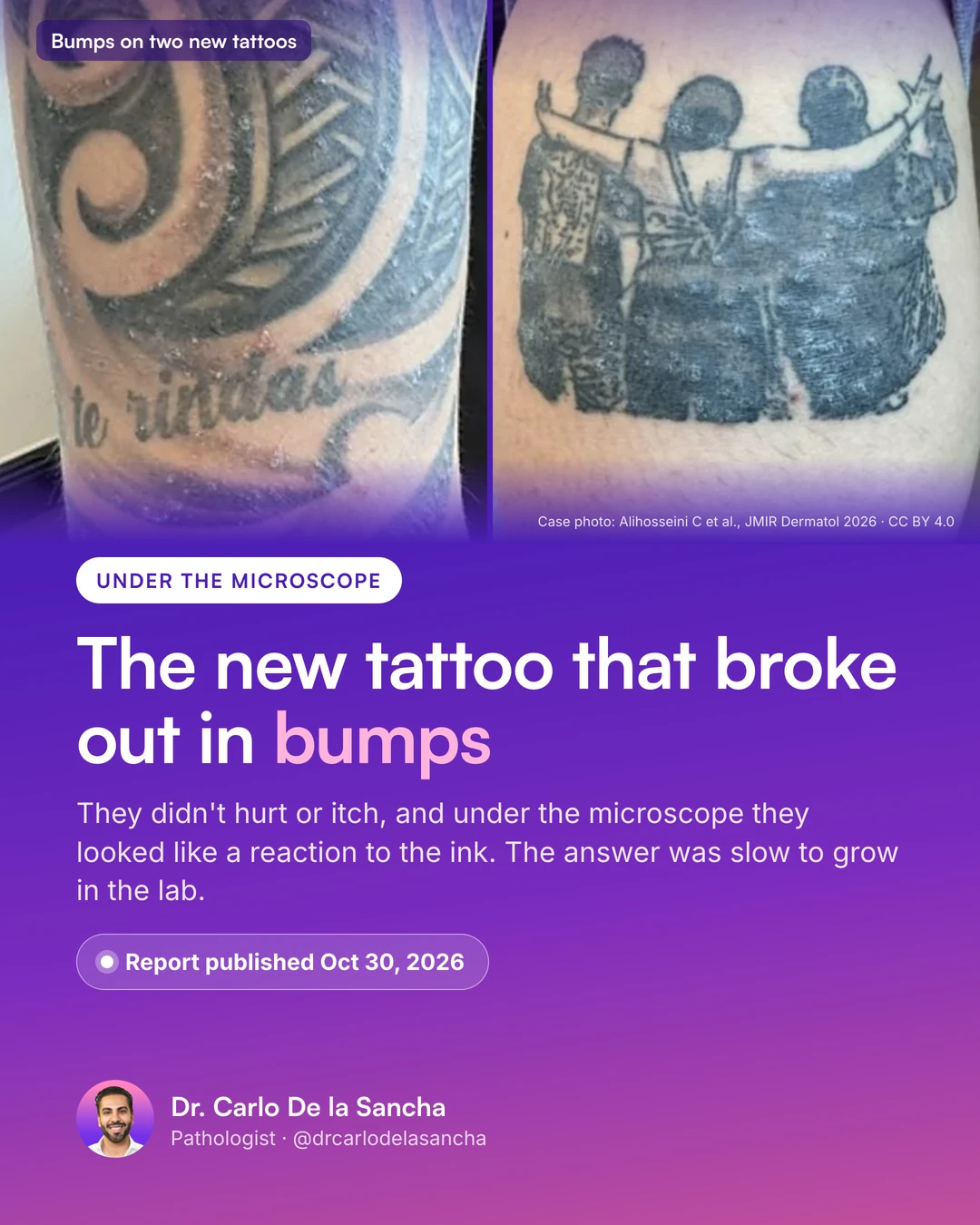
  • Bumps on two new tattoos Case photo: Alihosseini C et al., JMIR Dermatol 2026 · CC BY 4.0 Under the microscope The new tattoo that broke out in bumps They didn't hurt or itch, and under the microscope they looked like a reaction to the ink. The answer was slow to grow in the lab. Report published Oct 30, 2026 Dr. Carlo De la Sancha Pathologist · @drcarlodelasancha
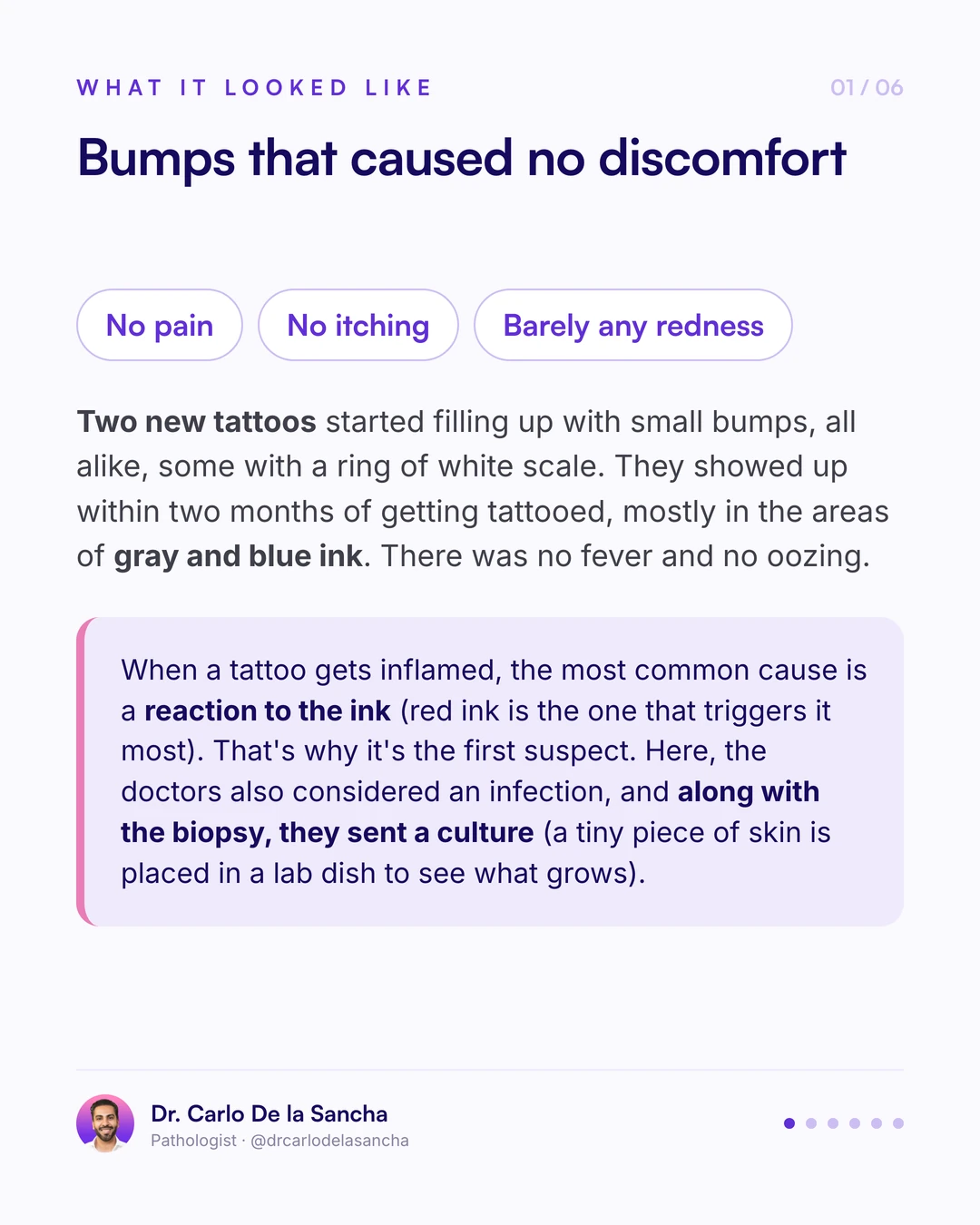
  • What it looked like 01 / 06 Bumps that caused no discomfort No pain No itching Barely any redness Two new tattoos started filling up with small bumps, all alike, some with a ring of white scale. They showed up within two months of getting tattooed, mostly in the areas of gray and blue ink. There was no fever and no oozing. When a tattoo gets inflamed, the most common cause is a reaction to the ink (red ink is the one that triggers it most). That's why it's the first suspect. Here, the doctors also considered an infection, and along with the biopsy, they sent a culture (a tiny piece of skin is placed in a lab dish to see what grows). Dr. Carlo De la Sancha Pathologist · @drcarlodelasancha
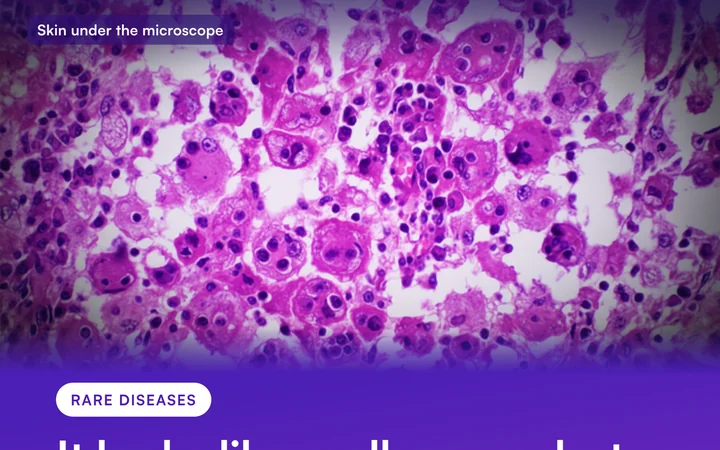
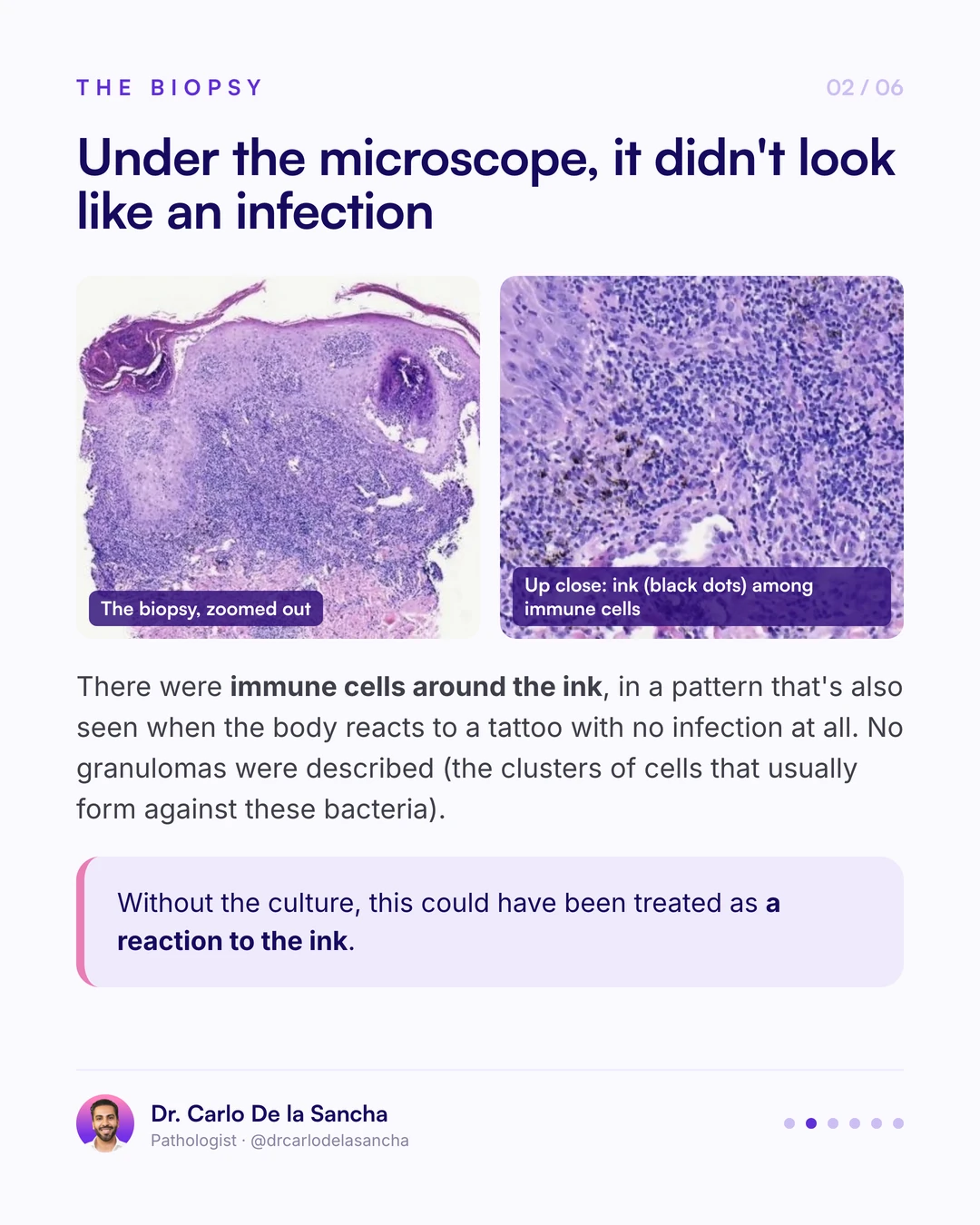
  • The biopsy 02 / 06 Under the microscope, it didn't look like an infection The biopsy, zoomed out Up close: ink (black dots) among immune cells There were immune cells around the ink, in a pattern that's also seen when the body reacts to a tattoo with no infection at all. No granulomas were described (the clusters of cells that usually form against these bacteria). Without the culture, this could have been treated as a reaction to the ink. Dr. Carlo De la Sancha Pathologist · @drcarlodelasancha
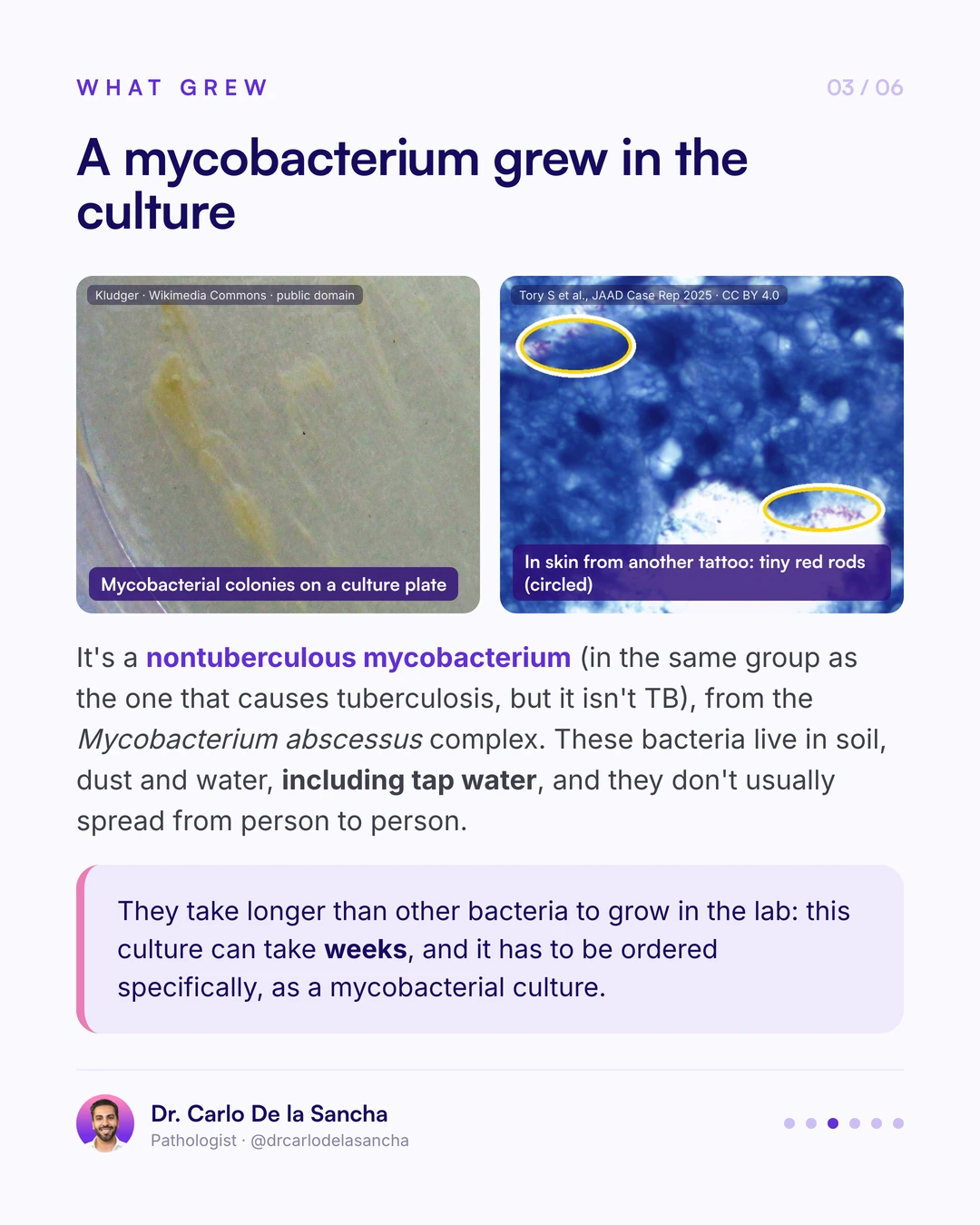
  • What grew 03 / 06 A mycobacterium grew in the culture Mycobacterial colonies on a culture plate Kludger · Wikimedia Commons · public domain In skin from another tattoo: tiny red rods (circled) Tory S et al., JAAD Case Rep 2025 · CC BY 4.0 It's a nontuberculous mycobacterium (in the same group as the one that causes tuberculosis, but it isn't TB), from the Mycobacterium abscessus complex. These bacteria live in soil, dust and water, including tap water, and they don't usually spread from person to person. They take longer than other bacteria to grow in the lab: this culture can take weeks, and it has to be ordered specifically, as a mycobacterial culture. Dr. Carlo De la Sancha Pathologist · @drcarlodelasancha
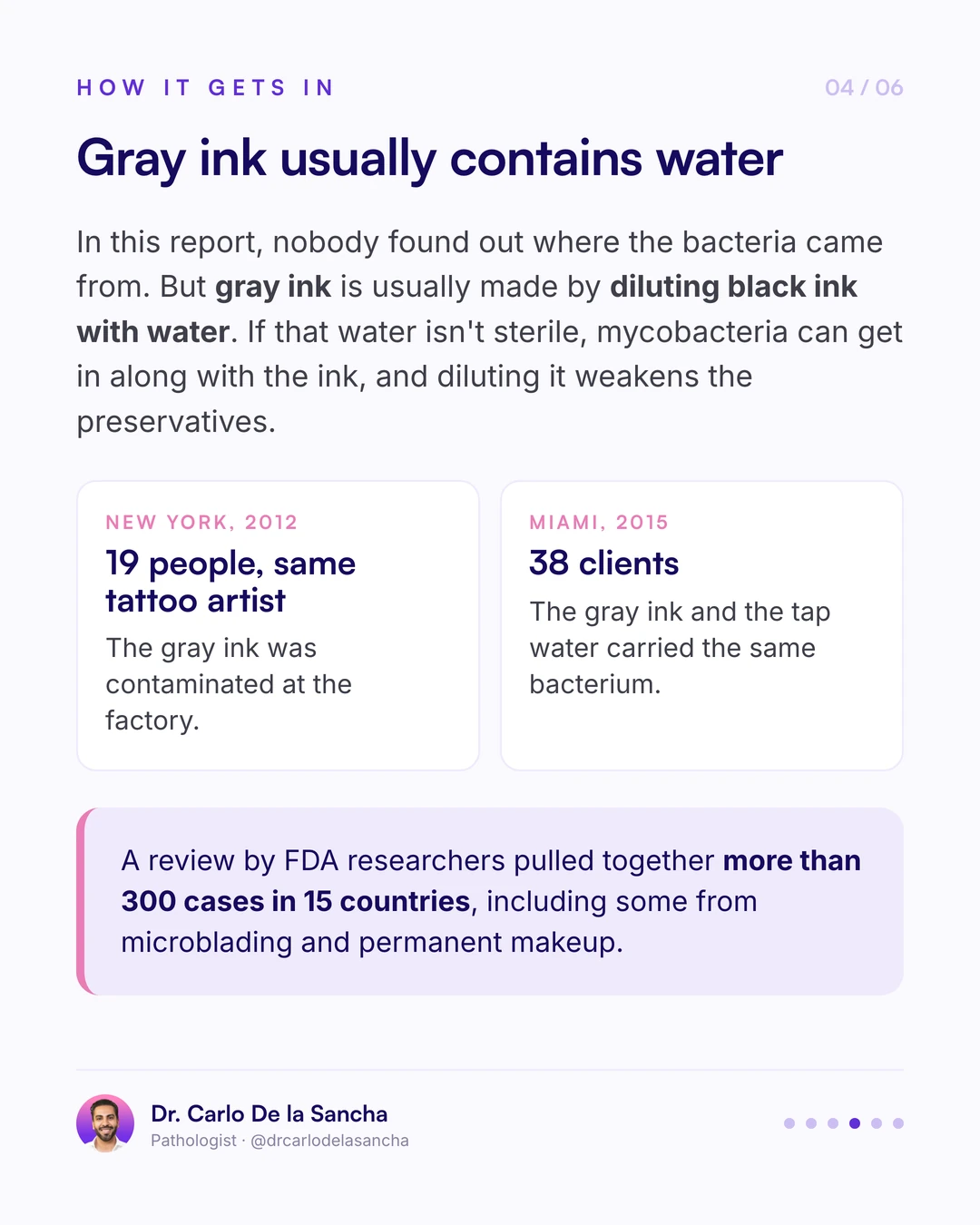
  • How it gets in 04 / 06 Gray ink usually contains water In this report, nobody found out where the bacteria came from. But gray ink is usually made by diluting black ink with water. If that water isn't sterile, mycobacteria can get in along with the ink, and diluting it weakens the preservatives. New York, 2012 19 people, same tattoo artist The gray ink was contaminated at the factory. Miami, 2015 38 clients The gray ink and the tap water carried the same bacterium. A review by FDA researchers pulled together more than 300 cases in 15 countries, including some from microblading and permanent makeup. Dr. Carlo De la Sancha Pathologist · @drcarlodelasancha
  • Why it slips by 05 / 06 Easily mistaken, and one antibiotic isn't enough In other reports: lumps and crusts Tory S et al., JAAD Case Rep 2025 · CC BY 4.0 In about 7 out of 10 published cases, the diagnosis was delayed or wrong at first, and many were first treated with steroid creams or pills. The bacterium is very elusive: there can be so few that, in about half of cases, the microscope doesn't pick it up. Treatment uses several antibiotics together, chosen based on lab testing, for months (usually 3 to 6). With the right treatment it usually gets better, and sometimes it leaves a scar. Dr. Carlo De la Sancha Pathologist · @drcarlodelasancha
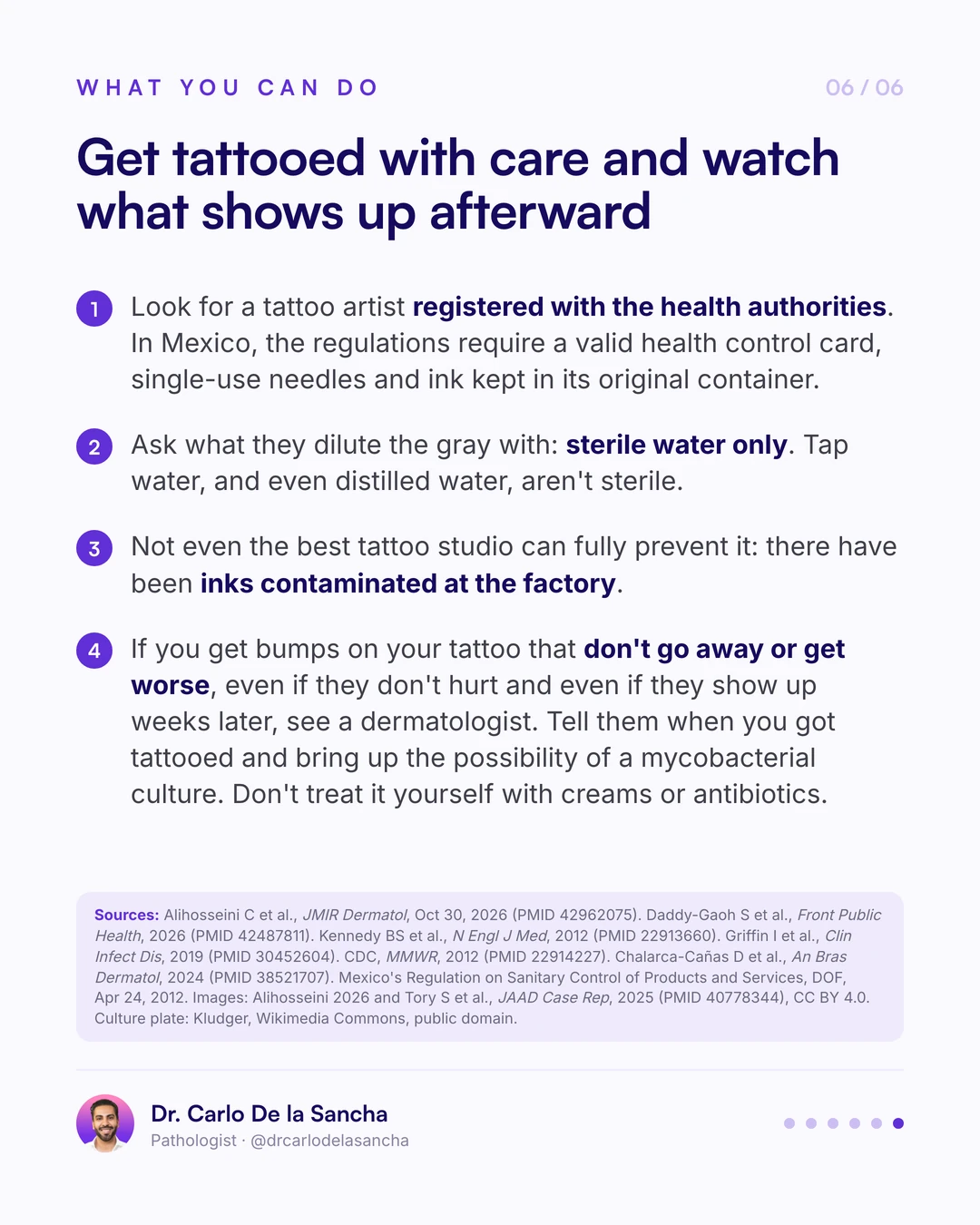
  • What you can do 06 / 06 Get tattooed with care and watch what shows up afterward Look for a tattoo artist registered with the health authorities. In Mexico, the regulations require a valid health control card, single-use needles and ink kept in its original container. Ask what they dilute the gray with: sterile water only. Tap water, and even distilled water, aren't sterile. Not even the best tattoo studio can fully prevent it: there have been inks contaminated at the factory. If you get bumps on your tattoo that don't go away or get worse, even if they don't hurt and even if they show up weeks later, see a dermatologist. Tell them when you got tattooed and bring up the possibility of a mycobacterial culture. Don't treat it yourself with creams or antibiotics. Sources: Alihosseini C et al., JMIR Dermatol, Oct 30, 2026 (PMID 42962075). Daddy-Gaoh S et al., Front Public Health, 2026 (PMID 42487811). Kennedy BS et al., N Engl J Med, 2012 (PMID 22913660). Griffin I et al., Clin Infect Dis, 2019 (PMID 30452604). CDC, MMWR, 2012 (PMID 22914227). Chalarca-Cañas D et al., An Bras Dermatol, 2024 (PMID 38521707). Mexico's Regulation on Sanitary Control of Products and Services, DOF, Apr 24, 2012. Images: Alihosseini 2026 and Tory S et al., JAAD Case Rep, 2025 (PMID 40778344), CC BY 4.0. Culture plate: Kludger, Wikimedia Commons, public domain. Dr. Carlo De la Sancha Pathologist · @drcarlodelasancha
  • Want to understand your body? Subscribe to my newsletter: drcarlodelasancha.com/en/newsletter Save it, share it and follow me → @drcarlodelasancha Educational content. Not a substitute for a visit to your doctor.

Know someone who would find this helpful?

Share it with them.