
YOUR BODY · SLIDE BY SLIDE

Your skin makes vitamin D and knows when to stop

How your skin makes it and then stops, in four steps.

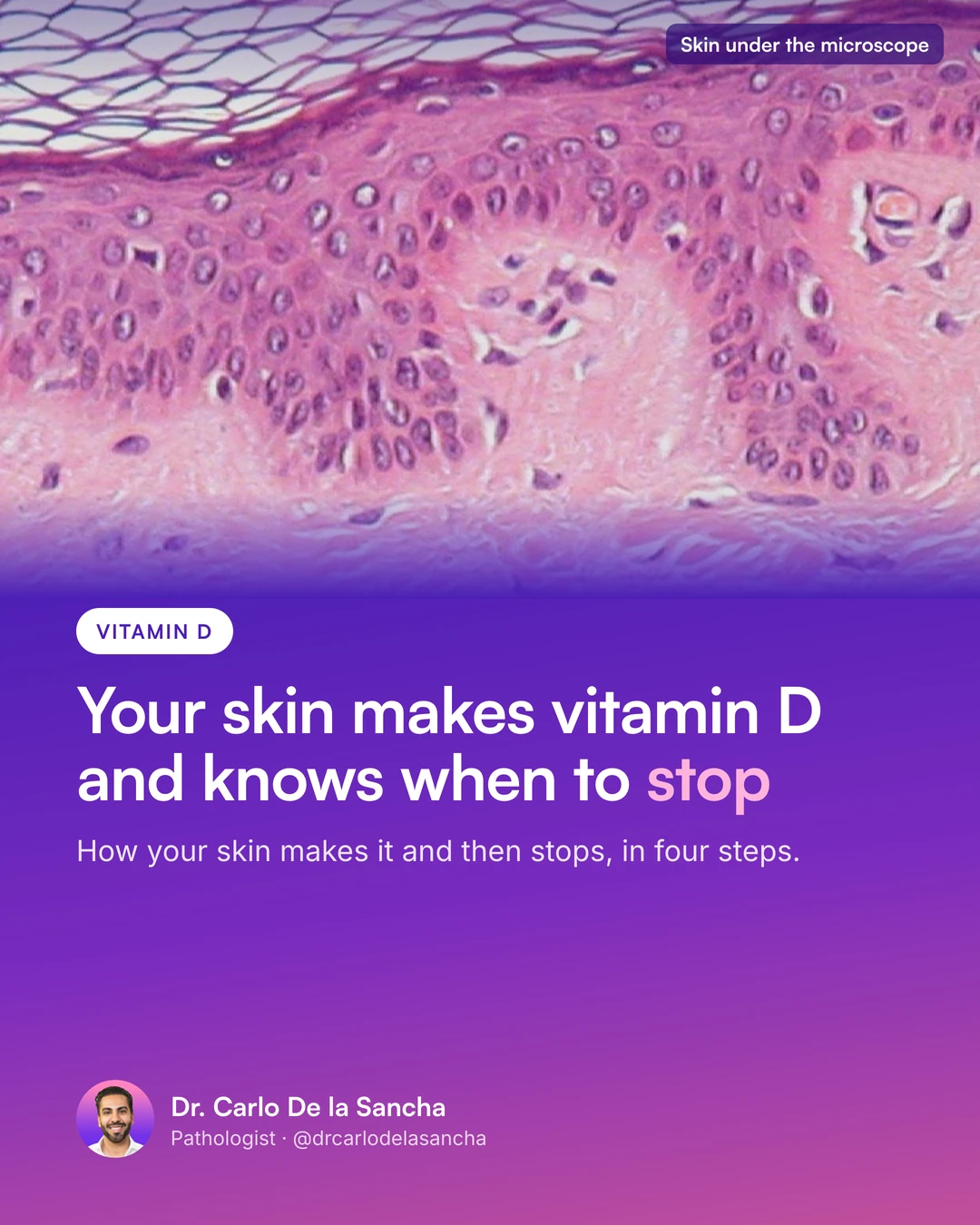
  • Skin under the microscope Vitamin D Your skin makes vitamin D and knows when to stop How your skin makes it and then stops, in four steps. Dr. Carlo De la Sancha Pathologist · @drcarlodelasancha
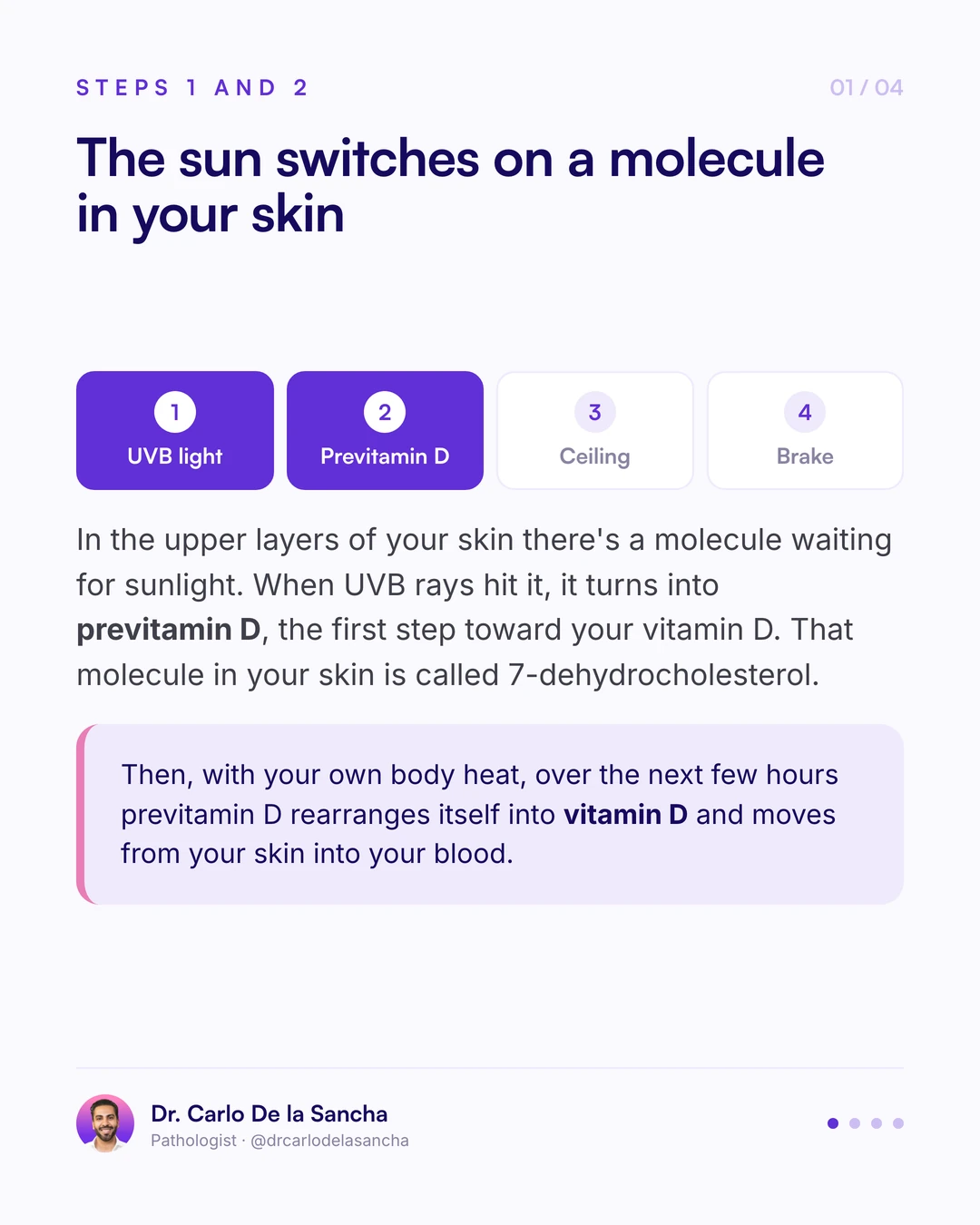
  • Steps 1 and 2 01 / 04 The sun switches on a molecule in your skin UVB light Previtamin D Ceiling Brake In the upper layers of your skin there's a molecule waiting for sunlight. When UVB rays hit it, it turns into previtamin D, the first step toward your vitamin D. That molecule in your skin is called 7‑dehydrocholesterol. Then, with your own body heat, over the next few hours previtamin D rearranges itself into vitamin D and moves from your skin into your blood. Dr. Carlo De la Sancha Pathologist · @drcarlodelasancha
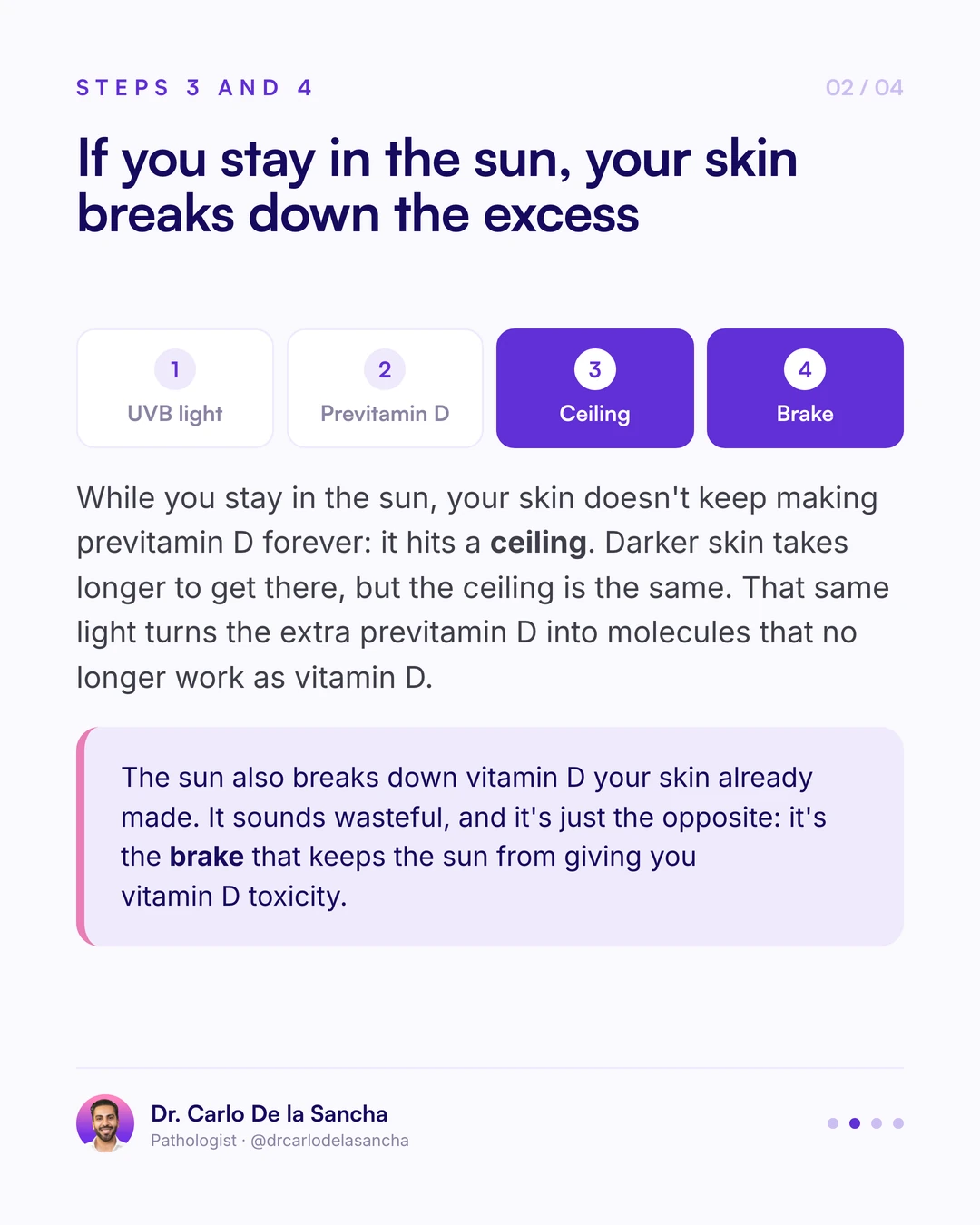
  • Steps 3 and 4 02 / 04 If you stay in the sun, your skin breaks down the excess UVB light Previtamin D Ceiling Brake While you stay in the sun, your skin doesn't keep making previtamin D forever: it hits a ceiling. Darker skin takes longer to get there, but the ceiling is the same. That same light turns the extra previtamin D into molecules that no longer work as vitamin D. The sun also breaks down vitamin D your skin already made. It sounds wasteful, and it's just the opposite: it's the brake that keeps the sun from giving you vitamin D toxicity. Dr. Carlo De la Sancha Pathologist · @drcarlodelasancha
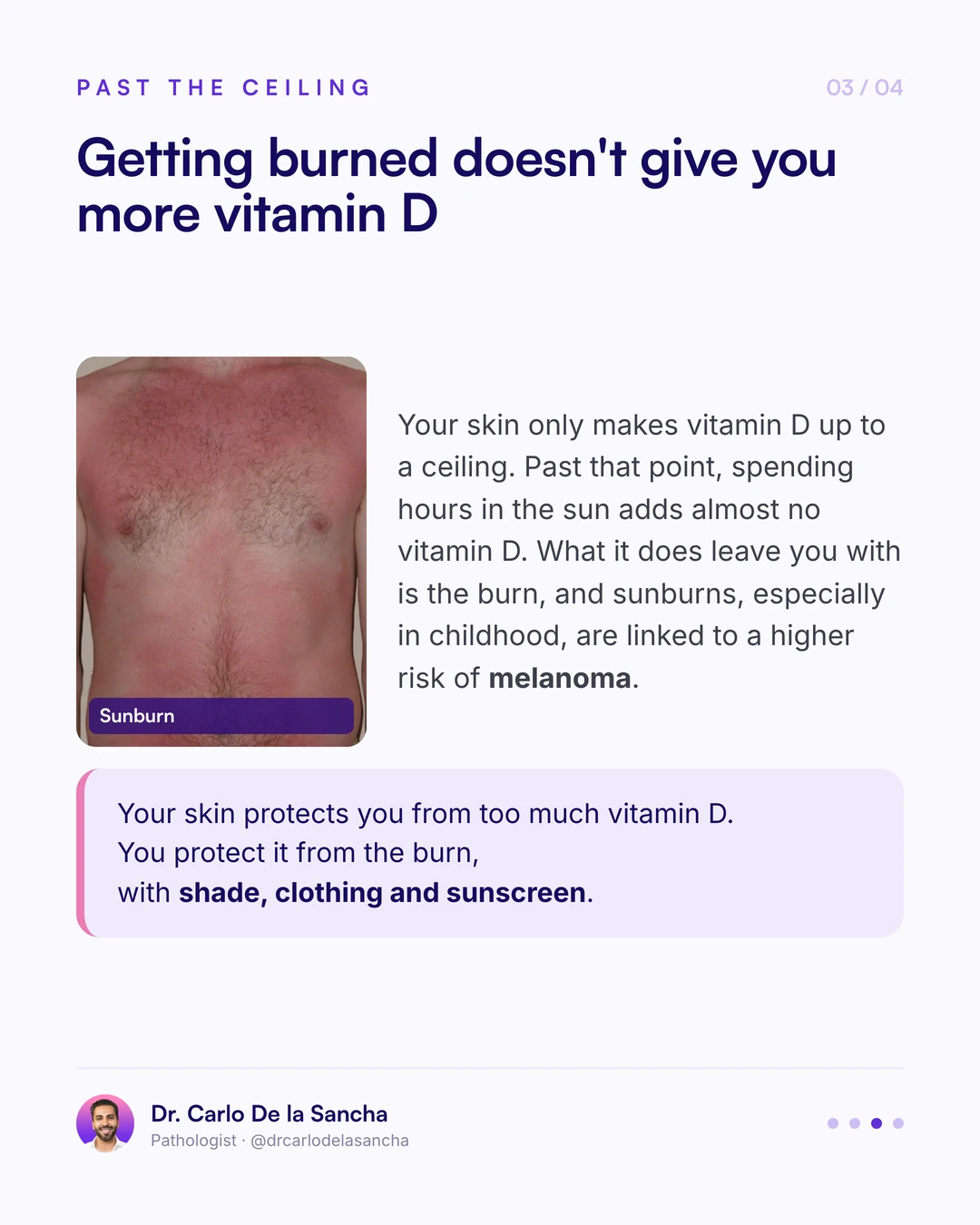
  • Past the ceiling 03 / 04 Getting burned doesn't give you more vitamin D Sunburn Your skin only makes vitamin D up to a ceiling. Past that point, spending hours in the sun adds almost no vitamin D. What it does leave you with is the burn, and sunburns, especially in childhood, are linked to a higher risk of melanoma. Your skin protects you from too much vitamin D. You protect it from the burn, with shade, clothing and sunscreen. Dr. Carlo De la Sancha Pathologist · @drcarlodelasancha
  • What helps you 04 / 04 Your skin does its part; this part is up to you Use your sunscreen without worry: a review of 76 studies found that, the way it's used in real life, it doesn't leave you short on vitamin D. The sun can't give you vitamin D toxicity. Very high doses of supplements can: they raise the calcium in your blood. If you're worried about your vitamin D, ask your doctor whether you need to have it checked or take a supplement, and at what dose. Sources: Holick MF et al., Science 1981 (PMID 6256855). Webb AR et al., J Clin Endocrinol Metab 1989 (PMID 2541158). Wacker M, Holick MF, Dermatoendocrinol 2013 (PMID 24494042). Neale RE et al., Br J Dermatol 2019 (PMID 30945275). Marcinowska-Suchowierska E et al., Front Endocrinol 2018 (PMID 30294301). WHO. Images: skin, Kilbad and M. Häggström, CC0; sunburn, QuinnHK, public domain. Dr. Carlo De la Sancha Pathologist · @drcarlodelasancha
  • Want to understand your body? Subscribe to my newsletter: drcarlodelasancha.com/en/newsletter Save it, share it and follow me → @drcarlodelasancha Educational content. Not a substitute for a visit to your doctor.

Know someone who would find this helpful?

Share it with them.