
YOUR BODY · SLIDE BY SLIDE

Your tears carry an antibacterial Fleming found before penicillin

How your tears protect your eye, in four steps.

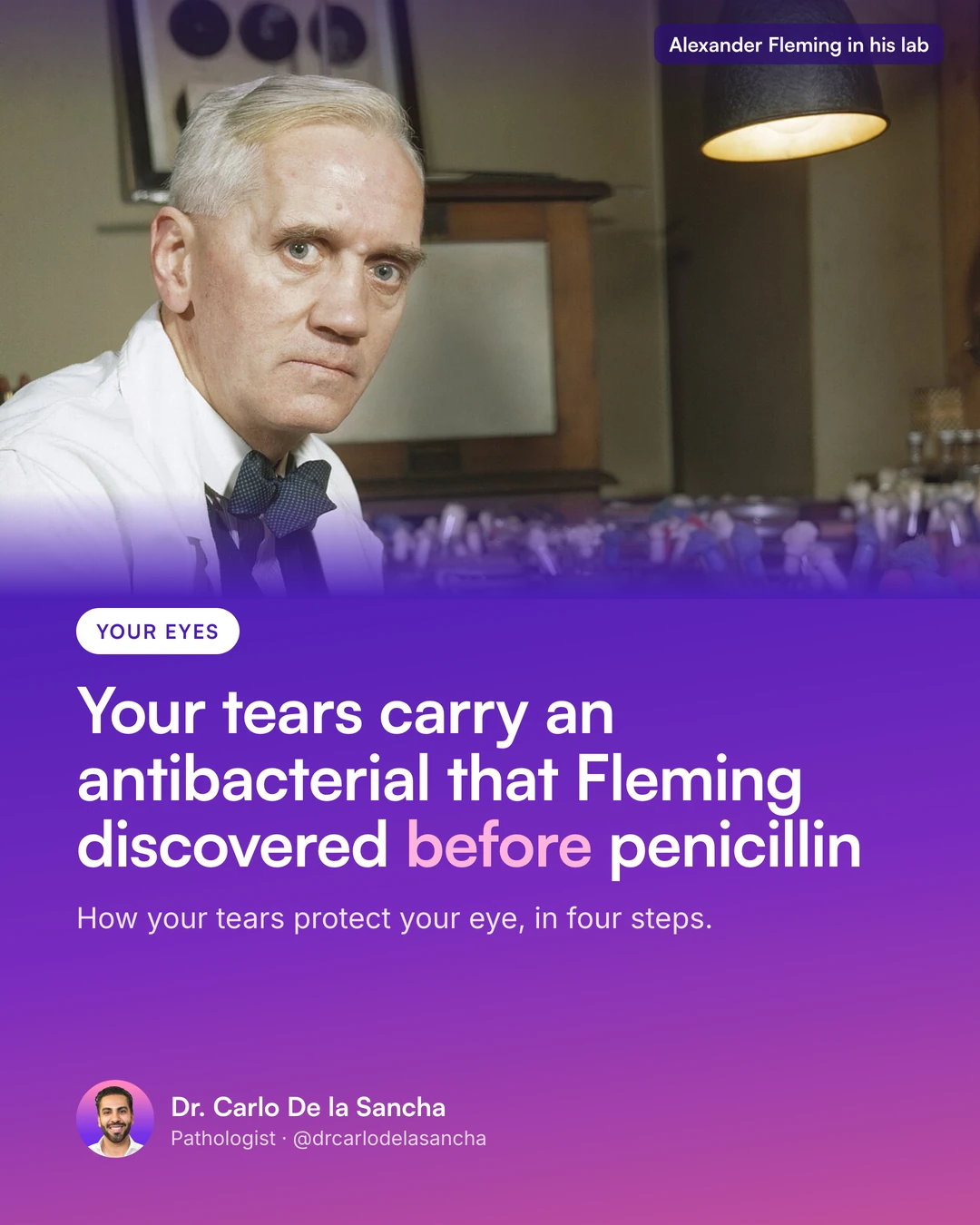
  • Alexander Fleming in his lab Your eyes Your tears carry an antibacterial that Fleming discovered before penicillin How your tears protect your eye, in four steps. Dr. Carlo De la Sancha Pathologist · @drcarlodelasancha
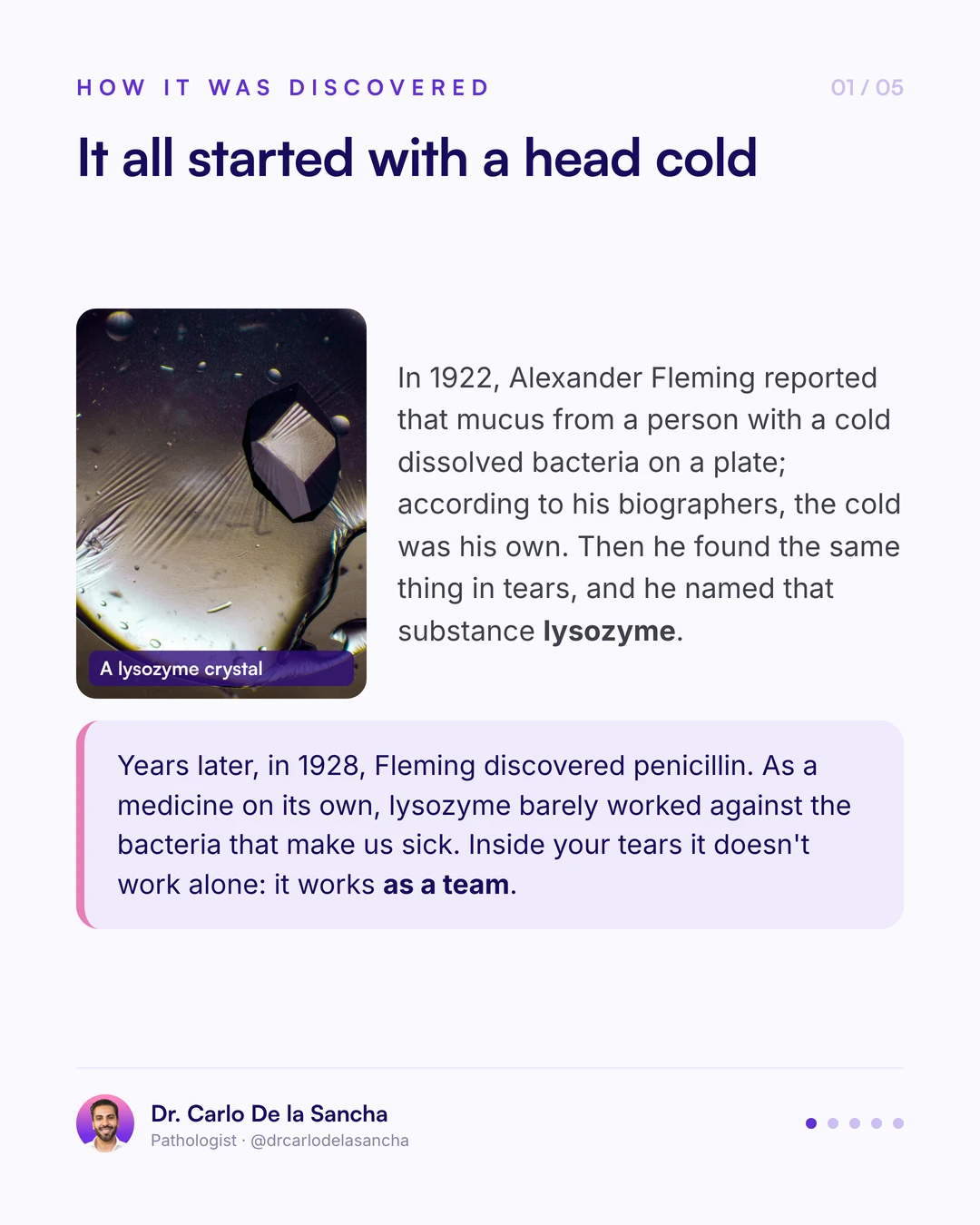
  • How it was discovered 01 / 05 It all started with a head cold A lysozyme crystal In 1922, Alexander Fleming reported that mucus from a person with a cold dissolved bacteria on a plate; according to his biographers, the cold was his own. Then he found the same thing in tears, and he named that substance lysozyme. Years later, in 1928, Fleming discovered penicillin. As a medicine on its own, lysozyme barely worked against the bacteria that make us sick. Inside your tears it doesn't work alone: it works as a team. Dr. Carlo De la Sancha Pathologist · @drcarlodelasancha
  • Steps 1 and 2 02 / 05 Your lacrimal gland makes lysozyme 1 Lacrimal gland 2 Lysozyme 3 Broken wall 4 Blinking Up in the outer corner of each eye sits your lacrimal gland. It makes the watery part of your tears and, along with it, their defenses. Your tears hold more than 1,500 proteins, and lysozyme is one of the most abundant: 20 to 30% of the total. Even when you cry a lot, like when you chop onions, your gland raises lysozyme almost in step with the water. So your tears don't get watered down: each drop carries nearly the same defense. Dr. Carlo De la Sancha Pathologist · @drcarlodelasancha
  • Step 3 03 / 05 Lysozyme breaks the bacterium's wall 1 Lacrimal gland 2 Lysozyme 3 Broken wall 4 Blinking Lysozyme is an enzyme, a protein that cuts. Many bacteria protect themselves with a wall made of a mesh of sugars called peptidoglycan. Lysozyme cuts the bonds in that mesh, and with its wall broken, the bacterium can no longer withstand the pressure inside it and bursts. Gram-negative bacteria are a bit harder for it: they carry an extra outer membrane that lysozyme can barely get through, and against some of them, the lactoferrin in your tears can clear the way. Dr. Carlo De la Sancha Pathologist · @drcarlodelasancha
  • Step 4 04 / 05 Every blink spreads your tears 1 Lacrimal gland 2 Lysozyme 3 Broken wall 4 Blinking Your tears don't just sit in a little puddle: every blink spreads them over your eye in a layer just a few thousandths of a millimeter thick. On the outside, an oily film covers it and slows evaporation. That film comes from the meibomian glands, along the edge of your eyelids. And in that tear layer, lysozyme isn't alone: lactoferrin deprives bacteria of iron, and there are antibodies and other defense proteins. A whole team protects your eye. Dr. Carlo De la Sancha Pathologist · @drcarlodelasancha
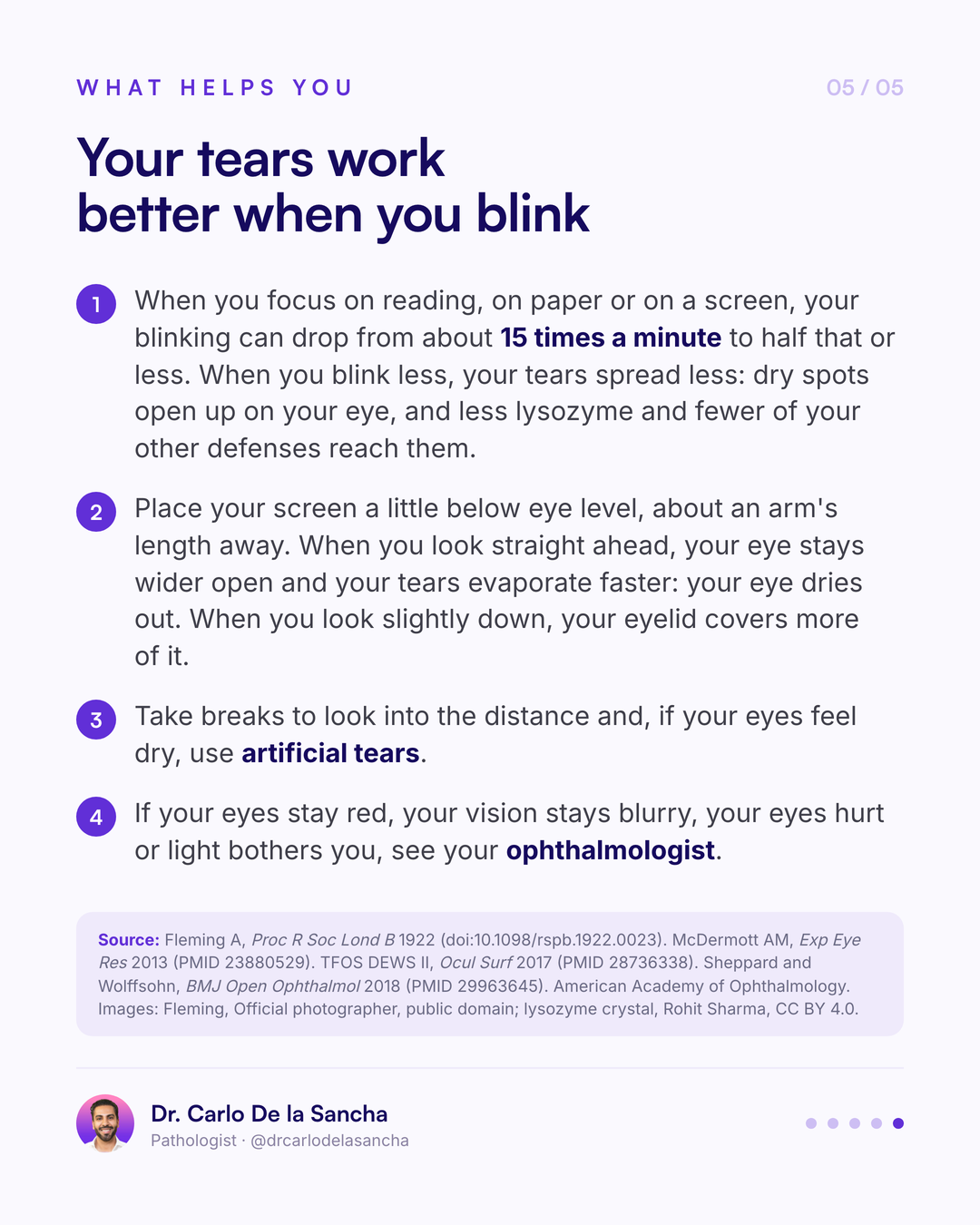
  • What helps you 05 / 05 Your tears work better when you blink When you focus on reading, on paper or on a screen, your blinking can drop from about 15 times a minute to half that or less. When you blink less, your tears spread less: dry spots open up on your eye, and less lysozyme and fewer of your other defenses reach them. Place your screen a little below eye level, about an arm's length away. When you look straight ahead, your eye stays wider open and your tears evaporate faster: your eye dries out. When you look slightly down, your eyelid covers more of it. Take breaks to look into the distance and, if your eyes feel dry, use artificial tears. If your eyes stay red, your vision stays blurry, your eyes hurt or light bothers you, see your ophthalmologist. Source: Fleming A, Proc R Soc Lond B 1922 (doi:10.1098/rspb.1922.0023). McDermott AM, Exp Eye Res 2013 (PMID 23880529). TFOS DEWS II, Ocul Surf 2017 (PMID 28736338). Sheppard and Wolffsohn, BMJ Open Ophthalmol 2018 (PMID 29963645). American Academy of Ophthalmology. Images: Fleming, Official photographer, public domain; lysozyme crystal, Rohit Sharma, CC BY 4.0. Dr. Carlo De la Sancha Pathologist · @drcarlodelasancha
  • Want to understand your body? Subscribe to my newsletter: drcarlodelasancha.com/en/newsletter Save it, share it and follow me → @drcarlodelasancha Educational content. Not a substitute for a visit to your doctor.

Know someone who would find this helpful?

Share it with them.