
YOUR BODY · SLIDE BY SLIDE

Fever: your brain raises your temperature on purpose

This is how your body does it, in four steps.

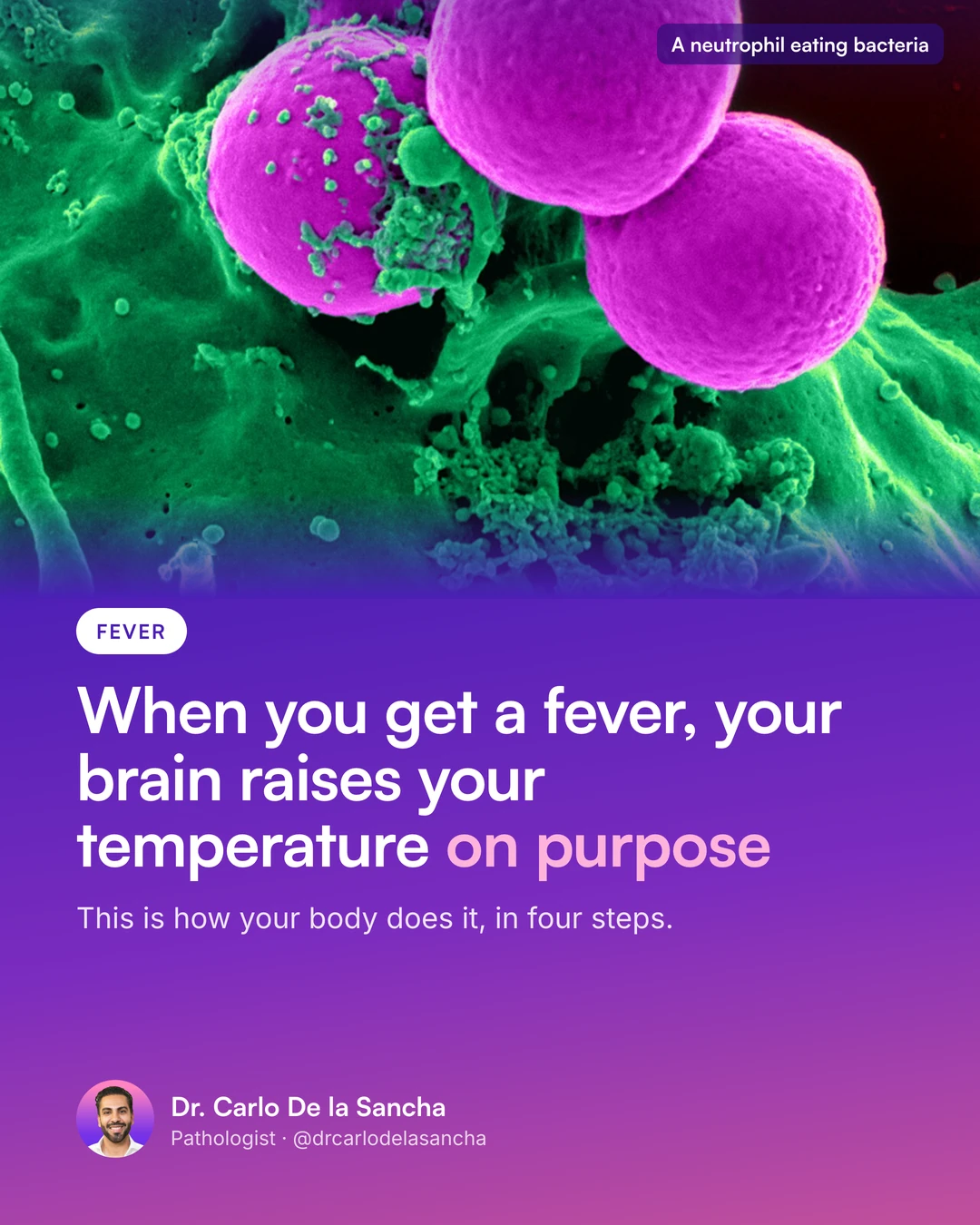
  • A neutrophil eating bacteria Fever When you get a fever, your brain raises your temperature on purpose This is how your body does it, in four steps. Dr. Carlo De la Sancha Pathologist · @drcarlodelasancha
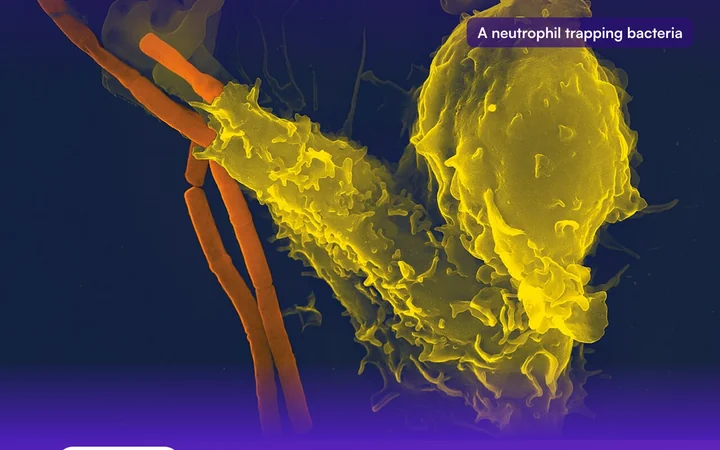
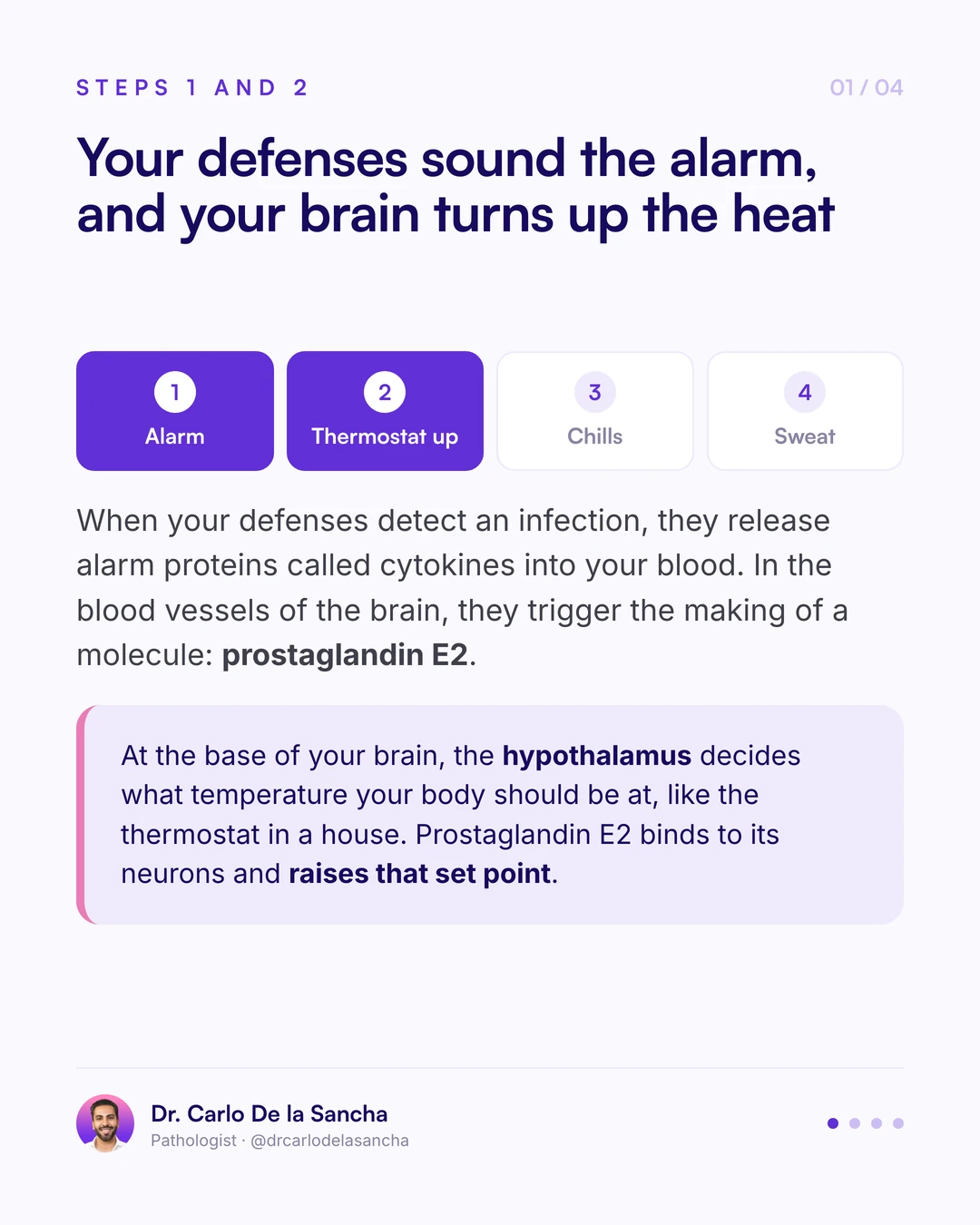
  • Steps 1 and 2 01 / 04 Your defenses sound the alarm, and your brain turns up the heat Alarm Thermostat up Chills Sweat When your defenses detect an infection, they release alarm proteins called cytokines into your blood. In the blood vessels of the brain, they trigger the making of a molecule: prostaglandin E2. At the base of your brain, the hypothalamus decides what temperature your body should be at, like the thermostat in a house. Prostaglandin E2 binds to its neurons and raises that set point. Dr. Carlo De la Sancha Pathologist · @drcarlodelasancha
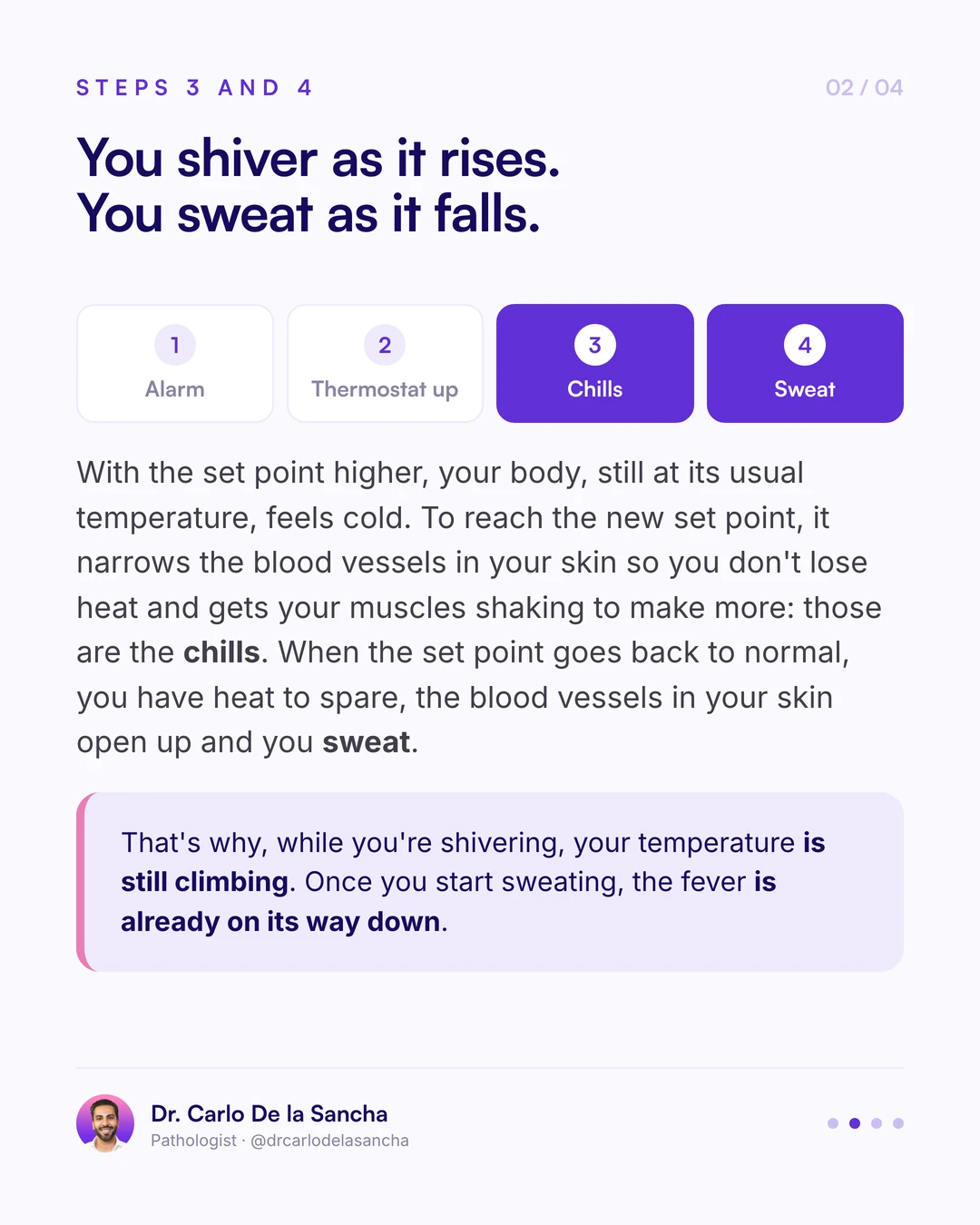
  • Steps 3 and 4 02 / 04 You shiver as it rises. You sweat as it falls. Alarm Thermostat up Chills Sweat With the set point higher, your body, still at its usual temperature, feels cold. To reach the new set point, it narrows the blood vessels in your skin so you don't lose heat and gets your muscles shaking to make more: those are the chills. When the set point goes back to normal, you have heat to spare, the blood vessels in your skin open up and you sweat. That's why, while you're shivering, your temperature is still climbing. Once you start sweating, the fever is already on its way down. Dr. Carlo De la Sancha Pathologist · @drcarlodelasancha
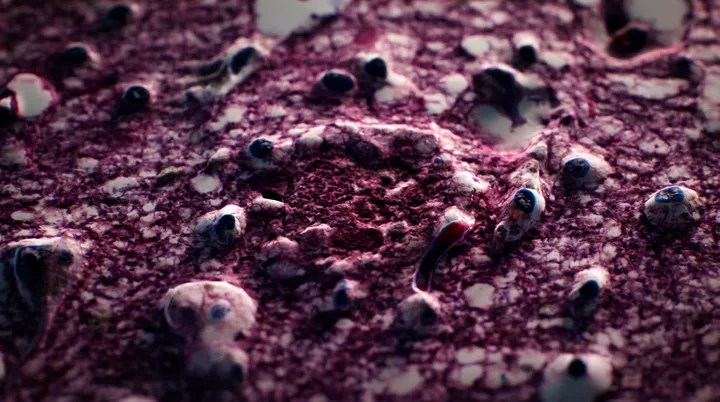
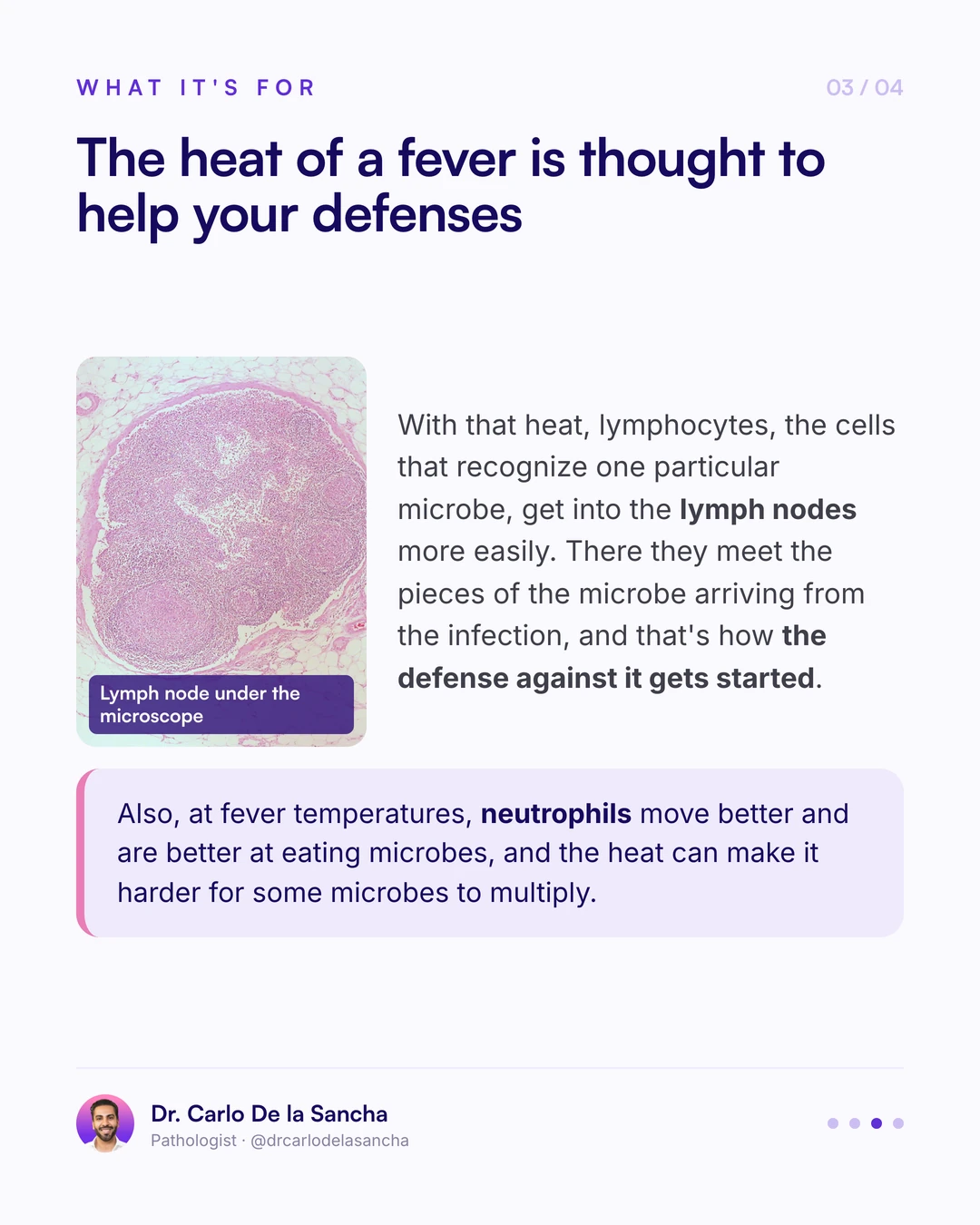
  • What it's for 03 / 04 The heat of a fever is thought to help your defenses Lymph node under the microscope With that heat, lymphocytes, the cells that recognize one particular microbe, get into the lymph nodes more easily. There they meet the pieces of the microbe arriving from the infection, and that's how the defense against it gets started. Also, at fever temperatures, neutrophils move better and are better at eating microbes, and the heat can make it harder for some microbes to multiply. Dr. Carlo De la Sancha Pathologist · @drcarlodelasancha
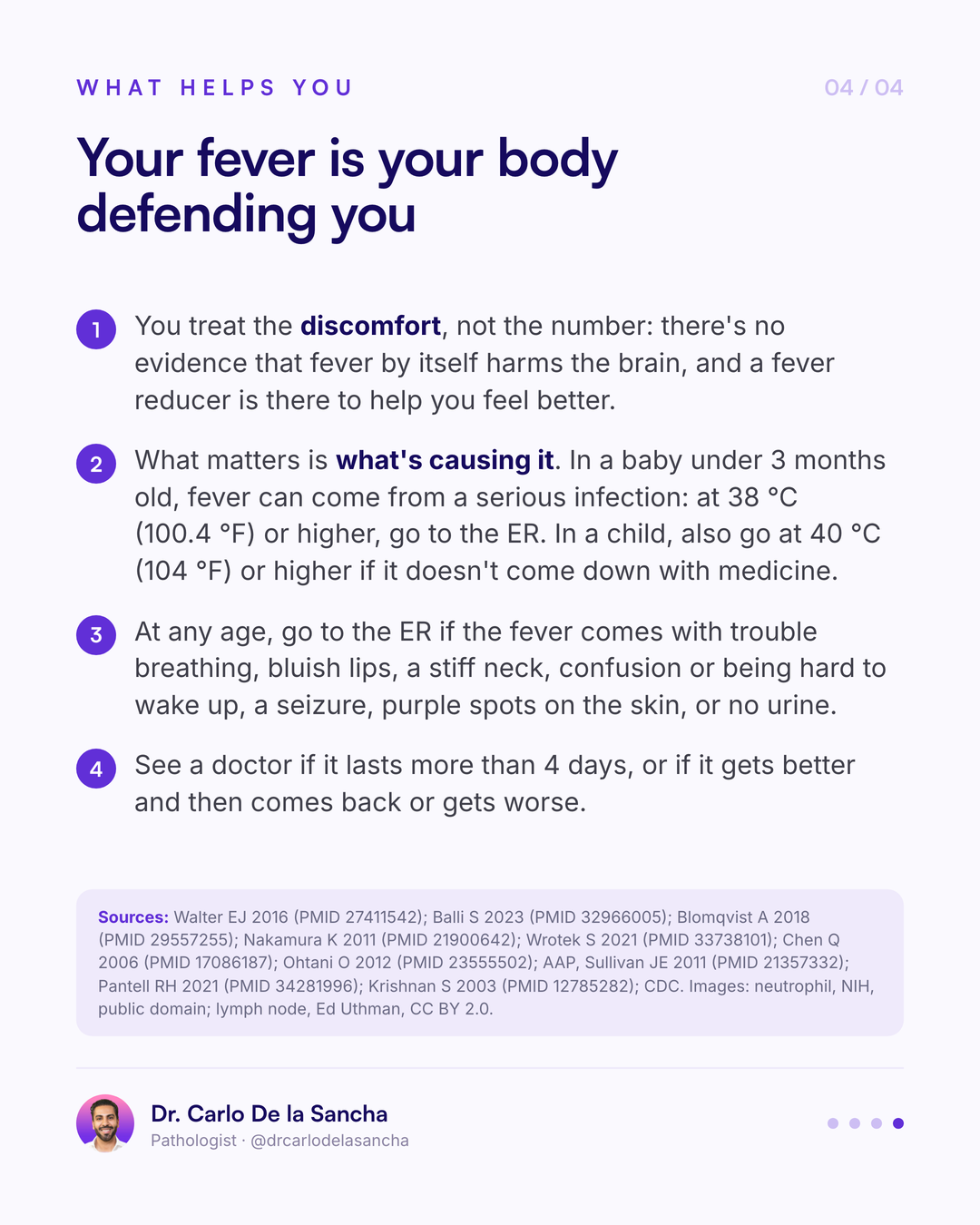
  • What helps you 04 / 04 Your fever is your body defending you You treat the discomfort, not the number: there's no evidence that fever by itself harms the brain, and a fever reducer is there to help you feel better. What matters is what's causing it. In a baby under 3 months old, fever can come from a serious infection: at 38 °C (100.4 °F) or higher, go to the ER. In a child, also go at 40 °C (104 °F) or higher if it doesn't come down with medicine. At any age, go to the ER if the fever comes with trouble breathing, bluish lips, a stiff neck, confusion or being hard to wake up, a seizure, purple spots on the skin, or no urine. See a doctor if it lasts more than 4 days, or if it gets better and then comes back or gets worse. Sources: Walter EJ 2016 (PMID 27411542); Balli S 2023 (PMID 32966005); Blomqvist A 2018 (PMID 29557255); Nakamura K 2011 (PMID 21900642); Wrotek S 2021 (PMID 33738101); Chen Q 2006 (PMID 17086187); Ohtani O 2012 (PMID 23555502); AAP, Sullivan JE 2011 (PMID 21357332); Pantell RH 2021 (PMID 34281996); Krishnan S 2003 (PMID 12785282); CDC. Images: neutrophil, NIH, public domain; lymph node, Ed Uthman, CC BY 2.0. Dr. Carlo De la Sancha Pathologist · @drcarlodelasancha
  • Want to understand your body? Subscribe to my newsletter: drcarlodelasancha.com/en/newsletter Save it, share it and follow me → @drcarlodelasancha Educational content. Not a substitute for a visit to your doctor.

Know someone who would find this helpful?

Share it with them.